
U.S. Labor Market Slowdown: Implications for Fed Policy and High-Yield Sectors


 Aime Summary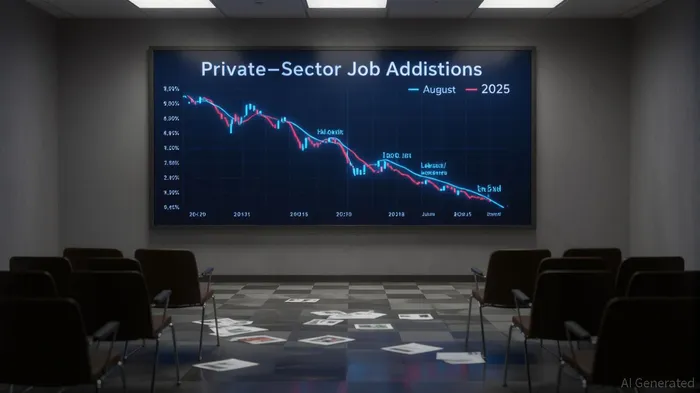
The U.S. labor market is showing signs of a significant slowdown, with the ADPADP-- National Employment Report for August 2025 revealing a mere 54,000 private-sector jobs added—far below the expected 68,000 and a stark drop from the revised 106,000 in July. This data, coupled with weak wage growth and rising jobless claims, has intensified speculation that the Federal Reserve will pivot toward rate cuts in September. For investors, the implications are clear: a shift in monetary policy could reshape risk appetites, with high-yield sectors like small-cap stocks and labor-dependent industries facing both opportunities and heightened volatility.
The ADP Data: A Harbinger of Policy Easing
The ADP report highlights a fragmented labor market. While leisure and hospitality added 50,000 jobs and construction gained 16,000, sectors like manufacturing (-7,000), education (-12,000), and trade (-17,000) saw notable declines. Wage growth also softened, with job-stayers seeing a 4.4% year-over-year increase and job-changers at 7.1%. These trends align with broader indicators, such as the JOLTS report, which showed the number of unemployed persons exceeding job openings for the first time since 2021.
ADP Chief Economist Nela Richardson attributed the slowdown to labor shortages, consumer uncertainty, and AI-driven disruptions. However, the political turmoil at the Bureau of Labor Statistics (BLS)—including the controversial appointment of a new commissioner—has raised questions about the reliability of official data. In this context, the ADP report has taken on added significance as an independent barometer of labor market health.
Fed Policy: A Tipping Point?
The Federal Reserve's September 2025 policy meeting is now a focal point for investors. With the labor market cooling and core PCE inflation at 2.9%, the Fed faces a delicate balancing act. Governor Christopher Waller has openly advocated for a 25-basis-point rate cut, arguing that the current policy stance is “moderately restrictive” and that waiting for a labor market collapse would be costly. Markets have already priced in a 97% probability of a September cut, with the VIX volatility index fluctuating between 16 and 58 as uncertainty mounts.
A rate cut would likely boost asset prices, particularly in sectors sensitive to borrowing costs. However, the Fed's dual mandate—price stability and maximum employment—means that premature easing could reignite inflation concerns. The upcoming August Nonfarm Payrolls (NFP) report, due on September 5, will be critical in confirming the ADP's weak trends and influencing the Fed's decision.
Investment Implications: High-Yield Sectors in the Crosshairs
The potential for rate cuts has direct implications for high-yield sectors, particularly small-cap stocks and labor-dependent industries. Small-cap equities, which are more sensitive to economic cycles and interest rate changes, could see a rebound if the Fed eases policy. The Russell 2000 Index, for instance, has underperformed the S&P 500 in 2025 due to higher borrowing costs and reduced consumer spending. A rate cut might reverse this trend, but investors must remain cautious: small-cap valuations are already stretched in some sectors, and a prolonged slowdown could exacerbate risks.
Labor-dependent industries, such as construction and healthcare, also face a mixed outlook. While construction added 16,000 jobs in August, the sector's reliance on interest-sensitive demand (e.g., housing) means it could benefit from cheaper financing post-rate cuts. Conversely, healthcare—despite adding 55,000 jobs in July—faces margin pressures from rising labor costs and regulatory shifts. Investors should prioritize companies with strong balance sheets and pricing power in these sectors.
Strategic Asset Allocation: Navigating the New Normal
For investors, the key is to balance defensive positioning with tactical opportunities. Fixed-income allocations should shift toward intermediate-duration bonds, as long-dated bonds may underperform in a low-inflation, low-growth environment. Cyclical sectors like information technology and consumer discretionary remain vulnerable, while defensive plays in healthcare and utilities offer stability.
Real estate and REITs could also benefit from rate cuts, particularly those with strong balance sheets. However, the sector's performance will depend on rental demand and debt costs. Investors should focus on REITs with diversified portfolios and low leverage.
Conclusion: Preparing for a Policy-Driven Market
The ADP data underscores a labor market at a crossroads. While the Fed's September rate cut is nearly certain, the broader economic outlook remains uncertain. For high-yield sectors, the path forward will depend on the pace of policy easing and the resilience of consumer demand. Investors should remain agile, prioritizing liquidity and diversification while monitoring key indicators like the NFP report and Fed statements. In a world where monetary policy can shift rapidly, adaptability is the ultimate asset.

Delivering real-time insights and analysis on emerging financial trends and market movements.
Latest Articles
Stay ahead of the market.
Get curated U.S. market news, insights and key dates delivered to your inbox.




Comments
No comments yet