
The U.S. Labor Market Slowdown and Its Implications for Equity and Bond Markets
 Aime Summary
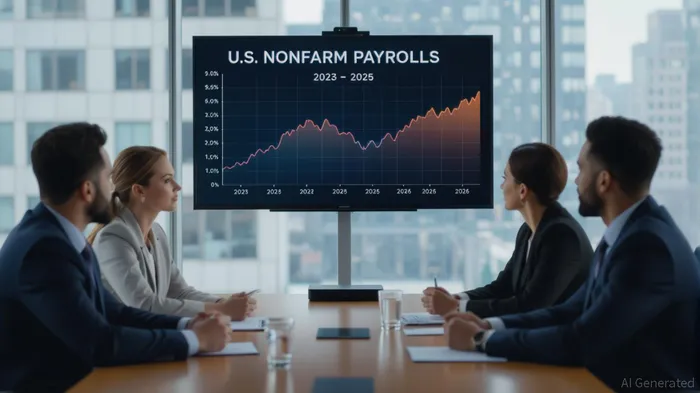
The U.S. labor market, once a cornerstone of economic resilience, is showing troubling signs of contraction. In July 2025, nonfarm payrolls added just 73,000 jobs—far below expectations—and downward revisions to May and June data erased 258,000 previously reported gains. This has pushed the three-month average job creation to 35,000, a stark slowdown compared to the 168,000 monthly average in 2024. The labor force participation rate has fallen to 62.2%, and the unemployment rate now stands at 4.2%, with broader measures of underutilization hitting 7.9%. These trends signal a labor market increasingly reliant on narrow sectors like healthcare and social assistance, which accounted for 94% of July's job gains.
Investor Sentiment: A Shift Toward Caution
The labor market slowdown has sent shockwaves through financial markets. Equity indices like the S&P 500 and Nasdaq-100 dropped 2.4% and 2.2%, respectively, in the week following the July jobs report. The CBOE Volatility Index (VIX) surged 22%, reflecting heightened uncertainty. While large-cap tech stocks have buoyed the S&P 500, which remains up 8.1% year-to-date, the market's overreaction has created opportunities in undervalued sectors.
Bond markets have mirrored this shift, with the 10-year Treasury yield falling to 4.22% as investors flocked to safe-haven assets. The yield curve's steepening suggests a growing expectation of a recession. Meanwhile, the probability of a Federal Reserve rate cut in September has climbed to 75.5%, up from 40% before the report.
Corporate Earnings: A Mixed Outlook
Corporate earnings forecasts are diverging sharply by sector. Health care and social assistance remain robust, with 55,000 and 18,000 job gains in July 2025. However, manufacturing, construction, and professional services have faltered. The ISM Services Index fell to 49.9 in May—a contraction for the first time in nearly a year—highlighting reduced demand and supply chain disruptions.
Goldman Sachs now forecasts 1% growth for the final two quarters of 2025, down from earlier projections, due to weaker consumer spending and tariff-driven inflation. Companies like Comfort Systems USAFIX-- (FIX) and Ridley (RIC) have emerged as undervalued plays, with Comfort trading at a 41.8% discount to its fair value and Ridley projecting 16.64% annual earnings growth. Even in the semiconductor sector, IntelINTC-- (INTC) trades at a forward P/E of 9.8, a historic discount, despite its critical role in the AI boom.
Central Bank Policy: Navigating a Fragile Balance
The Federal Reserve faces a delicate balancing act. While inflation remains a concern—wage growth is still 3.9% year-over-year—the labor market's weakening has increased pressure to cut rates. Fed Chair Jerome Powell has acknowledged “downside risks,” but policymakers remain cautious, with two board members dissenting against the July rate hold. The global context is equally complex: Canada and Japan are signaling openness to rate cuts, while emerging markets like Chile and South Africa have already acted.
The U.S. trade war has further complicated the Fed's calculus. Tariffs, now averaging 15%, have distorted global trade and shifted capital flows. The International Monetary Fund warns that while the global economy shows resilience, it remains vulnerable to shocks.
Investment Implications and Strategic Opportunities
For investors, the slowdown presents both risks and opportunities. The overreaction to weaker labor data has undervalued sectors like professional services and agribusiness. Comfort Systems USA and Ridley offer compelling long-term prospects, while the Fed's potential rate cuts could revive risk assets. However, caution is warranted in sectors like manufacturing, where automation and trade policy uncertainty persist.
In conclusion, the U.S. labor market slowdown is reshaping investor sentiment, corporate earnings trajectories, and central bank policy. While the path ahead is uncertain, strategic investors can capitalize on mispriced opportunities and prepare for a shifting economic landscape. The key lies in balancing defensive positions with selective, high-conviction bets in sectors poised for recovery.

Stay ahead of the market.
Get curated U.S. market news, insights and key dates delivered to your inbox.






Comments
No comments yet