
The U.S. Labor Market Reversal: Navigating Macroeconomic Shifts and Tactical Opportunities in a Volatile Climate


 Aime Summary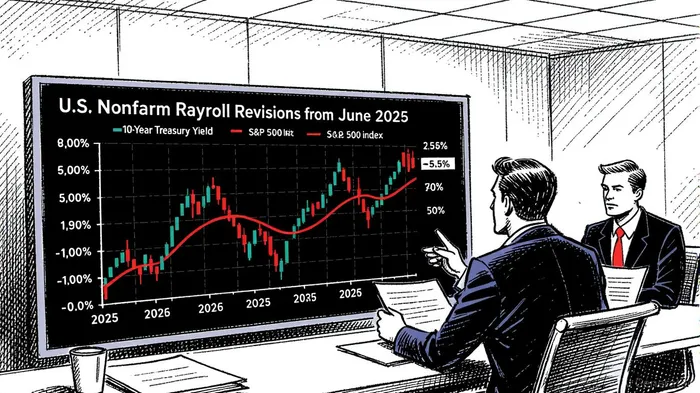
The U.S. labor market has entered uncharted territory. The June 2025 jobs report, revised to show a net loss of 13,000 nonfarm payrolls, marks the first decline since December 2020 and signals a structural shift in the economic landscape. Combined with a revised unemployment rate of 4.1%—a figure that masks growing fragility in the labor force—the data paints a picture of a market teetering on the edge of a "jobs recession." This reversal has profound implications for Federal Reserve policy, equity valuations, and credit markets, demanding a recalibration of investment strategies.
The Fed's Dilemma: Policy Tightening vs. Economic Softness
The Federal Reserve's dual mandate—maximum employment and price stability—is now in direct conflict. While inflation has moderated, the June jobs report and subsequent August data (adding just 22,000 jobs) have forced the Fed to confront the reality of a cooling labor market. The unemployment rate, though stable at 4.1%, is poised to rise further as underemployment and discouraged workers re-enter the labor force.
The market has already priced in aggressive rate cuts, with the 10-year Treasury yield dropping to a five-month low. However, the Fed's response will likely be constrained by lingering inflation risks, particularly from President Trump's tariff policies, which have exacerbated input costs for manufacturers and importers. This creates a policy paradox: rate cuts may stabilize markets in the short term but could deepen structural weaknesses in the labor market. Investors must now weigh the Fed's credibility in balancing these competing priorities.
Sectoral Impacts: Consumer Discretionary Under Siege
The consumer discretionary sector has borne the brunt of the labor market reversal. Tariffs on imports from China, South Korea, and Canada have eroded profit margins for retailers, automakers, and home improvement firms. General MotorsGM-- and Best Buy, for instance, have revised earnings guidance downward, citing margin compression and declining consumer confidence.
High-yield credit in energy, transportation, and retail has underperformed, with CCC-rated bonds in these sectors posting double-digit losses. Conversely, defensive sectors like healthcare and real estate have outperformed, with healthcare-related high-yield bonds returning 4.0% and real estate 3.9%. This divergence underscores a market increasingly focused on credit quality and sectoral resilience.
Tactical Reallocation: Under-Owned Resilient Assets
As volatility intensifies, investors must pivot to under-owned, economically resilient asset classes. Three categories stand out:
Municipal Bonds: Taxable municipal bonds have outperformed corporate investment-grade debt in Q2 2025, with the Bloomberg Taxable Municipal index returning 2.99%. Their local focus and limited exposure to trade policy make them a compelling hedge against macroeconomic uncertainty. Spreads remain attractive, particularly for high-quality issuers, offering yields that rival corporate bonds without the same credit risk.
Non-Agency MBS: Despite rising delinquencies in subprime segments, prime borrowers remain in a strong position. Non-Agency MBS offers loss-adjusted spreads in the low to mid-200s, outperforming public residential credit. The sector's valuation attractiveness is further bolstered by stable home prices and subdued refinancing activity.
Residential Whole Loans: With delinquency rates aligned with pre-pandemic levels and low inventory supporting home price stability, residential whole loans present a unique opportunity. Loss-adjusted spreads of 200–250 basis points offer strong relative value compared to public residential credit, making them a defensive play in a high-rate environment.
Conclusion: Preparing for a New Normal
The June 2025 jobs revision is not an isolated event but a harbinger of a broader economic recalibration. As the Fed navigates the tension between inflation and employment, investors must adopt a tactical approach that prioritizes resilience over growth. Defensive sectors, high-quality credit, and under-owned asset classes like municipal bonds and non-agency MBS will be critical in mitigating downside risk.
In this environment, patience and discipline are paramount. The coming months will test the durability of the U.S. economy, but for those who act decisively, the path forward is illuminated by opportunities in sectors and assets that have been overlooked in the pursuit of growth. The key is to reallocate capital to where it can thrive—not just survive—in a world where macroeconomic risks are no longer abstract but tangible.

Stay ahead of the market.
Get curated U.S. market news, insights and key dates delivered to your inbox.


AInvest
PRO
AInvest
PRO



Comments
No comments yet