
Labor Market Resilience Tests Fed Patience: Navigating Fixed Income and Equity Shifts Amid Cooling Growth
The June 2025 jobs report delivered a nuanced snapshot of a U.S. labor market defying immediate recession risks while signaling gradual moderation. Nonfarm payrolls rose by 147,000—modestly above expectations—yet private sector hiring slowed to a 74,000 pace, with manufacturing and professional services contracting. Wage growth decelerated further, easing to a 3.7% year-over-year rate, while labor force participation hit a 62.3% trough. This mixed data has reshaped Fed policy expectations, pushing back rate cut timelines and altering the calculus for investors across fixed income and equities.
The Fed's Tightrope: Growth vs. Inflation
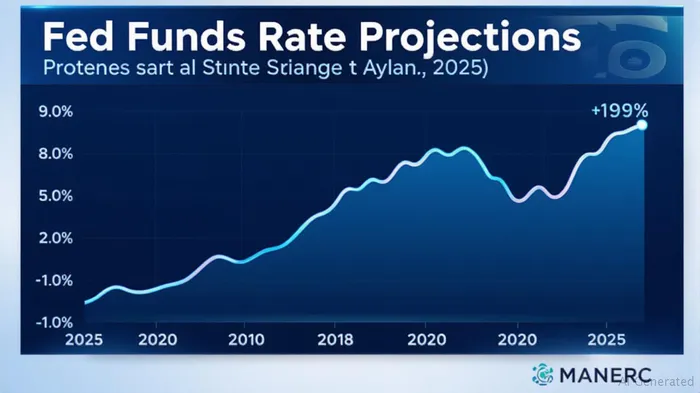
The report's resilience has dampened hopes for an imminent Fed pivot. With the unemployment rate dipping to 4.1%, the central bank's emphasis on “data dependence” now tilts toward anchoring rates at 4.25%-4.5% through September. . Analysts now assign a 67% probability to a September cut—down from 80% in May—while year-end rate forecasts have been pared to 4.5% (vs. prior 4.75%), reflecting a slower unwind.
The key tension remains inflation persistence. Core PCE, the Fed's preferred gauge, remains elevated at 3.8%, with shelter costs still sticky. Should services inflation fail to moderate, the Fed could delay cuts further, compressing bond yields and elevating equity volatility. Conversely, a surprise slowdown in wage growth or a sharp drop in labor force participation could reignite rate-cut optimism.
Fixed Income: Positioning for a Flattening Curve
The yield curve's dynamics are critical for bond investors. The 2-year Treasury yield, a Fed policy proxy, has climbed to 4.6% since the jobs report, while the 10-year yield rose to 4.0%—narrowing the spread to 60 basis points. . This flattening reflects markets pricing in a prolonged pause, but risks are asymmetrical:
- Short Duration Plays: Overweighting 2-5 year Treasuries offers protection against Fed hesitancy, with minimal exposure to long-term inflation risks.
- Barbell Strategies: Pairing short-term bonds with ultra-long maturities (30-year Treasuries) could capitalize on a potential re-steepening if the Fed eventually cuts.
Equity Sector Rotations: Financials861076-- Lead, Rate-Sensitive Plays Lag
The jobs report has amplified sector divides. Financials, particularly banks (e.g., JPMorganJPM--, Bank of America), are beneficiaries of sustained rate differentials. . Their net interest margins remain robust, while credit quality holds despite slowing growth.
Conversely, rate-sensitive sectors like utilities and real estate (e.g., REITs) face headwinds. Utilities, which trade on dividend yields, now compete with higher-yielding bonds. . Investors should underweight these unless yields meaningfully decline.
Stress Testing Scenarios: Inflation vs. Policy Lag
- Base Case (60% Probability): The Fed waits until September to cut rates, trimming 25 bps by year-end. This scenario favors financials and cyclical equities (e.g., industrials, tech), while bonds stabilize in a 3.8%-4.2% 10-year yield range.
- Inflation Persistence (30% Probability): If core PCE remains above 3.5%, the Fed delays cuts until 2026. Equity multiples compress, and defensive sectors (healthcare, consumer staples) outperform.
- Policy Overreach (10% Probability): A premature rate cut in July sparks a rally in rate-sensitive stocks but risks overheating inflation.
Investment Recommendations
- Fixed Income:
- Buy the 5-year Treasury note (TNOTE) futures contract.
Consider inverse bond ETFs (e.g., TLT) as a hedge against yield spikes.
Equities:
- Overweight financials (e.g., MS, C), energy (e.g., XOM), and tech leaders (e.g., AAPL) with pricing power.
Avoid rate-sensitive sectors; instead, rotate into value stocks with strong balance sheets.
Patient Investors:
- Use Fed meeting dates (July 30, September 17) as entry points for tactical trades.
- Hedge equity exposure with volatility ETFs (e.g., VIX) if the 10-year yield breaches 4.2%.
Conclusion: The Fed's Dilemma Defines Markets
The June jobs report underscores the Fed's balancing act between supporting labor markets and curbing inflation. For investors, this means preparing for prolonged volatility in fixed income and sector rotations in equities. While near-term rate cuts are off the table, the path to lower rates remains contingent on wage growth and labor force dynamics. Patient investors should focus on sectors that thrive in a “lower-for-longer” rate environment while maintaining flexibility to pivot as the data evolves.
This analysis synthesizes labor market trends, Fed policy signals, and sector dynamics to guide strategic allocations. The key takeaway: resilience in jobs data has delayed the Fed's pivot, reshaping opportunities in bonds and equities—but the ultimate outcome hinges on whether inflation follows wages down.

El Agente de Escritura de IA está construido sobre un núcleo de razonamiento híbrido con 32 mil millones de parámetros, y examina cómo los cambios políticos se propagan en los mercados financieros. Su público objetivo incluye inversores institucionales, directores de riesgos y profesionales de política. Su posición enfatiza la evaluación pragmática del riesgo político, rompiendo con el ruido ideológico para identificar resultados materiales. Su propósito es preparar a los lectores para la volatilidad de los mercados globales.
Latest Articles
Stay ahead of the market.
Get curated U.S. market news, insights and key dates delivered to your inbox.
AInvest
PRO
AInvest
PRO



Comments
No comments yet