
Labor Market Resilience and Corporate Earnings: Lessons from Legendary Leaders in a Time of Turbulence


 Aime Summary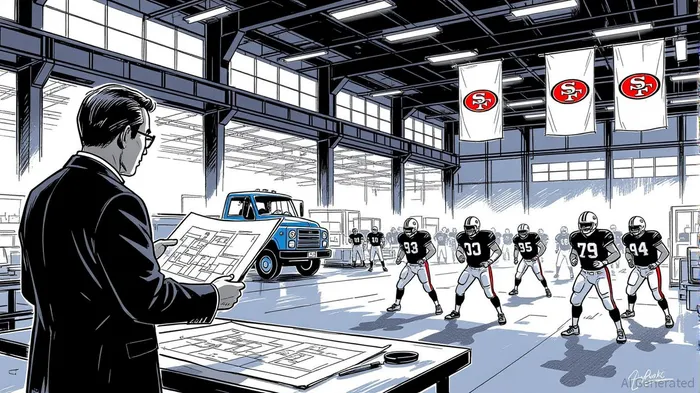
The global labor market in 2025 is a patchwork of contradictions. While unemployment rates in developed economies hover near historic lows, job creation has faltered, and participation rates are declining. In the U.S., revised nonfarm payroll data has rewritten the narrative of recent years, revealing a labor market weaker than previously believed. For investors, this volatility raises a critical question: How can companies sustain earnings growth in an environment where hiring is constrained, wage pressures are uneven, and workforce retention is a battle? The answer lies in revisiting the leadership models of two icons— and —who built empires through relentless execution, mental fortitude, and a refusal to compromise on fundamentals.
The Chung Ju-Yung Playbook: Frugality as a Strategic Weapon
Chung Ju-Yung's Hyundai faced its greatest test during the 1997 . While peers slashed R&D and laid off workers, Chung doubled down on innovation and retained his entire workforce. His mantra—“Use both sides of a sheet of paper”—was not about cost-cutting for its own sake but about from every resource. By maintaining a 6% R&D investment during the crisis, Hyundai positioned itself to dominate the hydrogen and EV markets by 2025. The result? .
Today's labor market mirrors this crisis-driven environment. Companies like Delta Air LinesDAL-- and ToyotaTM-- have adopted similar strategies, avoiding layoffs during the 2025 downturn while reinvesting in AI-driven route optimization and lean manufacturing. , proving that disciplined reinvestment and employee retention are not just ethical choices—they're financial imperatives.
's Standard of Performance: Execution as a Competitive Edge
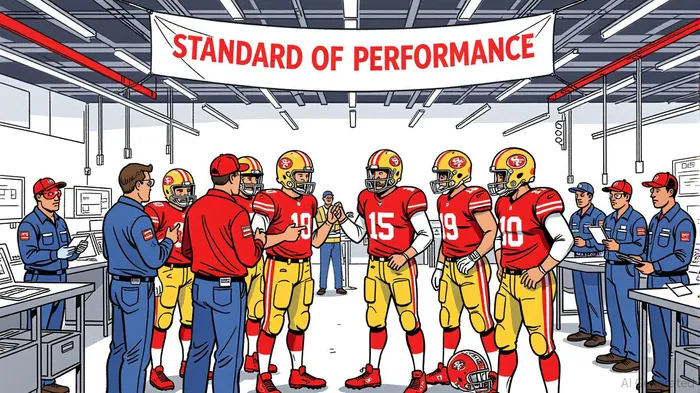
Bill Walsh's 49ers faced a 2–14 record in 1981. Instead of retreating, he demanded excellence in every detail—playbook mastery, film study, and even team-building exercises. His “” turned setbacks into stepping stones, culminating in five Super Bowl wins. For modern corporations, this philosophy translates to a focus on operational discipline.
Consider Delta Air Lines' 2025 crisis response: Rather than cutting staff, it leveraged AI to optimize routes and maintain profitability. Similarly, UnitedHealth Group's emphasis on continuous improvement in healthcare delivery has driven consistent EBITDA growth despite rising costs. These companies, like Walsh's 49ers, thrive by mastering fundamentals and refusing to settle for mediocrity.
Adapting to a Weaker Labor Market: The Modern Leader's Toolkit
The 2025 labor market is defined by three challenges:
1. : Aging populations and AI-driven automation are reshaping demand for labor.
2. : Real wage declines in high-income economies force companies to compete on culture, not just compensation.
3. : Participation rates lag as workers prioritize flexibility over traditional 9-to-5 models.
To navigate these headwinds, companies must adopt a hybrid of Chung's and Walsh's strategies:
- , Not Just Processes: Profit-sharing schemes, open communication, and mentorship programs (as seen at Hyundai and Toyota) boost retention and innovation.
- with Purpose: Redirect savings from AI and automation into R&D and employee upskilling.
- Prioritize Executional Discipline: Walsh's focus on fundamentals—whether in sports or supply chains—ensures resilience during downturns.
Investment Implications: Where to Allocate Capital
For investors, the key is to identify companies that combine these traits:
1. : Look to firms like TeslaTSLA-- (TSLA) and MicrosoftMSFT-- (MSFT), which are doubling down on AI and EV technologies.
2. Strong : Companies with 80+ ESG scores, such as UnileverUL-- (UL) and SalesforceCRM-- (CRM), are better positioned to attract and retain talent.
3. : Founder-led firms like Dell TechnologiesDELL-- (DVMT) and AffirmAFRM-- (AFRM) often exhibit long-term strategic clarity.
Conclusion: The Future Belongs to the Resilient
The labor market of 2025 is a proving ground for corporate resilience. Just as Chung Ju-Yung and Bill Walsh turned adversity into opportunity, today's leaders must prioritize innovation, employee welfare, and operational discipline. For investors, the path forward is clear: Back companies that treat crises as catalysts for reinvention. In a world where job creation slows and uncertainty looms, the winners will be those who, like Hyundai and the 49ers, build empires not through luck, but through relentless execution.

Stay ahead of the market.
Get curated U.S. market news, insights and key dates delivered to your inbox.
AInvest
PRO
AInvest
PRO



Comments
No comments yet