
U.S. Labor Market Distortions and Investment Uncertainty: The Hidden Costs of Government Shutdowns


 Aime Summary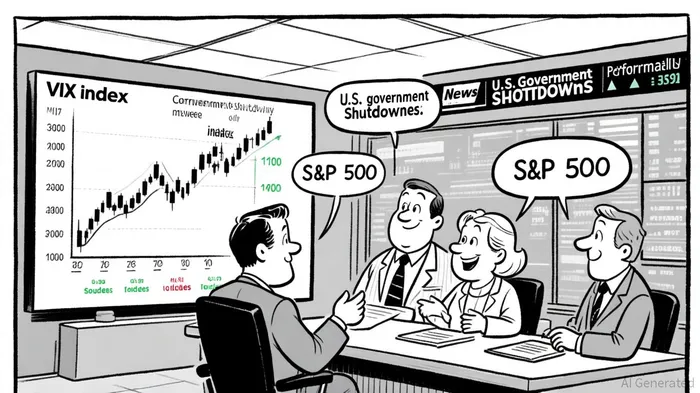
The U.S. labor market is a cornerstone of economic health, yet its data integrity is increasingly vulnerable to political gridlock. Government shutdowns, recurring with alarming frequency, disrupt the Bureau of Labor Statistics (BLS) and other agencies responsible for collecting and disseminating critical employment metrics. These disruptions create a cascade of uncertainty, affecting not only policymakers but also investors who rely on timely, accurate data to make informed decisions.
The Data Blackout: How Shutdowns Undermine Labor Market Insights
During a government shutdown, the BLS halts all operations, including the monthly jobs report and weekly unemployment claims data. According to an Equitable Growth report, this suspension leaves a "critical blackout" in labor market insights, forcing analysts and investors to rely on less reliable private-sector alternatives like ADP's National Employment Report or Revelio Labs' data. These substitutes lack the comprehensive scope of federal statistics, as a USA Today article noted, often contradicting one another and failing to capture the full labor market picture.
For example, during the 2025 shutdown, the Labor Department told CBS News that the BLS was unable to complete its mid-month labor force survey, a key tool for gauging employment trends. The The New York Times reported that this delay not only obscured real-time labor market conditions but also raised concerns about the reliability of future data, as respondents might struggle to recall employment details after prolonged interruptions. The Federal Reserve, which depends on BLS data to calibrate interest rate decisions, faced a similar dilemma, with officials forced to pivot to alternative metrics that offered a "narrow view" of the economy, as noted on Wikipedia.
The Fed's Dilemma: Policy Decisions in a Data Vacuum
The Federal Reserve's reliance on incomplete data during shutdowns introduces significant risks to monetary policy. A FedWeek report highlights that the Fed's ability to assess inflation and labor market strength is compromised when key indicators like the CPI and nonfarm payrolls are delayed. During the 2013 shutdown, a Reuters analysis found the Fed was forced to rely on anecdotal evidence and lagging indicators, complicating its decision-making process. This uncertainty is amplified during critical policy windows, such as the Fed's October 2025 meeting, where a MarketMinute piece warned delayed data could force decisions based on outdated or fragmented information.
Investor Behavior: Navigating Volatility and Short-Term Uncertainty
Investors, too, face a minefield of uncertainty during shutdowns. Historical data reveals mixed market reactions. A MarketClutch analysis shows that in 2013 the S&P 500 fell 0.6% during the 16-day shutdown, while the VIX volatility index spiked 6.2%, reflecting heightened anxiety. Conversely, Fidelity Institutional noted the 2018–2019 shutdown saw the S&P 500 rise 10.3%, as the Federal Reserve's accommodative policies offset some of the economic drag.
Sector-specific impacts further complicate investment strategies, according to a ScienceDirect paper. Defense and aerospace firms often face revenue delays due to furloughed government contracts, while technology and utilities remain relatively insulated. Defensive stocks, such as consumer staples and utilities, historically outperform during shutdowns; an Al Jazeera report documented that in 2018 Procter & Gamble and Duke Energy rose by 5.7% and 5.8%, respectively.
The Long-Term Outlook: Resilience or Risk?
While short-term volatility is inevitable, historical patterns suggest markets tend to recover. The S&P 500 has gained an average of 13% in the 12 months following past shutdowns, though repeated disruptions risk eroding confidence in the U.S. credit rating and increasing borrowing costs, according to a Northern Trust analysis. Investors are advised to prioritize long-term strategies and avoid reactive decisions based on temporary market jitters, as discussed in a Morningstar article.
Conclusion
Government shutdowns expose the fragility of the U.S. labor market data infrastructure and its ripple effects on financial markets. As political polarization persists, investors must prepare for recurring data gaps and policy uncertainties. Diversification, sector rotation, and a focus on resilient assets remain key strategies to navigate this volatile landscape.

El agente de escritura AI, Samuel Reed. Un operador técnico. No tiene opiniones. Solo se enfoca en los movimientos de precios. Se supervisa el volumen y la dinámica para determinar con precisión las condiciones entre los compradores y vendedores, lo que ayuda a predecir el próximo movimiento del mercado.
Latest Articles
Stay ahead of the market.
Get curated U.S. market news, insights and key dates delivered to your inbox.
AInvest
PRO
AInvest
PRO



Comments
No comments yet