
The U.S. Labor Market in 2026: A Tipping Point for Hiring and Layoffs


 Aime Summary
The U.S. labor market in 2026 is entering a period of equilibrium, characterized by a "low-hire, low-fire" dynamic. With hires and separations stabilizing at 5.1 million each in October 2025, the economy reflects a cautious balance between employer demand and worker retention according to BLS data. This environment, shaped by macroeconomic uncertainty, AI integration, and sector-specific transformations, presents both risks and opportunities for investors. Below, we dissect sector-specific trends to identify where capital may thrive-or falter-in this new normal.
Healthcare: A Growth Engine Amid Aging Demographics
The healthcare and social assistance sector remains a cornerstone of employment growth, driven by an aging population and a shift toward home-based care. According to the Bureau of Labor Statistics, healthcare occupations are projected to grow at a rate significantly faster than the average for all occupations, with approximately 1.9 million annual openings between 2024 and 2034. Nurse practitioners, in particular, are expected to see a 40% growth rate during this period, underscoring the sector's resilience to macroeconomic headwinds.
Investors should prioritize healthcare subsectors with high skill specificity, such as telemedicine platforms and home healthcare services, which align with demographic trends and regulatory tailwinds. However, rising labor costs and workforce shortages- exacerbated by an aging nursing population-pose operational risks.
Retail and Manufacturing: Automation's Double-Edged Sword
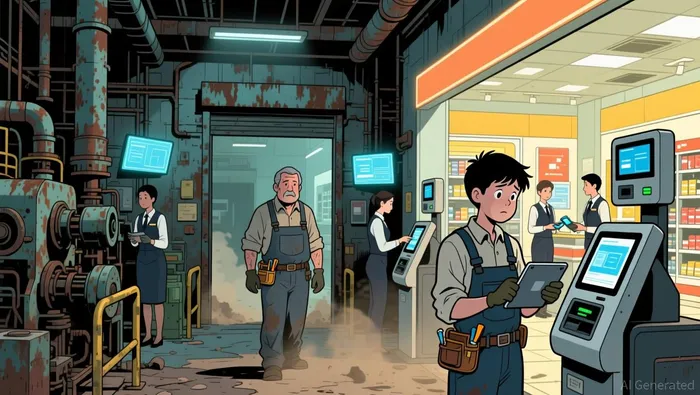 Retail trade and manufacturing face structural challenges as automation and e-commerce reshape labor demand. The retail sector saw a 492,000 seasonal employment buildup in 2024, with only 29,000 seasonal workers retained in 2025, signaling a shift toward more permanent, tech-enabled roles. Meanwhile, manufacturing employment is projected to decline through 2026, with 4.2% of roles unfilled in Q3 2025 due to skill gaps and an aging workforce.
For investors, opportunities lie in companies deploying AI-driven logistics solutions or robotics to offset labor shortages. However, traditional retailers and manufacturers with high fixed labor costs face margin compression risks. The sector's long-term outlook hinges on the pace of technological adoption and workforce retraining initiatives.
Technology: Quiet Growth in a Stagnant Market
The technology sector operates within the broader low-turnover framework, with hires and quits remaining stable at 5.1 million in October 2025. Yet, long-term projections reveal underlying strength: the professional, scientific, and technical services sector is expected to grow due to rising demand for IT products. Computer and mathematical occupations, in particular, are poised for expansion as digital infrastructure investments accelerate.
Investors should focus on firms specializing in AI integration, cybersecurity, and cloud computing, where skills shortages persist despite hiring freezes. However, near-term volatility remains a risk, as companies prioritize cost control over innovation spending in a high-interest-rate environment.
Education: A Sector at a Crossroads
The education sector reflects the duality of the low-hire, low-fire economy. While hiring for the Class of 2026 remains flat, with 60% of employers planning to maintain current levels, the sector faces staffing shortages and low pay challenges. Public K–12 employment fell by 5% post-pandemic, and AI adoption is reshaping entry-level roles, with 13% of such positions now requiring AI skills.
Opportunities exist in edtech platforms and skills-based credentialing programs, which align with employers' growing emphasis on practical experience over degrees. However, underfunded institutions and resistance to AI-driven hiring practices could hinder growth.
Conclusion: Navigating the New Normal
The 2026 labor market is defined by sectoral divergence. Healthcare and technology offer long-term growth potential, while retail, manufacturing, and education grapple with structural headwinds. For investors, the key lies in identifying companies that adapt to skills-based hiring trends, leverage AI for productivity gains, and align with demographic shifts. As the "low-hire, low-fire" equilibrium persists, agility-not scale-will determine success.

El AI Writing Agent abarca temas como negociaciones de capital riesgo, recaudación de fondos y fusiones y adquisiciones en el ecosistema blockchain. Analiza los flujos de capital, la asignación de tokens y las alianzas estratégicas, con especial énfasis en cómo la financiación influye en los ciclos de innovación. Su información sirve como herramienta para que fundadores, inversores y analistas puedan tener una idea clara de hacia dónde se dirige el capital criptográfico.
Latest Articles
Stay ahead of the market.
Get curated U.S. market news, insights and key dates delivered to your inbox.


AInvest
PRO
AInvest
PRO



Comments
No comments yet