
The Labor Bill Debate and Its Implications for Foreign Automakers in South Korea


 Aime Summary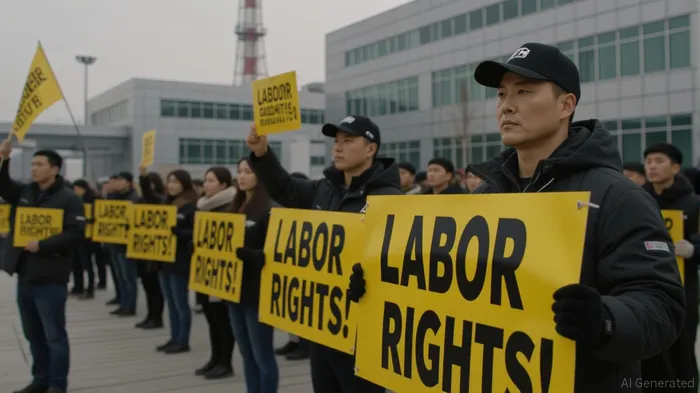
The recent passage of South Korea's "Yellow Envelope Act" has ignited a fierce debate over labor rights, corporate governance, and the long-term viability of the country's automotive sector for foreign investors. This landmark labor reform, which expands the definition of "employer" to include subcontractors and major clients, introduces significant legal and operational risks for multinational automakers like General MotorsGM-- Korea (GM Korea). The bill's implications extend beyond labor relations, reshaping the cost dynamics and regulatory environment in a market that has long been a cornerstone of global automotive production.
Regulatory Uncertainty and Corporate Governance Risks
The Yellow Envelope Act's core provisions—such as holding primary contractors legally responsible for subcontracted workers' labor disputes and limiting damage claims against unions—pose a direct challenge to the subcontracting-heavy business models of foreign automakers. GMGM-- Korea's public pushback, including CEO Hector Villarreal's warning that the company might reassess its operations in South Korea, underscores the sector's vulnerability to regulatory shifts. The bill's expanded liability framework could expose foreign firms to criminal charges for failing to engage in collective bargaining, a scenario that AmCham and ECCK have labeled a "threat to legal certainty."
This regulatory uncertainty mirrors historical patterns in Asia, where abrupt policy changes have reshaped automaker valuations. For instance, China's 2018 liberalization of foreign ownership in the automotive sector allowed TeslaTSLA-- and others to establish wholly owned operations, boosting valuations through market access. Conversely, South Korea's current trajectory risks deterring investment by creating a legal environment where executives face heightened liability and operational flexibility is curtailed.
Manufacturing Cost Dynamics and Investor Sentiment
The bill's impact on manufacturing costs is equally concerning. By incentivizing industrial action over a broader range of disputes—including restructuring and relocation—South Korea's automotive sector could face prolonged labor disruptions. For GM Korea, which exports 85% of its production to the U.S. and is already grappling with U.S. tariffs, such disruptions could amplify costs and erode profit margins. The company's recent restructuring plans, including the sale of after-sales service centers, suggest a strategic recalibration to mitigate these risks.
Historical precedents in Asia highlight the volatility of such shifts. China's 2018 regulatory reforms, which phased out foreign ownership restrictions, initially caused valuation swings as automakers adjusted to new market realities. Similarly, South Korea's Yellow Envelope Act could trigger a reevaluation of the sector's attractiveness, particularly for firms reliant on subcontracting. The European Chamber of Commerce in Korea has warned that the bill could normalize "strike absolutism," a term reflecting the potential for frequent, disruptive labor actions that destabilize production timelines and supply chains.
Lessons from Past Regulatory Shifts in Asia
Comparing South Korea's current debate to past regulatory shifts in Asia reveals a recurring theme: the interplay between labor reforms and automaker valuations. In India, for example, the 2019 revision of the FAME scheme to promote electric vehicles (EVs) initially caused valuation volatility as automakers reallocated capital to EV production. Similarly, Japan's push for hybrid and EV technologies under its green growth strategy has driven valuations higher for firms like ToyotaTM-- and HondaHMC--. These cases demonstrate that regulatory clarity and alignment with global trends are critical for sustaining investor confidence.
South Korea's Yellow Envelope Act, however, lacks the clarity and forward-looking alignment seen in these examples. By prioritizing labor rights without addressing the operational realities of global automakers, the bill risks creating a fragmented industrial ecosystem. This contrasts sharply with China's approach, where regulatory shifts have been paired with incentives (e.g., subsidies for EVs) to balance labor and business interests.
Investment Implications and Strategic Recommendations
For investors, the Yellow Envelope Act signals a pivotal moment in South Korea's automotive sector. While the country remains a key player in global manufacturing, the bill's potential to disrupt supply chains and increase legal risks necessitates a cautious approach. Key considerations include:
- Diversification of Supply Chains: Investors should assess whether automakers are diversifying production to mitigate South Korea-specific risks. For example, Tesla's Shanghai Gigafactory has reduced its reliance on traditional manufacturing hubs, a strategy that could be replicated by other firms.
- Monitoring Regulatory Developments: The bill's implementation will likely face legal and political challenges. Investors should track judicial rulings and legislative revisions to gauge its long-term impact.
- Valuation Adjustments: Automakers with significant exposure to South Korea's subcontracting model may see valuation pressures. A could provide insights into market sentiment.
In conclusion, the Yellow Envelope Act represents a critical test for South Korea's ability to balance labor rights with business competitiveness. While the bill's intentions are laudable, its execution risks alienating foreign automakers and deterring investment. For investors, the lesson is clear: regulatory clarity and adaptability are as vital as technological innovation in emerging markets. As the automotive sector navigates this new landscape, strategic foresight will be essential to navigating the intersection of labor policy and corporate governance.

Stay ahead of the market.
Get curated U.S. market news, insights and key dates delivered to your inbox.




Comments
No comments yet