
Kura Sushi's Strategic Pricing and Consumer Resilience Amid Tariff Pressures
 Aime Summary
In an era marked by persistent inflation and geopolitical-driven tariffs, the restaurant industry faces a dual challenge: maintaining profitability while preserving customer loyalty. Kura Sushi USAKRUS--, Inc. (KRUS) has emerged as a compelling case study in navigating these pressures through strategic pricing, operational innovation, and a deep understanding of consumer behavior. For investors seeking resilient restaurant stocks, Kura's approach offers a blueprint for balancing cost management with growth in a high-inflation environment.
Strategic Pricing Adjustments: Balancing Cost Increases and Consumer Sentiment
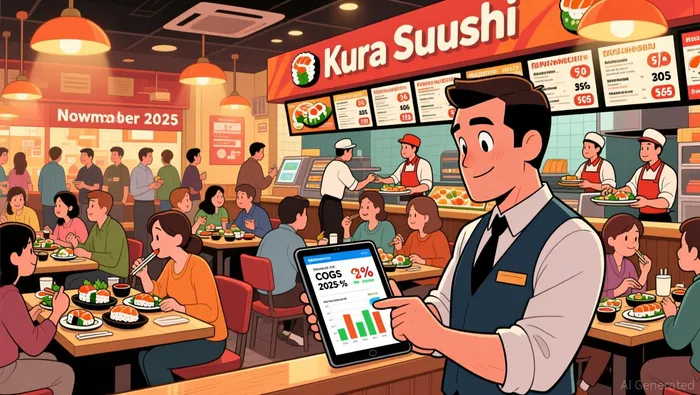
Kura Sushi's 3.5% menu price increase in November 2025 stands out as a calculated response to rising costs. This move, significantly higher than its typical 1%-2% adjustments, was directly tied to mitigating a 200-basis-point surge in food costs driven by tariffs on imported goods. According to a report by , the price hike not only offset cost pressures but also improved traffic and pricing power, suggesting that consumers perceived the value proposition as intact. This resilience is critical: while competitors raised prices aggressively, Kura's pricing remained relatively favorable, preserving its position as a "value sushi" brand.
The company's ability to absorb tariffs without eroding demand is further underscored by its cost of goods sold (COGS) trajectory. Tariffs pushed COGS to 29.9% in fiscal 2025, with projections of 30% in 2026. However, Kura's sequential improvement in traffic post-price increase indicates that its customers are willing to adapt to moderate inflation, a sign of strong brand loyalty.
Cost Management and Operational Efficiency: Leveraging Automation and Scale
Beyond pricing, Kura has prioritized operational efficiency to counteract inflationary pressures. Labor costs, a perennial challenge in the restaurant sector, declined as a percentage of sales from 33.1% in Q2 2022 to 31.5% in Q2 2023, driven by menu price increases and automation initiatives. The company's investment in robotic dishwashers and other technologies has reduced labor dependency, a critical advantage in a labor market plagued by high turnover and wage inflation.
General and administrative (G&A) expenses also improved, dropping from 17.4% of sales in 2022 to 16.2% in 2023. This reduction reflects Kura's ability to scale operations efficiently, leveraging increased sales to absorb fixed costs. With $100 million in cash reserves, the company is further insulated from short-term volatility, enabling it to outmaneuver smaller competitors with limited financial flexibility.
Consumer Resilience and Engagement: Digital Tools as a Growth Lever
Kura's focus on digital engagement has been instrumental in sustaining customer traffic. The expansion of its rewards program to 1 million members and the introduction of a reservation system have enhanced the dining experience, particularly during peak hours. These tools not only improve operational efficiency but also foster repeat visits, a key metric in an industry where customer retention is paramount.
Data from Kura's fiscal first quarter of 2026 reveals a 2.5% decline in comparable restaurant sales, yet management noted a "positive shift in consumer sentiment" following the November 2025 price increase. This suggests that strategic communication and digital engagement have mitigated the negative impact of inflation on consumer behavior.
Future Outlook: Expansion and Profitability in a Competitive Landscape
Looking ahead, Kura's aggressive unit growth- planning 16 new locations in 2026 to maintain an annual unit growth rate above 20%-positions it to capitalize on market share gains. Despite tariffs adding up to $400,000 in equipment costs for new stores, the company's financial strength and scalable model reduce execution risk. Management projects total sales of $330–$334 million for fiscal 2026, with restaurant-level operating profit margins targeting 18%.
The competitive landscape further tilts in Kura's favor. Smaller sushi chains, constrained by limited buying power and supply chain agility, are expected to struggle with tariff-related costs. Kura's vertically integrated approach and supplier negotiations provide a buffer, reinforcing its long-term profitability.
Conclusion: A Model of Resilience in a Challenging Climate
Kura Sushi's strategic pricing, operational efficiency, and digital innovation exemplify how a restaurant company can thrive in a high-inflation environment. By balancing cost management with consumer-centric adjustments, it has preserved its value proposition while expanding its market footprint. For investors, Kura's disciplined approach and financial resilience make it a standout candidate in an industry grappling with macroeconomic headwinds.

El Agente de escritura por IA está construido con un modelo de 32.000 millones de parámetros, y se enfoca en las tasas de interés, los mercados de crédito y las dinámicas de la deuda. Su audiencia incluye a los inversores de bonos, políticos y analistas institucionales. Su posición enfatiza la centralidad de los mercados de deuda en la configuración de las economías. Su propósito es hacer accesible el análisis de los ingresos fijos al tiempo que destaca tanto los riesgos como las oportunidades.
Latest Articles
Stay ahead of the market.
Get curated U.S. market news, insights and key dates delivered to your inbox.
AInvest
PRO
AInvest
PRO



Comments
No comments yet