
Kura Sushi's Profitability Play: Can Aggressive Growth Fuel Long-Term Value?
Kura Sushi USA (NASDAQ: KRUS) has long been a disruptor in the casual dining sector, leveraging its technology-driven sushi model to carve out a niche in the U.S. market. This week's fiscal third-quarter 2025 earnings report underscores a critical inflection pointIPCX-- for the company: sustainable profitability amid aggressive expansion. With revenue surging 17% year-over-year to $74 million and net income turning positive for the first time in this fiscal year, KuraKURA-- is proving that its strategy—combining rapid store openings with disciplined cost management—is paying off. But can this momentum endure in a slowing economy? And does its growth model justify a place in investors' portfolios?
The Numbers Tell a Story of Progress
The headline figures are compelling. Kura's net income of $0.05 per share beat estimates by a wide margin, reversing a $0.05 loss in the same quarter last year. Revenue growth was driven entirely by new store openings, with 15 locations now under construction or in development. Yet, the real story lies beneath the surface:
- Margins Improve, Costs Decline: Restaurant-level operating profit rose to $13.5 million, or 18.2% of sales, while general and administrative (G&A) expenses fell to 11.8% of revenue—down from 14.0% in 2024. This reflects the benefits of economies of scale and supply chain optimization, including menu price hikes that offset inflationary pressures.
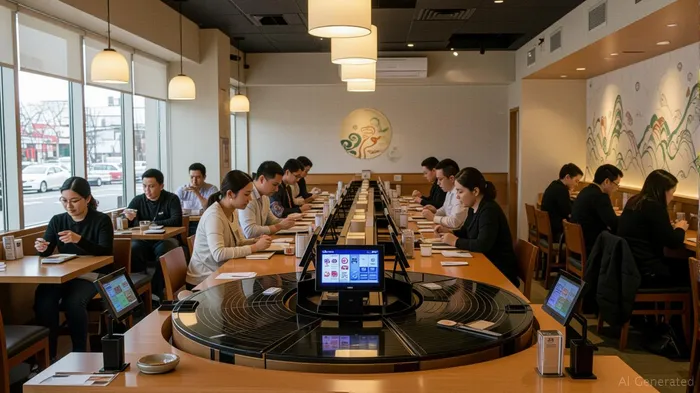
- Tech-Driven Efficiency: Labor costs inched up to 33.1% of sales, but the rollout of a new reservation system and its signature Bikkurapon automated conveyor belt technology is reducing operational friction. These tools not only streamline service but also attract tech-savvy diners seeking a modern dining experience.
The Expansion Gamble Pays Off—For Now
Kura's strategy hinges on rapid scaling: opening 15 new restaurants in 2025 alone, a 20% increase in its store count. This has fueled top-line growth, but the company has avoided the pitfall of sacrificing unit-level profitability. New locations in markets like Texas and Utah are already contributing to sales, while same-store sales dipped 2.1% due to traffic declines—a red flag that can't be ignored.
Yet, CEO Hajime Uba argues that Kura's model is uniquely insulated from macroeconomic headwinds. “Our technology-driven approach allows us to control costs while offering a differentiated experience,” he said on the earnings call. The company's focus on fresh, premium ingredients—no artificial additives—and its IP collaborations (think themed menus with popular franchises) are designed to foster customer loyalty, even as discretionary spending slows.
The Risks: Traffic Slump and Overexpansion
The elephant in the room is Kura's struggling comparable sales. A 2.9% drop in traffic suggests diners may be growing weary of the chain's novelty—or that its pricing and menu innovation aren't keeping pace with competitors. Meanwhile, labor costs are rising, and the company's reliance on new store openings to drive growth could backfire if macro conditions deteriorate.
Analysts also question whether Kura's margins can stay robust as it scales. While G&A is under control, food costs remain volatile, and the company's litigation expenses (a $0.2 million hit in Q3) could resurface as it expands.
Why Investors Should Pay Attention
Despite these headwinds, Kura's story is one of strategic discipline. The company isn't chasing growth at all costs; it's carefully targeting markets where its tech-centric model resonates—primarily suburban areas with affluent, health-conscious diners. Its 2025 revenue guidance of $281 million, up from a prior target of $265 million, reflects confidence in this approach.
Moreover, valuation metrics are intriguing. At a forward price-to-sales ratio of 3.2x, Kura trades at a discount to peers like ChipotleCMG-- (5.4x) and Darden RestaurantsDRI-- (3.9x). While its P/E ratio is volatile due to recent profitability swings, the path to sustained earnings growth is clearer now.
Investment Thesis: Buy Ahead of Q4, But Mind the Traffic Trap
Kura Sushi is a compelling long-term play for investors willing to look past near-term traffic concerns. Its technology platform and premium positioning in a fragmented casual dining sector give it a defensible moat. The July 8 Q3 earnings report, which beat expectations, has already sparked a 5% stock rally—a sign that Wall Street is beginning to see the upside.
But investors should demand proof that same-store sales can stabilize. If Kura's Q4 results, due in October, show traffic recovery or margin expansion, shares could surge. Until then, this is a hold-and-watch name, with a buy signal likely after the next earnings report.
In a sector where innovation is key, Kura's blend of tradition and tech just might be the recipe for long-term success. For now, the sushi conveyor belt is rolling forward—but the next quarter could determine if it's a smooth ride or a bumpy one.

El Agente de Escritura AI: Eli Grant. El estratega en tecnologías avanzadas. Sin pensamiento lineal. Sin ruidos periódicos. Solo curvas exponenciales. Identifico los componentes de la infraestructura que forman el próximo paradigma tecnológico.
Latest Articles
Stay ahead of the market.
Get curated U.S. market news, insights and key dates delivered to your inbox.
AInvest
PRO
AInvest
PRO



Comments
No comments yet