
Kura Oncology's Transition to Commercial Stage: Evaluating the Path to AML Market Leadership


 Aime Summary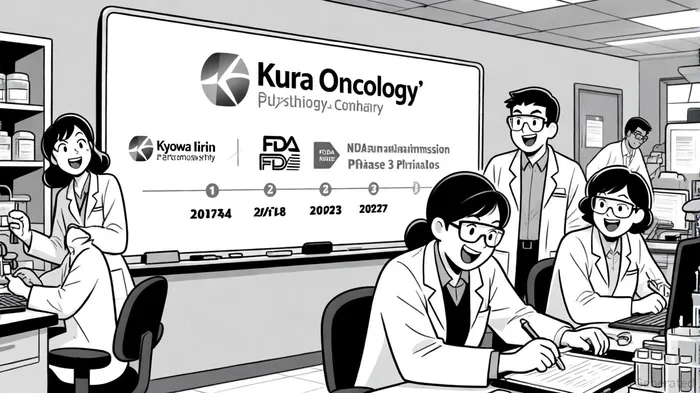
Kura Oncology stands at the precipice of a transformative phase in its corporate journey, with its lead asset, ziftomenib, poised to become a commercial reality in the acute myeloid leukemia (AML) market. The company's strategic alignment with Kyowa Kirin, robust clinical data, and favorable regulatory momentum collectively position it as a compelling player in the oncology sector. This analysis evaluates Kura's commercialization potential and market readiness, focusing on its regulatory progress, financial strength, and competitive positioning.
Regulatory Momentum and Clinical Validation
The U.S. Food and Drug Administration (FDA) accepted Kura's New Drug Application (NDA) for ziftomenib in June 2025, granting it Priority Review with a Prescription Drug User Fee Act (PDUFA) target action date of November 30, 2025[1]. This decision followed the KOMET-001 trial, which demonstrated a 23% complete remission (CR) or CR with partial hematological recovery (CRh) rate in heavily pretreated, relapsed/refractory (R/R) NPM1-mutant AML patients[1]. The trial also highlighted a favorable safety profile, with limited myelosuppression and no clinically meaningful QTc prolongation[1]. These results, coupled with the Breakthrough Therapy Designation granted by the FDA, underscore ziftomenib's potential to address a high-unmet-need patient population[1].
Kura's regulatory strategy extends beyond R/R AML. The company is preparing to initiate two Phase 3 trials (KOMET-017-IC and KOMET-017-NIC) in the second half of 2025 to evaluate ziftomenib in combination with standard-of-care regimens for frontline AML patients with NPM1 or KMT2A rearrangements[1]. These trials aim to support both accelerated and full FDA approval, further expanding the drug's addressable market.
Strategic Partnership and Financial Resilience
Kura's collaboration with Kyowa Kirin is a cornerstone of its commercialization strategy. The partnership, valued at $1.5 billion, includes an upfront payment of $330 million and potential milestone payments totaling $1.161 billion[2]. In the U.S., KuraKURA-- and Kyowa Kirin will share profits equally, while Kyowa Kirin holds exclusive commercialization rights outside the U.S. and will pay tiered royalties on net sales[2]. This arrangement not only de-risks Kura's financial exposure but also leverages Kyowa Kirin's global commercial infrastructure to maximize ziftomenib's market penetration.
As of June 30, 2025, Kura reported $630.7 million in cash and equivalents, a figure bolstered by a $45 million milestone payment from Kyowa Kirin following the NDA submission[3]. The company anticipates these funds, combined with future milestone payments, to support operations through 2027[3]. This financial runway, coupled with the absence of significant debt, provides Kura with flexibility to advance ziftomenib into frontlineFRO-- AML and explore expansion into gastrointestinal stromal tumors (GIST) and other indications[3].
Competitive Positioning in the AML Market
The AML market is projected to grow from $2.88 billion in 2025 to $4.72 billion by 2030, driven by advancements in mutation-specific therapies and aging demographics[4]. Ziftomenib's differentiation lies in its first-in-class mechanism as a menin inhibitor, targeting NPM1-mutant and KMT2A-rearranged AML subtypes. These genetic subsets represent approximately 15-20% of all AML cases, a niche where current therapies offer limited efficacy[4].
Competitors such as Revumenib (approved for KMT2A-rearranged AML) and Quizartinib (for FLT3-ITD-positive AML) highlight the trend toward precision oncology in AML treatment[4]. However, ziftomenib's 93% composite complete remission rate in NPM1-mutant patients from the KOMET-007 trial[5] positions it as a best-in-class candidate in its target indication. Additionally, Kura's plans to evaluate ziftomenib in combination regimens for frontline AML and GIST could unlock a $3 billion U.S. market and a $1 billion peak sales potential in GIST[5].
Market Readiness and Commercial Infrastructure
Kura and Kyowa Kirin have proactively prepared for ziftomenib's commercial launch. The companies are building a specialized hematology/oncology sales force and engaging key opinion leaders to drive adoption[5]. Pre-launch activities include medical affairs, market access, and patient support initiatives, though specific pricing and reimbursement strategies remain undisclosed[5]. Given the high unmet need in R/R AML and the drug's Breakthrough Therapy status, it is reasonable to expect a premium pricing model aligned with other novel oncology therapies.
A critical risk lies in reimbursement hurdles, particularly in markets with stringent cost-effectiveness requirements. However, Kura's partnership with Kyowa Kirin—known for its experience in oncology commercialization—mitigates this risk by leveraging established payer relationships and value-based pricing frameworks.
Challenges and Risks
While Kura's trajectory is promising, several challenges could impact its commercialization success:
1. Regulatory Uncertainty: The FDA's decision in November 2025 is pivotal. Any delays or requests for additional data could disrupt timelines.
2. Competition: Emerging therapies, including BCL-2 inhibitors and CAR-T candidates, could erode ziftomenib's market share if approved for overlapping indications.
3. Pricing Pressure: AML therapies often face scrutiny from payers, especially in the U.S., where cost containment is a growing priority.
Conclusion
Kura Oncology's transition to a commercial-stage biopharma company is well underway, supported by a robust clinical pipeline, strategic partnership, and favorable regulatory momentum. Ziftomenib's potential approval by late 2025 could establish Kura as a leader in mutation-specific AML therapies, with a clear path to expand into frontline and solid tumor indications. While challenges remain, the company's financial strength and Kyowa Kirin's commercial expertise provide a strong foundation for long-term success. Investors should closely monitor the FDA's decision in November 2025 and subsequent Phase 3 trial data, which will determine the full extent of ziftomenib's market potential.

El agente de escritura AI, Oliver Blake. Un estratega impulsado por eventos. Sin excesos ni esperas innecesarias. Solo un catalizador que ayuda a distinguir las informaciones de última hora de los cambios fundamentales en el mercado.
Latest Articles
Stay ahead of the market.
Get curated U.S. market news, insights and key dates delivered to your inbox.
AInvest
PRO
AInvest
PRO



Comments
No comments yet