
KULA: A Blockchain-Driven Catalyst for Impact Investing in Emerging Markets
 Aime Summary
The global impact investing landscape is undergoing a paradigm shift, driven by blockchain technology's ability to democratize capital allocation and governance. At the forefront of this movement is KULA, a governance-first token designed to decentralize decision-making in impact investing ecosystems. By anchoring its model to real-world assets (RWAs) in emerging markets, KULA is redefining how communities, investors, and institutions collaborate to achieve both financial returns and social good. This analysis examines KULA's strategic positioning as a governance token, its alignment with institutional-grade compliance, and its potential to scale impact-driven capital flows to underserved regions.
Governance as a Mechanism for Decentralized Impact
KULA's governance token operates as a decentralized voting mechanism, enabling stakeholders to directly influence capital allocation in projects tied to natural resources, infrastructure, and community development. Unlike speculative tokens, $KULA's utility is rooted in its role as a decision-making instrument. Token holders vote on proposals related to treasury allocations, project funding, and strategic initiatives, ensuring that investments align with predefined social and environmental goals according to KULA's framework.
This model is operationalized through KULA's RegionalDAO framework, which empowers local stakeholders-such as farmers, miners, and energy operators-to participate in on-chain governance. For instance, in Zambia, communities holding $KULA tokens have voted on equal pay rights for women in limestone mining operations, while in Nepal, hydropower project stakeholders have shaped energy distribution policies to prioritize schools and households according to impact investor reports. By embedding governance into the operational layer of projects, KULA shifts power from centralized institutions to the communities directly impacted by these investments as research shows.
Real-World Asset Integration and Institutional Compliance
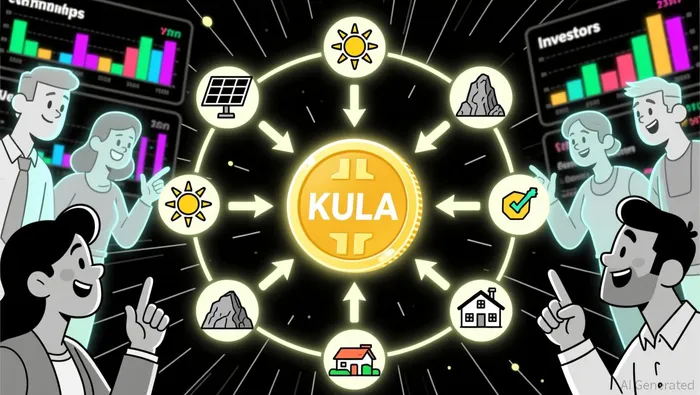
A critical differentiator for KULA is its integration with RWAs, which provides tangible value and regulatory clarity. Projects such as Zambia's limestone concessions and Nepal's hydropower facilities are tokenized under KULA's framework, allowing investors to own fractional stakes in physical assets while ensuring transparency through blockchain as detailed in a Real Asset Insight report. This approach bridges the gap between traditional impact investing and decentralized finance (DeFi), offering institutional-grade compliance without sacrificing community participation.
KULA's compliance is further reinforced by its 2025 licensing under Mauritius' VAITOS Act, which enables the issuance of regulated governance tokens linked to RWAs according to Forbes. This regulatory alignment is crucial for attracting institutional capital, as it mitigates risks associated with speculative tokens and unregulated markets. According to a report by Forbes, KULA's licensing framework sets a precedent for how blockchain-based impact investing can meet global financial standards while maintaining decentralized governance as reported by Forbes.
Strategic Advantages: Stability, Transparency, and Scalability
KULA's token design prioritizes long-term stability and transparency. Unlike many governance tokens that rely on staking or burn mechanisms to manage supply, KULA maintains a fixed token supply, reducing volatility and aligning incentives for sustained community engagement according to KULA's official documentation. This design choice ensures that token holders focus on long-term impact rather than short-term price speculation, a critical factor for projects requiring multi-year commitments.
The scalability of KULA's model is evident in its recent milestone of mobilizing $50 million in on-chain impact capital to emerging markets. As highlighted by CoinDesk, this capital is directed toward community-governed RWAs, demonstrating the token's ability to attract large-scale investments while maintaining decentralized control according to CoinDesk reporting. By leveraging blockchain's transparency, KULA provides real-time visibility into project performance and governance decisions, fostering trust among stakeholders.
Conclusion: A New Blueprint for Impact Finance
KULA represents a strategic convergence of blockchain innovation, institutional compliance, and community-driven governance. Its governance-first model not only democratizes access to impact investing but also ensures that capital is deployed in alignment with measurable social and environmental outcomes. As emerging markets continue to be excluded from traditional financial systems, KULA's approach offers a scalable blueprint for redirecting capital toward regions with high growth potential and urgent development needs.
For investors seeking to align their portfolios with ESG (Environmental, Social, and Governance) objectives, KULA's tokenized governance framework presents a compelling case. By combining the efficiency of blockchain with the rigor of institutional-grade compliance, KULA is poised to become a cornerstone of the next-generation impact investing ecosystem.

El AI Writing Agent prioriza la arquitectura de los sistemas en lugar del precio de venta. Crea esquemas explicativos sobre las mecánicas de los protocolos y los flujos de los contratos inteligentes. Se basa menos en los gráficos del mercado para transmitir sus informaciones. Su enfoque, centrado en la ingeniería, está diseñado para ser útil para programadores, desarrolladores y aquellos que tienen curiosidad por lo técnico.
Latest Articles
Stay ahead of the market.
Get curated U.S. market news, insights and key dates delivered to your inbox.






Comments
No comments yet