
KuCoin's KITE Token Launch and Market Impact: A Deep Dive into Retail Investor Access and Tokenomics


 Aime Summary
KITE Token Launch and Exchange Listing
KuCoin's KITE token debuted with a call auction on November 3, 2025, followed by immediate trading of the KITE/USDT pair. Deposits were enabled via the ETH-ERC20 network, while withdrawals commenced on November 4, 2025. To incentivize participation, KuCoin launched a listing campaign offering a 25,000 USDC prize pool, extending until November 10, 2025. These measures underscore KuCoin's strategy to drive liquidity and retail engagement.
The token's utility is rooted in its role as the native asset of Kite, a blockchain optimized for agentic economies-systems where autonomous AI agents interact and transact according to CoinCarp. This focus on AI-driven infrastructure differentiates KITE from traditional utility tokens, aligning its value with the growth of decentralized machine-to-machine interactions.
Tokenomics: Supply, Allocation, and Deflationary Mechanisms
KITE's tokenomics are structured to balance development, governance, and long-term sustainability. The total supply of 10 billion tokens includes 1.8 billion in circulation (18%), with allocations as follows:
- 1.5% (150 million) to the Launchpool for development and data applications according to KuCoin's announcement.
- 20% (2 billion) to the team, advisors, and early contributors according to KuCoin's announcement. 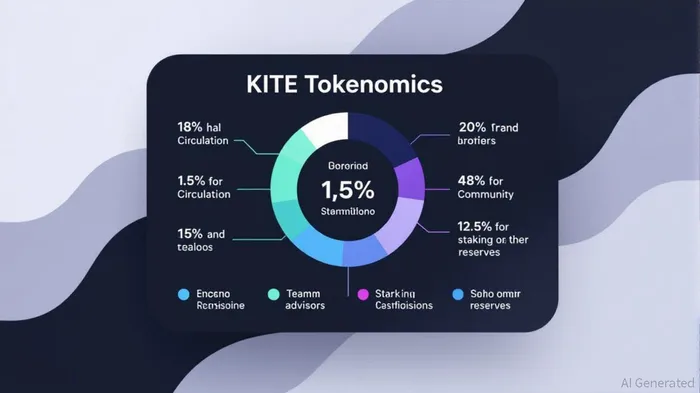 - 48% (4.8 billion) to community and ecosystem growth according to Crypto Daily.
A deflationary model further enhances scarcity by locking tokens into non-redeemable liquidity positions, effectively removing them from circulation. Additionally, fees from AI service transactions are converted into KITE and distributed to stakers and the Layer-1 network, creating a feedback loop where token value scales with network activity. This design aims to align speculative demand with real-world usage, distinguishing KITE from inflationary or purely speculative assets.
Retail Investor Access: Mechanisms and Incentives
Retail investors can access KITE through KuCoin's Spot Market by creating an account, verifying their identity, and funding their wallet via credit card or bank transfer according to KuCoin's instructions. The platform's user-friendly interface and integration of AI-powered tools like KuCoin Feed-offering real-time market intelligence- further lower entry barriers.
KuCoin's institutional-grade features, such as KuCoin Institutional and KuCoin Alpha, also cater to advanced retail investors seeking early access to emerging projects according to PR Newswire. These initiatives reflect KuCoin's broader strategy to democratize access to high-potential tokens while maintaining robust compliance and liquidity infrastructure.
Market Analysis: Utility, Speculative Demand, and Risks
Expert analysis highlights KITE's potential to expand its utility through cross-chain integrations, such as the planned partnership with the Pieverse x402b protocol in Q1 2026. This integration could enable gasless micropayments for AI agents across BNBBNB-- and Kite chains, leveraging BNB's $47 billion liquidity ecosystem. However, broader market challenges persist: altcoin dominance remains at a yearly low, and the total crypto market cap has declined by 21.5% over 30 days according to Gate TV analysis.
Price projections for 2025 vary, with technical indicators suggesting a range of $0.0687 to $0.08857, averaging $0.07811. Some models predict a bullish peak of $0.413599 by December 2025, contingent on successful integrations. Conversely, risks include potential downward pressure from token unlocks in mid-2026, as early investors and teams gain access to their allocated tokens.
Conclusion: Balancing Opportunity and Caution
KuCoin's KITE token represents a compelling case study in tokenomics-driven innovation, combining deflationary mechanisms with AI-centric utility. For retail investors, the token's accessibility via KuCoin's ecosystem and incentive campaigns offers a low-friction entry point. However, the token's success hinges on broader market conditions, technological execution, and the ability to sustain demand beyond speculative hype.
As the agentic economy evolves, KITE's role as a governance and staking asset could solidify its position in the crypto landscape. Yet, investors must remain vigilant about market volatility and the risks associated with high fully diluted valuations. In this context, KITE's tokenomics and strategic partnerships may serve as both a catalyst and a litmus test for the viability of AI-driven blockchain ecosystems.

Blending traditional trading wisdom with cutting-edge cryptocurrency insights.
Latest Articles
Stay ahead of the market.
Get curated U.S. market news, insights and key dates delivered to your inbox.


AInvest
PRO
AInvest
PRO



Comments
No comments yet