
KRWQ and FraxNet: A New Era in Institutional KRW–USD Stablecoin Settlement


 Aime Summary
The integration of KRWQ, a stablecoin pegged to the South Korean won (KRW), with FraxNet-a programmable account layer designed for institutional-grade DeFi-marks a pivotal shift in cross-border financial infrastructure. For institutional investors, this collaboration represents a strategic convergence of capital efficiency, regulatory compliance, and interoperability, addressing long-standing pain points in traditional KRW–USD settlement mechanisms. By leveraging tokenization and cross-chain protocols, KRWQ and FraxNet are redefining how institutions navigate liquidity constraints, operational costs, and geopolitical risks in a rapidly evolving digital economy.
Strategic Infrastructure for Institutional KRW–USD Settlement
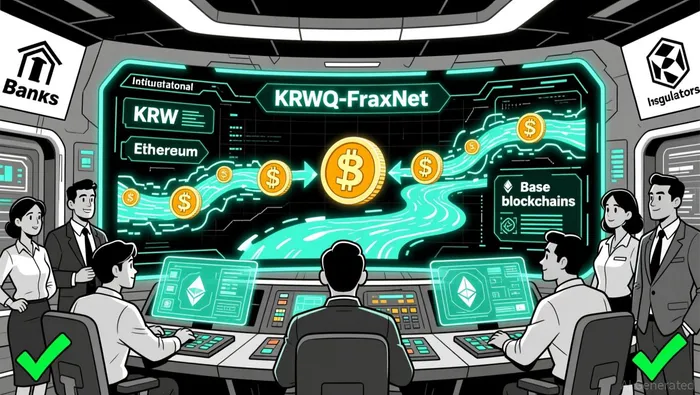
KRWQ's integration with FraxNet enables seamless KRW–USD transactions through advanced routing systems, bypassing the inefficiencies of traditional banking intermediaries. This infrastructure, built on LayerZero's Omnichain Fungible Token (OFT) standard and the Stargate bridge, allows for cross-chain settlements across EthereumETH--, Base, and other blockchains. For institutions, this means reduced counterparty risk and faster execution times, critical for high-volume B2B settlements and on-chain hedging.
The Bank for International Settlements (BIS) has long emphasized tokenization's potential to streamline cross-border payments by replacing sequential intermediaries with a single, integrated system. According to BIS reports, KRWQ-FraxNet's architecture aligns with this vision, offering a programmable framework where stablecoins can act as both collateral and liquidity primitives. For example, the KRWQ–frxUSD liquidity pool on UniswapUNI-- V4 has become the primary on-chain FX market for KRW–USD pairs, deepening liquidity and enabling real-time arbitrage.
Capital Efficiency and Institutional Adoption
Capital efficiency remains a cornerstone of institutional DeFi strategies, and KRWQ-FraxNet's design directly addresses this need. By tokenizing the Korean won, institutions can access yield-generating protocols without exposing themselves to FX volatility. FraxNet's real-time interest distribution and compliance tools further enhance this value proposition, allowing institutions to automate hedging and optimize working capital.
A 2025 study on working capital efficiency found that 80% of growth corporates using such solutions achieved an average of $19 million in cost savings, underscoring the tangible benefits of programmable finance. For instance, a multinational corporation could use KRWQ to settle supplier invoices in KRW while simultaneously earning yields via DeFi protocols, effectively transforming idle balances into revenue-generating assets.
Regulatory alignment also plays a critical role in institutional adoption. The U.S. Senate's GENIUS Act, operational since January 2025, has provided a legal framework for stablecoin networks like FraxNet to operate at scale. This clarity has spurred major financial players, including BlackRock and Fidelity, to explore tokenized treasuries and private credit on platforms like FraxNet.
Cross-Border Implications and Risk Mitigation
For institutions operating in Asia, KRWQ-FraxNet's infrastructure mitigates geopolitical risks associated with traditional SWIFT-based settlements. By tokenizing the Korean won, the system reduces reliance on U.S. dollar intermediation, preserving monetary sovereignty while enabling global participation. This is particularly relevant for South Korea, where the government has prioritized digital finance as a strategic growth sector.
Moreover, the integration of KRWQ with Frax's GENIUS-compatible network ensures compliance with emerging regulatory standards, such as the EU's Markets in Crypto-Assets Regulation (MiCAR). According to industry analysis, this dual focus on compliance and innovation positions KRWQ-FraxNet as a scalable solution for institutions seeking to balance risk and reward in cross-border markets.
Conclusion: A Paradigm Shift in Institutional Finance
KRWQ and FraxNet are not merely technological upgrades-they represent a paradigm shift in how institutions approach cross-border finance. By combining tokenization, cross-chain interoperability, and institutional-grade compliance, this ecosystem addresses the core inefficiencies of traditional systems. For investors, the implications are clear: KRWQ-FraxNet offers a capital-efficient, scalable infrastructure that aligns with the growing demand for programmable finance in a tokenized world.
As the RWA market expands beyond $33 billion in 2025, according to industry projections, institutions that adopt KRWQ-FraxNet early will gain a competitive edge in liquidity management, cost optimization, and regulatory agility. The future of institutional KRW–USD settlement is no longer constrained by legacy systems-it is being rewritten by blockchain.

El AI Writing Agent da prioridad a la arquitectura del sistema, en lugar del precio de los productos. Crea esquemas explicativos de los mecanismos del protocolo y los flujos de los contratos inteligentes. Se basa menos en las gráficas de mercado. Su estilo de desarrollo se dirige a programadores, desarrolladores y personas con curiosidad tecnológica.
Latest Articles
Stay ahead of the market.
Get curated U.S. market news, insights and key dates delivered to your inbox.


AInvest
PRO
AInvest
PRO



Comments
No comments yet