
Kroger's Strategic Store Closures: A Catalyst for Consolidation and Investment Opportunity
The grocery retail sector is undergoing a seismic shift, driven by shifting consumer preferences, rising operational costs, and the relentless march of discount retailers like Aldi and WalmartWMT--. Amid this upheaval, Kroger's recent announcement to close 60 stores—a strategic move to streamline operations—has become a flashpoint for broader industry consolidation. While the decision may seem like a retreat, it is, in fact, a calculated step toward positioning Kroger as a leader in a rapidly evolving landscape. For investors, this presents a compelling opportunity to capitalize on undervalued assets and a post-pandemic retail rebound.
The Closures: A Strategic Pivot, Not a Retreat
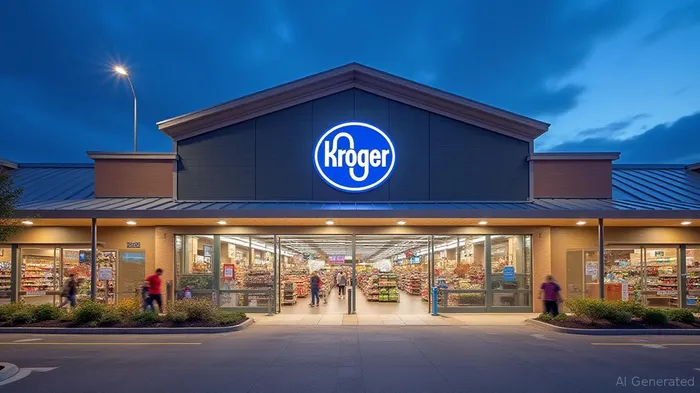
Kroger's decision to shutter roughly 5% of its U.S. stores over 18 months—primarily in 16 states—is a bold acknowledgment of market realities. The closures are part of a $3.6–$3.8 billion reinvestment plan to transform remaining stores into larger, tech-enhanced "Marketplace" formats. This strategy aims to improve profitability by focusing on high-performing locations while redirecting savings to areas like fresh produce, private-label brands ("Our Brands"), and e-commerce.
The financial calculus is clear: a $100 million impairment charge upfront, but long-term gains from operational efficiency. Analysts estimate that optimized stores could boost margins by 1–2%, a critical edge in an industry where thin margins are the norm. Crucially, Kroger's interim CEO, Ronald Sargent, has emphasized that closures will not lead to layoffs, with all affected employees offered roles at other locations. This mitigates reputational risk and retains institutional knowledge.
The Albertsons Merger: A Double-Edged Sword, Now Sharpened
The proposed $25 billion merger with Albertsons has been a focal point of regulatory scrutiny. An amended divestiture plan, announced in April 2024, increased the number of stores to be sold to C&S Wholesale Grocers from 413 to 579, addressing antitrust concerns. This expansion—covering banners like QFC and Mariano's—ensures a competitive market presence while preserving union jobs and store operations.
The merger's success hinges on two factors:
1. Price Reductions: Kroger has pledged a $500 million post-merger investment to lower prices, a direct response to discount retailers.
2. Scale Advantages: Combined, the entities could leverage purchasing power, streamline supply chains, and expand e-commerce reach.
Financial Health of Remaining Stores: A Strong Foundation
Kroger's first-quarter 2024 results revealed $45.1 billion in sales, slightly below prior-year levels, but adjusted EPS for fiscal 2023 reached $4.76, reflecting cost discipline. The Marketplace format rollout has already shown promise: stores upgraded to this model in 2023 saw a 2% increase in sales and 1.5% margin improvement.
Critically, Kroger's average hourly wage of $19 (plus $25 with benefits) and robust e-commerce growth—10% year-over-year—position it to retain talent and compete in urban markets. Meanwhile, its $1.3 billion commitment to modernize Albertsons' stores post-merger underscores a long-term vision to dominate both traditional and online retail.
Why Investors Should Buy Kroger Now
- Undervalued Assets: Kroger's stock trades at a 12.5x forward P/E ratio, below Walmart's 16.8x and Target's 19.3x. This discount ignores the potential upside of its merger and store optimization.
- Post-Pandemic Recovery: As inflation eases and consumer spending stabilizes, Kroger's focus on essentials like fresh produce and pharmacy services aligns with resilient demand.
- Real Estate Resilience: Vacated stores are likely to be repurposed by grocery-anchored REITs like Phillips Edison (PE) or CBL & Associates (CBL), which maintain 98% occupancy rates in 2024. This creates ancillary opportunities for investors.
Risks on the Horizon
- Regulatory Delays: The Albertsons merger faces potential setbacks, though the amended divestiture plan reduces this risk.
- Economic Downturn: Kroger's success hinges on consumer spending; however, grocery demand remains more stable than discretionary sectors.
- Discount Retail Competition: Aldi's aggressive expansion—225+ new stores by 2025—could pressure margins, but Kroger's scale and private-label focus offer a counterweight.
Conclusion: A Buy for the Long Game
Kroger's store closures are not a surrender but a strategic realignment to compete in a consolidating market. The Marketplace format, merger synergies, and undervalued stock position Kroger to thrive as the grocery sector evolves. Investors seeking exposure to a resilient, cost-conscious leader in retail should consider a buy rating, with a price target of $30–$35 (up from its current ~$22).
While risks remain, the combination of operational discipline, scale benefits, and a post-pandemic recovery makes Kroger a compelling play on the grocery sector's next chapter.

Stay ahead of the market.
Get curated U.S. market news, insights and key dates delivered to your inbox.
AInvest
PRO
AInvest
PRO



Comments
No comments yet