
Kroger's Strategic Retreat: How Store Closures Signal Retail's Evolution Toward Profitability
Kroger's announcement of closing 60 stores—roughly 2% of its U.S. footprint—marks a pivotal moment in the evolution of traditional retail. Far from a retreat, this move embodies a calculated shift toward strategic real estate optimization, a strategy that could redefine profitability in an industry grappling with overexpansion and shifting consumer habits. For investors, the decision raises critical questions: Is Kroger's pivot a harbinger of things to come for supermarkets? How does its asset-light transformation compare to peers? And what risks and opportunities lie ahead?
The Strategic Turn: Closing Stores to Open New Doors
Kroger's closures are not arbitrary. They targetTGT-- underperforming locations in 16 states, with a focus on markets exhibiting overlap or declining foot traffic. The company plans to repurpose vacated sites into logistics hubs and mixed-use developments, such as the $600 million Crossings project in New Jersey—a former mall reborn as an industrial-anchored complex. This approach aligns with a broader industry trend: retailers are moving beyond physical stores as their sole revenue driver and instead leveraging real estate as an asset class.
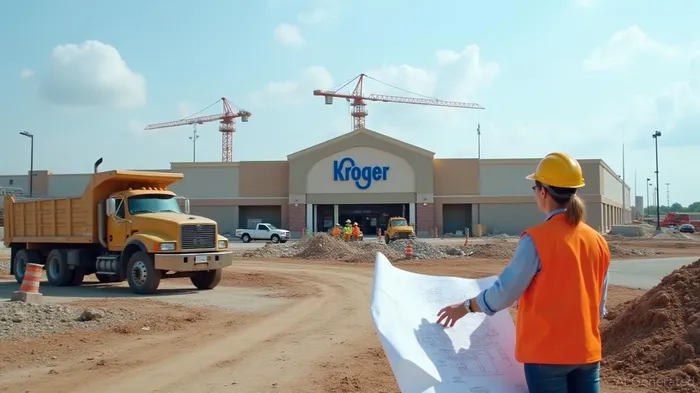
The financial logic is clear: Kroger's $100 million impairment charge for closures pales compared to the long-term benefits of last-mile delivery efficiency and customer convenience. By partnering with Ocado Systems to build automated fulfillment centers, KrogerKR-- aims to cut delivery costs while competing with e-commerce giants like AmazonAMZN-- and WalmartWMT--. Meanwhile, mixed-use developments—such as the Forest Acres, South Carolina, project combining retail, residential, and green space—tap into urbanization trends, offering higher foot traffic and loyalty.
Industry-Wide Lessons: Overexpansion's Cost and Efficiency's Rise
Kroger's move reflects a sector-wide reckoning. Over the past decade, supermarkets expanded aggressively, often prioritizing scale over profitability. Now, overcorrection is in play. Walmart, Target, and even discounters like Aldi are similarly pruning underperforming stores while doubling down on e-commerce and logistics. For investors, this signals a shift toward asset-light models, where real estate is optimized for flexibility rather than sheer volume.
Kroger's valuation lags behind peers, yet its undervalued status could be a buying opportunity if its strategy succeeds. The company's 1.8% dividend yield offers stability, but its real upside lies in execution. Unlike rivals, Kroger is explicitly tying closures to real estate reinvestment, a play that could boost margins by reducing overhead while unlocking latent property value.
Risks and Challenges: The Pitfalls of Restructuring
Despite the strategic vision, hurdles abound. First, union opposition and job losses in rural areas may spark backlash, complicating execution. Second, delays in repurposing sites—due to zoning battles or material shortages—could erode projected savings. Third, the last-mile delivery model hinges on customer adoption: if Kroger's Ocado partnership fails to match Walmart's speed or Amazon's convenience, the gamble backfires.
Moreover, closures in food deserts risk alienating communities. In Abingdon, Virginia, residents protested a closure, highlighting a tension between corporate efficiency and social responsibility. Investors must monitor how Kroger balances these priorities.
Investment Implications: Valuations, Peers, and Beyond
For investors, Kroger's stock (KR) offers a value proposition at current levels, but with caveats. Its 3.2% identical-store sales growth in Q1 2025 and plans to open 30 new stores in growth markets suggest resilience. However, the $100 million impairment charge underscores the risks of restructuring. Peers like Walmart (WMT) and Target (TGT) offer safer bets but lack Kroger's explicit real estate angle.
Kroger's stock has underperformed the market, reflecting skepticism about its turnaround. Yet, if its logistics and mixed-use projects deliver, a re-rating is possible. Investors might also consider REITs exposed to industrial or mixed-use real estate, such as PrologisPLD-- (PLD) or Simon Property GroupSPG-- (SPG), which could benefit indirectly from Kroger's asset sales.
Conclusion: A New Playbook for Retail
Kroger's closures are not an admission of failure but a strategic pivot to align with the future of retail. By converting underperforming stores into logistics hubs and mixed-use developments, the company aims to reduce costs, boost e-commerce, and capitalize on urbanization. For investors, this creates a nuanced opportunity: Kroger's undervalued shares and dividend offer a floor, while its real estate bets could drive upside. However, execution risks remain high, and the path to profitability depends on navigating labor, logistics, and community challenges.
In a sector where efficiency and adaptability are king, Kroger's move underscores a truth: the retail landscape is no longer about how many stores you have, but how well you use the space you keep. For investors, staying attuned to this shift—whether through Kroger itself or its real estate partners—could yield dividends in the years ahead.

Stay ahead of the market.
Get curated U.S. market news, insights and key dates delivered to your inbox.
AInvest
PRO
AInvest
PRO



Comments
No comments yet