
Kroger's Store Closures Signal a New Era in Retail: How Efficiency-Driven Consolidation is Shaping Investment Opportunities
The retail sector is undergoing a seismic shift. No longer is scale alone a virtue; profitability, geographic optimization, and operational efficiency are now the keys to survival. Kroger's recent announcement of closing 60 stores—a move aimed at streamlining its footprint and redirecting savings into e-commerce, fresh offerings, and technology—serves as a bellwether for this transformation. For investors, this is a critical moment to reassess which retailers are best positioned to thrive in a world where cost discipline and strategic reinvestment trump sheer physical expansion.
The Rationale Behind Kroger's Strategic Realignment
Kroger's decision to shutter 60 stores over 18 months is not a retreat but a calculated pivot. The company has explicitly tied the closures to improving operational efficiency and the customer experience. The $100 million impairment charge—though a one-time hit—will free up capital to invest in high-margin initiatives like premium produce sections, technology upgrades, and expanding its e-commerce infrastructure.
Crucially, Kroger's first-quarter 2025 results underscore the financial logic: its Adjusted FIFO Operating Profit rose to $1.518 billion, with gains from lower shrinkage and supply chain savings offsetting margin pressures. While its net debt-to-EBITDA ratio has risen to 1.69 (from 1.25 a year earlier), the company remains focused on maintaining investment-grade ratings and shareholder returns via dividends and buybacks.
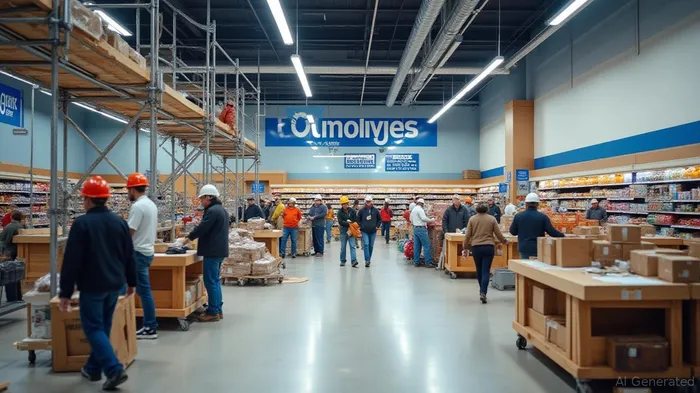
Why This Matters for the Retail Sector
Kroger's move reflects a broader industry trend: retailers are moving away from a "more stores = more customers" mindset toward a "better stores = better profitability" model. The rise of e-commerce and shifting consumer preferences have forced traditional retailers to prioritize geographic optimization—closing underperforming locations while doubling down on high-traffic areas.
Consider the data:
While Kroger's stock has underperformed peers like Walmart in recent years, its recent strategic moves—store closures, e-commerce investment, and private-label growth—suggest a potential turning point.
Investment Themes to Watch
Cost-Cutting as a Competitive Advantage
Retailers that can cut fixed costs (e.g., closing unprofitable stores) while preserving or boosting margins will outperform. Kroger's $100 million charge is painful, but its focus on reinvesting savings into high-return areas (e.g., fresh produce, which commands premium pricing) positions it to capitalize on consumer trends.E-Commerce Integration
Kroger's investment in its PickUp and Delivery services is critical. Its partnership with Ocado and expansion of automated warehouses signal a commitment to blending physical and digital retail. Investors should favor retailers that marry physical store density with robust online platforms.Geographic Optimization
Closing stores in saturated or declining markets while expanding in growing regions (e.g., urban centers or areas with rising demand for fresh, local products) is key. Kroger's focus on urban grocery stores and pharmacy closures (a margin-heavy but less profitable segment) highlights this strategy.
Risks and Considerations
The path isn't without hurdles. Kroger's debt-to-EBITDA ratio, while manageable, is above its long-term target. Investors must monitor whether cost savings materialize as promised and whether e-commerce investments pay off. Additionally, macroeconomic factors—such as a potential recession—could pressure consumer spending, testing Kroger's ability to retain price-sensitive shoppers.
Actionable Investment Takeaways
- Buy Kroger (and similar retailers) on dips: Despite short-term charges, Kroger's strategic moves align with a sustainable path to profitability. A pullback to $20–$22 per share (from recent $23–$25 levels) could present an entry point.
- Avoid retailers clinging to outdated models: Companies that resist closing underperforming stores or underinvest in e-commerce will lag.
- Look for consolidation winners: The retail sector is ripe for consolidation. Investors should favor firms with strong balance sheets (e.g., Walmart) or niche players (e.g., Publix) that can capitalize on weaker competitors' missteps.
Conclusion
Kroger's store closures are not a retreat but a reset—a strategic acknowledgment that the retail landscape is now defined by precision, not sprawl. For investors, this is a clarion call: the winners will be those that trade scale for profitability, optimize physical footprints, and invest in the future of shopping. In this new era, Kroger's moves are a master class in how to navigate the transformation—and a roadmap for where to place bets.
With Kroger's updated sales guidance of 2.25%–3.25% excluding fuel, the company is signaling confidence in its strategies. Investors would be wise to heed that confidence—and act accordingly.

Delivering real-time insights and analysis on emerging financial trends and market movements.
Latest Articles
Stay ahead of the market.
Get curated U.S. market news, insights and key dates delivered to your inbox.
AInvest
PRO
AInvest
PRO



Comments
No comments yet