
Kroger's Stock Slides as $330M Volume Surges to 363rd in U.S. Rankings Amid Institutional Buying and Earnings Beat Amid Amazon Threat
 Aime Summary
Market Snapshot
On November 17, 2025, shares of The Kroger Co.KR-- (KR) fell 0.91%, closing with a trading volume of $0.33 billion, ranking 363rd in U.S. stock trading activity for the day. The stock, which operates as a major U.S. food and drug retailer, has a market capitalization of $44.2 billion and a price-to-earnings (P/E) ratio of 16.93. It currently trades within a 52-week range of $57.08 to $74.90, with a 2.1% dividend yield based on its $1.40 annualized payout. Analysts maintain a "Moderate Buy" consensus rating, with an average price target of $74.50.
Key Drivers
Institutional Investment Activity and Ownership Trends
Kroger’s institutional ownership surged in Q2 2025, with key investors increasing stakes significantly. Candriam S.C.A. boosted its holdings by 38.2%, acquiring 20,762 additional shares to own 75,061 shares valued at $5.38 million. National Pension Service added 0.6% to its position, purchasing 7,609 shares, while Wellington Management Group increased holdings by 85.3% in Q1, acquiring 2.945 million shares to hold 6.398 million shares valued at $433.07 million. These moves reflect strong institutional confidence in Kroger’s long-term value, with institutional investors now owning 80.93% of the company’s stock. Smaller players, including SOA Wealth Advisors and Whipplewood Advisors, also made outsized bets, with the latter increasing its position by 10,425% in Q2.
Earnings Performance and Guidance
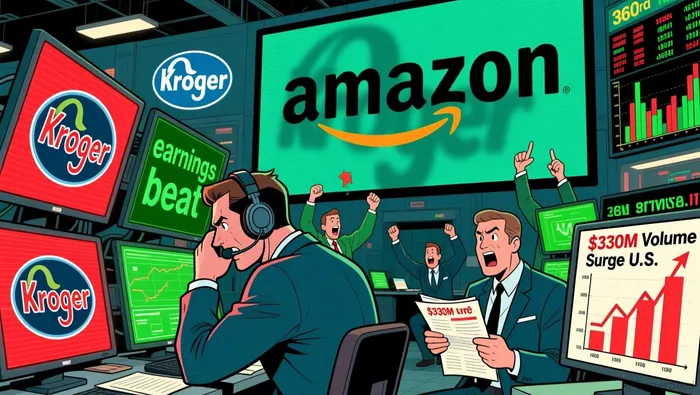
Kroger reported Q2 2025 earnings of $1.04 per share, slightly outperforming the $1.00 consensus estimate. However, revenue of $33.94 billion fell short of the $34.08 billion forecast, reflecting modest growth amid a competitive retail landscape. The company provided FY2025 guidance of $4.70–$4.80 per share, exceeding the $4.44 analyst consensus. This guidance, coupled with a 32.62% return on equity, signals management’s confidence in navigating macroeconomic pressures. Analysts, including Roth Capital and Barclays, have reiterated "Buy" ratings, with price targets ranging from $75.00 to $82.00, underscoring optimism about Kroger’s ability to maintain market share in the face of Amazon’s growing grocery presence.
Dividend Policy and Analyst Sentiment
Kroger’s dividend strategy remains a key draw for income-focused investors. The company declared a $0.35 quarterly dividend, payable on December 1, with an ex-dividend date of November 14. At a 2.1% yield, this payout aligns with its historical dividend growth trajectory, which has averaged a 35.53% payout ratio. Analysts have highlighted the stock’s valuation metrics, including a P/E ratio of 16.93 and a PEG ratio of 1.92, as reasonable for a defensive retail play. However, some caution exists around Kroger’s debt load, with a debt-to-equity ratio of 1.85 and a current ratio of 0.95, which could limit flexibility in a high-interest-rate environment.
Legal and Competitive Risks
While Kroger’s core operations remain stable, indirect risks emerged from lawsuits involving third-party partners. Johnson Fistel, PLLP is investigating Ibotta, Inc. (a digital rewards platform partnered with Kroger) for alleged misstatements regarding the at-will nature of its contract with KrogerKR--. Though no direct claims were made against Kroger, the litigation could cast a shadow on its reliance on such partnerships for customer retention. Additionally, Amazon’s expanding grocery footprint—mentioned in multiple articles—poses a structural threat to Kroger’s market dominance. Analysts at Argus and Evercore ISI have acknowledged this risk but emphasize Kroger’s competitive advantages, including its extensive physical store network and loyalty programs.
Conclusion: Balancing Strengths and Challenges
Kroger’s recent performance reflects a mix of institutional confidence, earnings resilience, and a robust dividend policy. The surge in institutional buying, particularly by large funds like Wellington and National Pension Service, underscores the stock’s appeal as a long-term hold. However, the company faces headwinds from both macroeconomic factors and disruptive competition. While analysts remain cautiously optimistic, investors should monitor Kroger’s ability to execute its digital transformation and maintain profit margins in an increasingly competitive retail sector. The stock’s current valuation appears justified by its earnings potential and dividend yield, but its path to the $74.50 price target will depend on navigating these dual challenges effectively.

Encuentren esas acciones que tienen un volumen de transacciones muy alto.
Latest Articles
Stay ahead of the market.
Get curated U.S. market news, insights and key dates delivered to your inbox.
AInvest
PRO
AInvest
PRO



Comments
No comments yet