
Kroger's Q1 2026: Contradictions Emerge on Pricing Strategy, E-commerce, Private Labels, and Pharmacy Integration
 Aime Summary
Date of Call: September 11, 2025
Financials Results
- EPS: $1.04 adjusted EPS, up 12% YOY
- Gross Margin: FIFO gross margin rate +39 bps YOY; excluding sale of Kroger Specialty Pharmacy, -9 bps YOY; company expects full-year underlying gross margin to be relatively flat
- Operating Margin: Adjusted FIFO operating profit $1.1B; OG&A rate -5 bps YOY (-41 bps underlying excluding sale of Specialty Pharmacy)
Guidance:
- Identical sales without fuel raised to 2.7%–3.4% for full year; Q3 expected slightly below midpoint.
- Adjusted FIFO net operating profit guidance raised to $4.8B–$4.9B.
- Net earnings per diluted share guidance raised to $4.70–$4.80.
- Expect underlying FIFO gross margin to be relatively flat for the full year.
- Fuel gallons expected to remain lower YoY for remainder of 2025.
- $5B ASR to complete in Q3; open‑market repurchases to resume under remaining $2.5B authorization.
- 30 major store projects in 2025; store openings expected to increase ~30% in 2026.
- E‑commerce strategic review update expected in Q3 (outcome not included in current guidance).
Business Commentary:
* Sales Growth and Strategic Price Investments: - Kroger reportedidentical sales without fuel growth of 3.4% for Q2 2025, marking the sixth consecutive quarter of improvement. - The growth was driven by strong performance in pharmacy, e-commerce, and fresh categories, partly due to strategic price investments that lowered prices on more than 3,500 products.- E-commerce and Delivery Expansion:
- Kroger's e-commerce business experienced
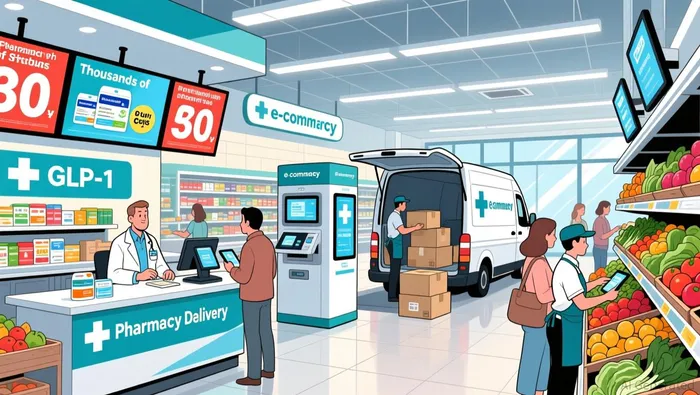
16%growth in Q2, led by strong performance in delivery with a shift in sales favoring delivery over store pickup. This growth is attributed to faster delivery times, with delivery from 97% of stores available in under 2 hours, which resonates with customer demand.
Pharmacy Sales and Script Growth:
- Kroger's pharmacy business continued to show strong growth, driven by core pharmacy scripts and growth in GLP-1s.
- The growth in pharmacy sales contributed to improved gross profit dollar growth, although it created some pressure on margin due to its lower margins.
- Operational Efficiency and Cost Optimization:
- The company achieved a decrease in the operating, general and administrative (OG&A) rate, excluding fuel and adjustment items, of
5 basis pointsin Q2. This improvement was driven by enhanced productivity and favorable comparisons to prior years, reflecting Kroger's focus on optimizing costs and driving efficiency.
Capital Allocation and Shareholder Returns:
- Kroger raised its quarterly dividend by
9%, reflecting strong free cash flow and commitment to returning capital to shareholders. - The increased dividend is part of Kroger's broader total shareholder return strategy, aimed at maximizing return on invested capital over time.
Sentiment Analysis:
Overall Tone: Positive
- Management described "another quarter of strong results," raised identical‑sales and profit guidance, reported adjusted EPS of $1.04 (up 12% YOY) and identical sales without fuel of 3.4% ahead of expectations; emphasized cost reductions, e‑commerce and pharmacy growth as drivers of momentum.
Q&A:
- Question from Leah Jordan (Goldman Sachs): I mean, the biggest call out for me that was new is it seems like you plan to use your stores a bit more for e-commerce fulfillment. Can you help us understand how you plan to implement that? Any color on timing and cost? How much capacity do you have in your stores today? And then will you have to rework the back of the stores? And how are you thinking about labor? And I guess, ultimately, how does this balance with your CFC network today as well?
Response: Stores already fulfill the bulk of e‑commerce; strategic review nearly complete, little in‑store rework required, stores enable asset‑light, faster delivery (delivery now passed pickup); update planned in Q3.
- Question from Leah Jordan (Goldman Sachs): That's very helpful. And then I wanted to switch and ask about price investments. You called out lower prices on, I think, 3,500 products, and that's a step-up from 2,000, I think you said last quarter. And I know you've changed in how you're presenting some of these promotions to [indiscernible] as well. But just has anything changed in the competitive environment? How do you view your price gap today? Is that 3,500 the end of the line? And are you still -- make these investments in a margin-neutral way at this point?
Response: Pricing environment remains rational; will continue incremental price reductions beyond 3,500 SKUs and aim to absorb cost increases to preserve margins, doing so responsibly.
- Question from Rupesh Parikh (Oppenheimer): So just going back to your ID sales momentum, now 2 consecutive quarters above 3%. How does your team feel about sustaining close to that level of momentum going forward?
Response: Management is confident but notes tougher year‑over‑year comps in back half; guidance reflects conservative view while expecting healthy 2‑year stacks.
- Question from Rupesh Parikh (Oppenheimer): Great. And then maybe my one follow-up question, just on retail media. The comment here appears more positive in retail media this quarter versus recent quarters. So is my understanding correct? And what do you think is driving that improved performance?
Response: Retail media acceleration driven by a differentiated offering and improved client engagement; slight acceleration this quarter with meaningful upside potential.
- Question from Simeon Gutman (Morgan Stanley): So if you take the first to second quarter comp, so it got a little bit better sequentially. And press -- the slide deck said that the -- there was some sequential improvement in volume. I think it still implies that maybe volume is not positive, but it improved quarter-to-quarter. Can you explain which one moved more? Was it ticket growth or volume growth sequentially? Or was it about the same to get to the 3.4%?
Response: Sequential improvement was driven more by unit (volume) growth than by lower inflation; grocery units are now roughly flat year‑over‑year.
- Question from Simeon Gutman (Morgan Stanley): Got it. Okay. And related to that... is there a debate around the pricing architecture and whether there is a debate around even moving to like a strict EDLP pricing architecture?
Response: No move to strict EDLP; Kroger will remain promotional but simplify pricing, narrow everyday price spreads and be sharper in execution.
- Question from Michael Lasser (UBS): How much further can you drive improvement from these actions while maintaining a margin rate that's been around 3.1% for the last few years?
Response: Significant runway remains—opportunities in sourcing, pricing, private brands, e‑commerce improvements, OG&A and operating‑model modernization to drive margin expansion.
- Question from Michael Lasser (UBS): Can you unpack the back half guidance a little bit more? You raised the ID outlook, you lowered your tax rate. You took up the low end of both your operating profit outlook and as well as your EPS outlook. So what changes from a margin or below-the-line perspective have you made to help us frame how we should be thinking about the second half of the year?
Response: Back half faces headwinds from pharmacy mix (dollar growth but lower margin), fuel weakness, and consumer uncertainty; offsets are cost and efficiency actions; tax changes are immaterial decimal moves.
- Question from Seth Sigman (Barclays): The growth that continues to accelerate, is there a way to think about the incrementality of what you're seeing there, thinking about new customers versus existing customers? And then ... shorter delivery windows. What are you seeing? What is the consumer looking for as they look for that quicker delivery?
Response: E‑commerce is adding new households and raising order frequency for existing shoppers—users become more valuable; customers prioritize freshness, complete orders and rapid (2‑hour) delivery and will pay for speed.
- Question from Seth Sigman (Barclays): To what extent do you think the script share gains are translating into improvements in other parts of the business, and how are you thinking about vaccines for the second half of the year?
Response: Pharmacy drives incremental store traffic and cross‑shopping; vaccine timing has been delayed but is expected to normalize later in the year.
- Question from Paul Lejuez (Citigroup): Curious if you could talk about performance by your different income segments, where you're seeing stronger versus weaker results? Also, any regional callouts? And inflation/unit assumptions for second half—do you expect units to turn positive?
Response: Low/mid incomes seek deals, use coupons, buy private label and make smaller frequent trips; higher incomes still spend on premium; no material regional divergence; inflation assumption 1.5%–2.5%; units roughly flat with cautious consumer behavior.
- Question from Thomas Palmer (JPMorgan): Any traits you're looking for in a CEO? Are there areas you're holding off on reviewing or making decisions until the seat is filled?
Response: No major decisions on hold; Board seeks an experienced retail leader with strong leadership attributes; company proceeding at full speed across initiatives.
- Question from Edward Kelly (Wells Fargo): LIFO charge higher than expected this quarter—how should we think about LIFO for the back half of the year?
Response: Q2 LIFO uptick reflects a reset of accruals (catch‑up) plus ongoing assumptions tied to inflation; expect the impact split between catch‑up and ongoing run‑rate.
- Question from Edward Kelly (Wells Fargo): Why wasn't free cash flow guidance raised despite higher EBIT this quarter?
Response: Management kept FCF guidance unchanged to balance consumer uncertainty, pharmacy mix, investments for ROIC, and timing/LIFO considerations.
- Question from John Heinbockel (Guggenheim): How do you think about sizing the sourcing opportunity? Is it billions of dollars over time? What needs to change and how quickly?
Response: Sourcing (COGS and indirect) is viewed as a material multi‑year opportunity; new Head of Product Sourcing in place, but sizing/timing not yet quantified.
- Question from John Heinbockel (Guggenheim): On speed of delivery and in‑store improvements—what can you do to speed picking (ESLs, picking methods)?
Response: Can deliver under 2 hours now and faster for a fee; speed gains coming from AI‑driven picking, electronic shelf labels rollouts, optimized pick zones and store layout adjustments.
- Question from Robert Ohmes (BofA): How significant is the shift back to paper coupons for non‑digital customers—new incremental driver or tailwind?
Response: Paper coupons are generating measurable unit lift and helping recruit/retain less‑digital customers; management is tracking positive customer feedback.
- Question from Robert Ohmes (BofA): Is paper couponing pulling many new customers? Any changes to fuel rewards?
Response: Paper coupons are incremental in recruiting and lifting units; no immediate plans to change fuel rewards in Kroger Plus offerings.
- Question from Jacob Aiken-Phillips (Melius Research): Many customers don't realize stores have pharmacy—what are you doing to close the awareness gap and drive cohesive shopping?
Response: Plan to better merchandise and integrate pharmacy with HBC and loyalty to boost awareness and cross‑shopping; pharmacy growth opportunity exists from competitor closures.
- Question from Jacob Aiken-Phillips (Melius Research): Concrete AI examples and rollout strategy?
Response: AI has been deployed to reduce shrink and improve inventory/sell‑through with measurable results; priority rollouts include scheduling, planograms and personalization to drive top‑line and operational gains.
- Question from Michael Montani (Evercore ISI): Can you conceptualize potential profit impact from the e‑com strategic review (several hundred million?) and is that included in the guide?
Response: Management will discuss path and timeline in general but will not quantify profit impact now; outcomes of the e‑com review are not included in current guidance.
Contradiction Point 1
Pricing Strategy and Margins
It directly impacts expectations regarding the company's approach to pricing and margins, which are crucial for maintaining market competitiveness and profitability.
How will you implement using stores for e-commerce fulfillment? What are the expected timelines and costs? - Leah Jordan (Goldman Sachs Group, Inc., Research Division)
2025Q2: Pricing remains competitive and rational. We are reducing price spreads with our competitors and maintaining gross margins responsibly. We are lowering prices and simplifying promotions. - [Ronald Sargent](CEO)
How do you plan to address pricing gaps and value perception with customers, and can these initiatives be executed without impacting margins? - Edward Kelly (Wells Fargo)
2026Q1: Overall, when you look at our competitive pricing environment, it remains very rational. As we mentioned in the comments, we do intend to continue to invest in lower prices. - [Ronald Sargent](CEO)
Contradiction Point 2
E-commerce Growth and Strategy
It involves differing perspectives on the growth and strategic direction of the company's e-commerce platform, which is critical for future expansion and customer engagement.
What is driving e-commerce growth and incremental gains? - Seth Sigman (Barclays Bank PLC, Research Division)
2025Q2: Consumers want fast delivery and fresh products. We are adjusting to offer faster delivery using stores and Instacart. E-commerce is adding new households and increasing order frequency. - [Ronald Sargent](CEO)
Do you need to increase investments in e-commerce to accelerate growth, and how are you evaluating the Ocado revolver drawdown and long-term e-commerce strategy? - Simeon Gutman (Morgan Stanley, Research Division)
2026Q1: We have a terrific foundation in place in our e-commerce business, and we have invested heavily in our e-commerce business over the last several years. We are, I think, offering a better customer experience. We're improving things like wait times. We're delivering faster. - [Ronald Sargent](CEO)
Contradiction Point 3
Private Label Brand Growth
It highlights discrepancies in the company's statements regarding the growth and competitive positioning of its private label brands, which are crucial for market differentiation and profitability.
What is driving the improvement in retail media performance? - Rupesh Parikh (Oppenheimer & Co. Inc., Research Division)
2025Q2: Our Brands remained strong, continuing to outpace national brands with seven consecutive quarters of growth, driven by fresh, center store and non-food items. - [Ronald Sargent](CEO)
Can you provide more details on the growth of the Our Brands portfolio compared to the rest of the business and how the gap is trending? - Paul Lejuez (Citigroup)
2026Q1: As we noted, we had another strong quarter in Our Brands, and I believe there's a big opportunity for Our Brands products that could accelerate this even further in the years ahead. - [Ronald Sargent](CEO)
Contradiction Point 4
Pharmacy Strategy and Integration
It involves differing strategies and plans for integrating and emphasizing the pharmacy department, which is a significant part of the company's operations and customer engagement.
How do you plan to bridge the gap between pharmacy awareness and shopping? - Jacob Aiken-Phillips (Melius Research LLC)
2025Q2: We are integrating pharmacy into Health and Beauty Care (HBC), making it a destination within the store. Pharmacy will be a focal point in our HBC strategy. - [Ronald Sargent](CEO)
How will digital profitability improve over the next couple of years? - Leah Jordan (Goldman Sachs)
2025Q4: Pharmacy will be a key part of our evolved store experience and our digital experience as well. We have plans to expand our digital pharmacy platform and our brick-and-mortar pharmacies. - [Todd Foley](CFO)

Discover what executives don't want to reveal in conference calls
Latest Articles
Stay ahead of the market.
Get curated U.S. market news, insights and key dates delivered to your inbox.


AInvest
PRO
AInvest
PRO



Comments
No comments yet