
Kroger's Profit Resilience Signals Grocery Sector Leadership Amid Challenges
Kroger's fiscal first quarter 2025 results underscore its position as a resilient competitor in the grocery sector, defying broader industry headwinds through disciplined execution and strategic investments. While total sales dipped slightly year-over-year, adjusted metrics—excluding fuel and pharmacy impacts—revealed a 3.7% sales growth and a 3.2% rise in identical sales, outpacing the prior year's anemic .5% gain. This outperformance, paired with margin improvements and a strengthened balance sheet, positions KrogerKR-- to capitalize on shifting consumer behaviors and sustain its leadership in a fragmented market.
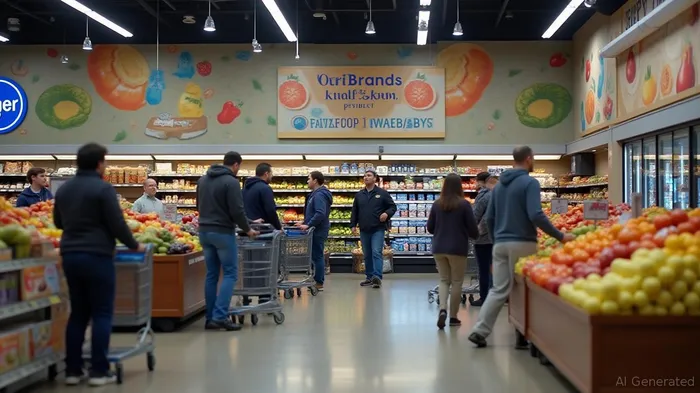
Profitability Gains Amid Strategic Shifts
Kroger's operating profit held steady at $1.32 billion, while adjusted FIFO operating profit rose to $1.52 billion, a 1.3% increase from the prior year. Gross margins expanded to 23.0% of sales, up from 22.0%, driven by lower shrink, reduced supply chain costs, and the sale of its Specialty Pharmacy business. Despite margin pressure from higher pharmacy sales (which typically carry thinner margins), Kroger's focus on high-margin categories like fresh groceries and private labels—its “Our Brands” portfolio—continues to pay dividends.
The company's decision to close 60 stores over the next 18 months, while incurring a $100 million impairment charge, signals a pragmatic reallocation of capital toward higher-potential markets. Management estimates these closures will yield $100 million in annual savings, which will be reinvested into customer experience initiatives, such as store renovations and digital tools. This move aligns with Kroger's broader strategy to optimize its footprint and prioritize profitable locations.
Strategic Leverage: E-Commerce and Private Labels
Kroger's e-commerce segment grew sales by 15% year-over-year, a critical win in a sector where digital adoption remains a key differentiator. The company's investments in grocery delivery, click-and-collect, and its loyalty app—now used by 20 million households—are bearing fruit, with digital sales accounting for over 10% of total revenue. This progress positions Kroger to compete more effectively with Amazon and Walmart, which dominate online grocery spaces.
Equally important is the expansion of its private label portfolio. “Our Brands” now represents 27% of Kroger's sales, up from 24% in 2022, with margins significantly outperforming national brands. This not only boosts profitability but also reduces reliance on suppliers facing inflationary pressures.
The company's stock has underperformed peers in 2025, but this creates a potential buying opportunity. While Kroger's valuation at 15x forward earnings appears reasonable relative to its historical averages, the current dip may reflect broader sector pessimism rather than Kroger's fundamentals.
Risks and Resilience
Despite these positives, Kroger faces persistent risks. Labor disputes at Amazon and other retailers could disrupt supply chains, while inflation—though moderated—remains a wildcard for consumer spending. The grocery sector's price-sensitive customer base could also pressure margins if discounters like Aldi and Lidl continue to gain share.
However, Kroger's financial discipline mitigates these risks. Its net debt-to-EBITDA ratio of 1.69 is well below its 2.3–2.5 target, providing ample flexibility for capital returns. The ongoing $5 billion accelerated share repurchase (ASR) program, set to conclude by Q3 2025, reinforces management's confidence in Kroger's long-term prospects.
Bullish Outlook: A Steady Hand in a Turbulent Sector
Kroger's Q1 results and updated guidance—raising identical sales expectations to 2.25%–3.25% for the year—highlight a company executing against its strategic pillars. With a focus on margin expansion, e-commerce leadership, and private labels, Kroger is well-positioned to outpace peers in a consolidating industry.
Investors seeking stable, dividend-paying exposure to the grocery sector should take note. Kroger's 1.8% dividend yield, paired with its growth catalysts, offers a compelling risk-reward profile. The stock's current valuation and undemanding P/E multiple suggest it's pricing in too much pessimism.
Investment Recommendation: Buy Kroger (KR) for investors with a 3–5 year horizon. The company's operational discipline, digital transformation, and fortress balance sheet make it a rare blend of stability and growth in a challenging sector.
In a grocery landscape defined by price wars and digital disruption, Kroger's resilience and strategic clarity make it a standout play. For investors willing to look past near-term sector volatility, Kroger offers a durable way to profit from the grocery sector's evolution.

Stay ahead of the market.
Get curated U.S. market news, insights and key dates delivered to your inbox.
AInvest
PRO
AInvest
PRO



Comments
No comments yet