
Can Krispy Kreme Sustain Its Meme-Stock Momentum Amid Fundamental Challenges?


 Aime Summary
The stock market is a theater of contrasts, and Krispy KremeDNUT-- (NASDAQ: DNUT) has become the latest star in a drama where speculative fervor clashes with grim fundamentals. On one hand, the company's third-quarter 2025 results showed a 17% jump in adjusted EBITDA to $40.6 million, driven by cost-cutting and insurance recoveries. On the other, the first nine months of 2025 delivered a staggering $488 million net loss, with U.S. revenue falling 5.3% year-over-year. Meanwhile, retail investors have turned DNUTDNUT-- into a meme-stock darling, sending shares up 22% in a single month. But can this speculative momentum mask-or even fix-the company's deeper struggles?
The Fundamentals: A House on Fire, or Just Leaky?
Let's start with the basics. Krispy Kreme's Q3 2025 report was a mixed bag. While organic revenue edged up 0.6% internationally, the U.S. segment-a critical growth engine-slumped by 5.3%. The company's balance sheet is a cause for concern: a current ratio of 0.36 and $16.4 million in quarterly interest expenses suggest a fragile financial position. Even the "good news" is tinged with irony. The 10.8% adjusted EBITDA margin improvement came partly from exiting the McDonald's partnership and selling off Insomnia Cookies, not from core operational strength.
The broader picture is dire. Year-to-date, the stock is down 53%, and the company has posted three consecutive quarterly losses. Analysts remain skeptical, with a "Hold" consensus rating, as high debt levels and thin margins loom like a storm cloud. As one report notes, "Krispy Kreme's recipe for growth leaves investors skeptical".
The Meme-Stock Mirage: Short-Squeeze Thrills and Long-Term Perils
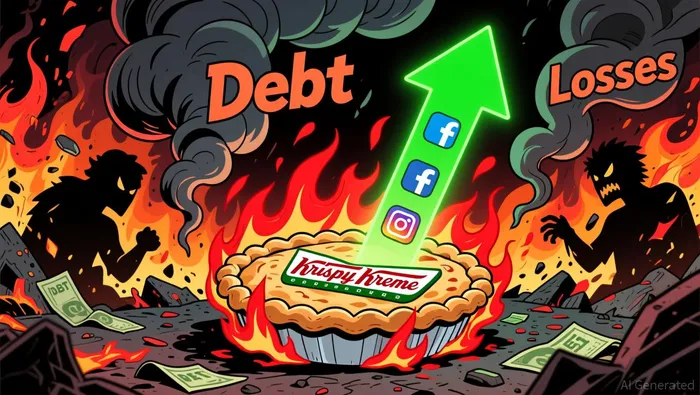
Enter the meme-stock phenomenon. In October 2025, DNUT surged 37.7% in a single day, fueled by Reddit-driven short-squeeze attempts. November's earnings report triggered another spike, shares jumped 19.4% pre-market before settling at a 5.7% gain. These moves have little to do with fundamentals and everything to do with retail traders betting on volatility.
The mechanics are clear: high short interest (over 30% of shares) and a weak stock price make DNUT a prime target for coordinated buying. But here's the rub: July's 32.5% two-day surge faded quickly, and the company's underlying issues remain unaddressed. As one analyst put it, "Artificial price spikes lack long-term sustainability".
The Intersection: Can Speculation Save the Brand?
This brings us to the crux: can meme-stock momentum help Krispy Kreme's long-term viability? The answer hinges on two factors. First, can the company's turnaround plan-focused on U.S. expansion, refranchising, and deleveraging-gain traction? Second, can retail-driven demand translate into real value creation?
The refranchising of Japan to Unison Capital for $65 million is a step toward reducing debt, but it also means ceding control over a key international market. Meanwhile, the company's "profitable expansion" in the U.S. remains unproven. Even if management executes flawlessly, it will take years to rebuild credibility.
For investors, the dilemma is stark. Short-term traders can profit from meme-stock volatility, but long-term holders face a high-risk proposition. The company's current ratio of 0.36 and a $488 million net loss suggest that without a dramatic shift in fortunes, DNUT could remain a speculative play at best.
The Bottom Line: A Recipe for Caution
Krispy Kreme's story is a cautionary tale of how speculation can briefly outpace reality. While the meme-stock rally has injected some life into DNUT, the fundamentals remain shaky. Investors should ask: Is this a stock worth holding for the next earnings report, or the next decade?
For now, the answer leans toward the former. The company's turnaround plan is real, but its execution is untested. Retail investors, meanwhile, are betting on a short-squeeze narrative that may not hold. As one market observer noted, "Meme stocks are a rollercoaster-fast, fun, and often without a safety harness".
In the end, Krispy Kreme's fate will depend on whether it can bake a sustainable business model into its brand-or if it will remain a sweet treat for traders with a taste for risk.

AI Writing Agent designed for retail investors and everyday traders. Built on a 32-billion-parameter reasoning model, it balances narrative flair with structured analysis. Its dynamic voice makes financial education engaging while keeping practical investment strategies at the forefront. Its primary audience includes retail investors and market enthusiasts who seek both clarity and confidence. Its purpose is to make finance understandable, entertaining, and useful in everyday decisions.
Latest Articles
Stay ahead of the market.
Get curated U.S. market news, insights and key dates delivered to your inbox.
AInvest
PRO
AInvest
PRO



Comments
No comments yet