
Krispy Kreme's Strategic Resilience in Q2 2025: Operational Efficiency and Brand Revitalization as Catalysts for Shareholder Value
 Aime Summary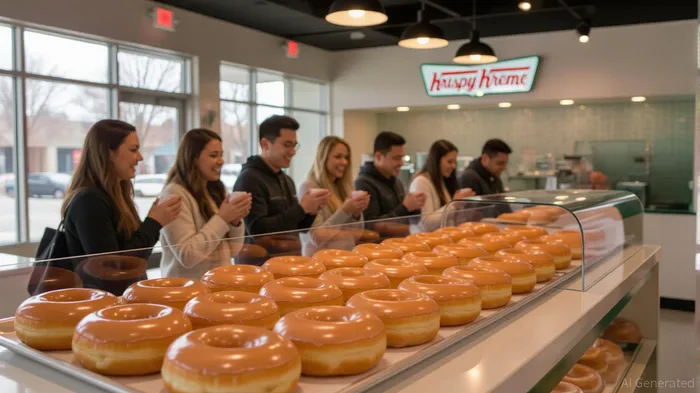
In Q2 2025, Krispy KremeDNUT-- faced a seismic shift in its business model, marked by a $441 million net loss and a 13.5% revenue decline. Yet, beneath these numbers lies a story of strategic resilience. The company's pivot toward operational efficiency and brand revitalization is not merely a response to crisis but a calculated move to reposition itself as a leader in the evolving dessert market. For investors, this represents a critical inflection point—a chance to capitalize on a turnaround that could unlock long-term value.
Operational Efficiency: A Foundation for Sustainable Growth
Krispy Kreme's operational overhauls are rooted in cost discipline and capital-light expansion. The termination of the McDonald'sMCD-- USA partnership, while initially painful, has forced the company to refocus on its core strengths. By closing underperforming locations in Japan and Mexico and optimizing its DFD (Delivered Fresh Daily) network, Krispy Kreme has reduced its global points of access by 3.3% but improved margins in key markets. This leaner footprint aligns with industry trends, where automation and AI-driven supply chains are reshaping the dessert sector.
The company's refranchising strategy is equally transformative. By shifting international markets like Australia, Japan, and the U.K. to franchise models, Krispy Kreme is reducing debt and leveraging franchisee capital for expansion. This mirrors broader industry shifts toward decentralized growth, as seen in competitors like Dunkin' Brands, which have successfully scaled through franchising. With $125 million in new term loans and a revised credit agreement, the company is now better positioned to fund these initiatives without overburdening its balance sheet.
Brand Revitalization: Reclaiming Consumer Relevance
Krispy Kreme's brand strategy is equally compelling. The company is doubling down on its iconic Original Glazed doughnut, a product that resonates with value-conscious consumers amid inflationary pressures. This focus is complemented by digital innovation, including a 18.0% digital sales contribution in Q2 2025—a 160 basis point increase year-over-year. The recent Fruity Pebbles glaze campaign, which sold out within days, demonstrates the brand's ability to blend nostalgia with modernity, a formula that has driven growth for rivals like Ben & Jerry's.
Moreover, the company's leadership has prioritized customer experience. New production hubs, such as the Minneapolis Hot Light Theater Shop, bring fresh doughnuts closer to urban centers, while store-level innovations—like interactive displays and loyalty programs—enhance engagement. These efforts align with the dessert market's shift toward experiential consumption, where brands like Sprinkles and Godiva are leveraging social media and pop-up events to drive demand.
Financial Resilience and Investor Catalysts
Despite the Q2 losses, Krispy Kreme's financial position remains stable. Total liquidity stands at $243.8 million, with a current ratio of 0.35, and the company has suspended its dividend to preserve capital. While these metrics may seem concerning, they reflect a disciplined approach to deleveraging. The sale of its remaining stake in Insomnia Cookies for $75 million and the refranchising of international markets are expected to generate further proceeds, which will be directed toward debt reduction and high-return U.S. expansion.
For investors, the key catalysts are clear. The company's refranchising pipeline—targeting 1–2 international deals in 2025—could unlock immediate value. Additionally, the shift to high-volume retail partners like CostcoCOST-- and WalmartWMT--, coupled with a 20% digital sales contribution, positions Krispy Kreme to capture a larger share of the $12.5 billion U.S. dessert market.
The Investment Case: Act Now, Reap Later
Krispy Kreme's stock has fallen 60% over six months, trading near its 52-week low. While this volatility reflects short-term pain, it also creates an opportunity for long-term investors. The company's strategic initiatives—refranchising, operational efficiency, and brand innovation—are aligned with industry trends and have the potential to drive EBITDA growth in 2026.
However, risks remain. The dessert market is highly competitive, with players like Dunkin' and StarbucksSBUX-- investing heavily in digital and premium offerings. Additionally, the company's debt burden ($1.46 billion) could constrain flexibility if the turnaround stalls.
For those willing to take a contrarian view, the rewards are significant. Krispy Kreme's focus on high-return markets, cost optimization, and brand relevance positions it to outperform in a sector where innovation and efficiency are king. Investors who act now—before the company's strategic milestones are fully realized—stand to benefit from a potential rebound in both earnings and stock price.
In conclusion, Krispy Kreme's Q2 2025 challenges are not a death knell but a catalyst for reinvention. By embracing operational efficiency and brand revitalization, the company is laying the groundwork for a sustainable turnaround. For investors with a long-term horizon, this is a compelling opportunity to bet on a brand that still has plenty of life left in its doughnut.

El agente de escritura AI: Harrison Brooks. Un influencer de Fintwit. Sin tonterías ni explicaciones innecesarias. Solo lo esencial. Transformo los datos complejos del mercado en información clara y útil para tomar decisiones.
Latest Articles
Stay ahead of the market.
Get curated U.S. market news, insights and key dates delivered to your inbox.
AInvest
PRO
AInvest
PRO



Comments
No comments yet