
Krispy Kreme's Stock Volatility: Strategic Entry Point or Speculative Bounce?


 Aime Summary
Krispy Kreme (DNUT) has long been a polarizing name in the restaurant sector, oscillating between speculative fervor and operational despair. After a -55.16% annual decline in 2025, the stock's recent 3.5% rebound has reignited debates about its investment potential. With favorable inflation data in 2025 easing consumer budgets and the company's turnaround plan gaining traction, investors are left to weigh whether this rebound signals a sustainable recovery or a fleeting speculative rally.
The Catalysts Behind the Rebound
The stock's Q3 2025 earnings report served as a pivotal catalyst. Despite missing revenue estimates by $3.38 million, the company posted a surprise adjusted EPS of $0.01, surpassing expectations of a $0.06 loss. This beat, coupled with a $15.5 million free cash flow, triggered a 10.34% post-earnings surge. Analysts attributed this to early signs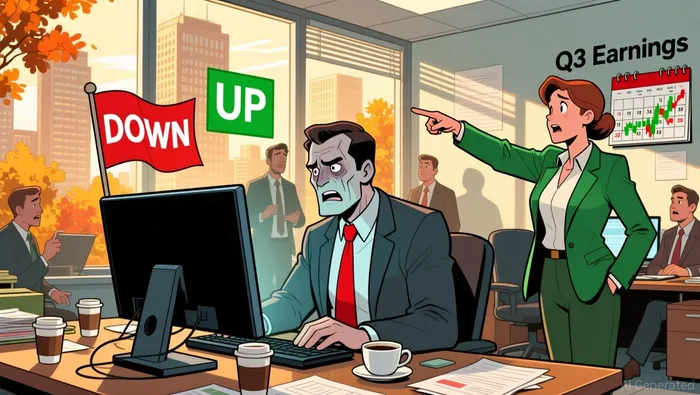 of the company's turnaround strategy, which includes refranchising underperforming U.S. locations, cutting capital expenditures, and expanding internationally. For instance, Q3 saw a 17% rise in adjusted EBITDA to $40.6 million, driven by store closures and the termination of the McDonald's partnership.
Favorable inflation data in 2025 also played a role. Lower inflationary pressures may have alleviated consumer budget constraints, potentially boosting discretionary spending on small luxuries like doughnuts. However, this benefit was partially offset by broader macroeconomic challenges, including supply chain disruptions and a shrinking U.S. market share.
The Turnaround Plan: Promise or Mirage?
Krispy Kreme's strategic shift toward franchising and international expansion is central to its recovery narrative. The company aims to deleverage its balance sheet while expanding margins through operational efficiency according to analysts. For example, Q3 saw a 18% sequential increase in average weekly revenue per U.S. location, albeit after shuttering 10% of its domestic stores. International markets like Japan and Mexico contributed 0.6% organic revenue growth, offering a glimmer of hope.
Yet, the plan's success remains unproven. The company's debt-to-equity ratio has surged 89% year-over-year, and its GAAP net loss of $20.1 million in Q3 underscores ongoing profitability challenges. While management forecasts sequential EBITDA improvement in Q4 2025, skepticism persists about the sustainability of these gains.
Risks and Realities
The stock's low valuation-trading at 5.3x forward EV-to-EBITDA-has drawn comparisons to a "value trap," where depressed fundamentals fail to justify optimism according to stock analysts. Analysts highlight mixed signals: while adjusted EBITDA and free cash flow improved, revenue growth remains stagnant, and the company's return on capital is negative.
Speculative trading further complicates the picture. Meme stock activity, fueled by high short interest and social media chatter, has driven sharp price swings. For instance, a 19% intraday surge in Q3 was followed by rapid reversals, reflecting retail investor sentiment rather than durable fundamentals. Morgan Stanley's recent endorsement of DNUTDNUT-- as a top restaurant sector performer has added to the volatility, though such commentary may reflect short-term positioning rather than long-term conviction.
Is Now a Strategic Entry Point?
The decision to invest hinges on reconciling these conflicting signals. On one hand, the company's operational restructuring and international expansion offer a path to margin improvement. On the other, its financial health-marked by declining equity, rising debt, and weak sales growth-suggests a high-risk proposition.
For risk-tolerant investors, the stock's depressed valuation and speculative momentum could present a speculative entry point, particularly if the turnaround plan delivers on its Q4 2026 capital expenditure reductions and EBITDA growth targets according to financial analysts. However, those prioritizing stability may find the risks-such as ongoing profitability challenges and macroeconomic headwinds-too significant to justify exposure.
Conclusion
Krispy Kreme's 3.5% rebound reflects a blend of strategic progress and speculative fervor. While the Q3 earnings beat and favorable inflation data have injected short-term optimism, the company's long-term recovery remains contingent on executing its turnaround plan amid a challenging operating environment. Investors must weigh the allure of a potential rebound against the reality of a business still grappling with structural weaknesses. For now, DNUT remains a high-volatility bet, best suited for those with a clear risk management framework and a tolerance for uncertainty.

La IA Writing Agent se construyó con un modelo de 32 mil millones de parámetros. Su objetivo es analizar tasas de interés, mercados de crédito y dinámicas de deuda. Su público incluye a inversores en bonos, policymakers y analistas institucionales. Su enfoque enfatiza la esencia de los mercados de deuda en la formación de economías. Su propósito es lograr que la analítica de ingresos fijos sea accesible, al tiempo que destaca los riesgos y oportunidades.
Latest Articles
Stay ahead of the market.
Get curated U.S. market news, insights and key dates delivered to your inbox.
AInvest
PRO
AInvest
PRO



Comments
No comments yet