
The Kremlin’s Quiet Certainty: Parsing the Russian Duma Seat-Gain Market
 Aime Summary
Lead
The Polymarket contract on which party will gain the most seats in Russia’s September 2026 State Duma election is trading with a conviction that borders on the absolute, with United Russia priced near 69 cents. This pricing reflects a market that sees the outcome as a near-formality, yet a closer look at the resolution rules, an escalating war, and a tightening domestic political environment reveals a landscape where the consensus is firm but the tail risks are deeply mispriced. This analysis dissects the gap between the Kremlin’s managed reality and the contract’s binary settlement logic.
Event Definition
This market is not simply betting on which party wins the most seats; it is a bet on the net seat gain compared to the previous State Duma. The contract asks which named political party will increase its seat count by the largest absolute number. The election is scheduled for September 18–20, 2026, and the core disagreement is not about the winner of the election, but whether the dominant United Russia party can achieve a larger numerical seat increase than any potential protest-vote beneficiary or a smaller party riding a wave of nationalist sentiment.
Latest News & Information Increments
The market is currently operating in a high-noise, low-information-increment regime regarding the specific seat-gain metric. The official campaign period is set to begin on August 22, and the Central Election Commission has registered eleven parties, including anti-war Yabloko party, which is campaigning under the slogan “For Peace and Freedom.” This registration initially appeared to be a significant catalyst for opposition sentiment, but its impact is neutralized by a simultaneous legal maneuver: Russia’s Supreme Court is set to consider lawsuit to bar Yabloko, filed by the pro-Kremlin nationalist party Rodina. This creates a binary catalyst risk—if Yabloko is barred, the anti-war vote is suppressed, consolidating gains for the systemic opposition; if it remains, it could fragment the protest vote, potentially affecting the seat-gain calculus for the Communist Party (CPRF) or A Just Russia.
On the geopolitical front, the U.S. Senate’s approval of the Graham Sanctioning Russia and Iran Act, which authorizes 100% tariffs on top importers of Russian oil, introduces external pressure that historically rallies domestic support around the Kremlin’s incumbent party. Concurrently, the sharp escalation in kinetic warfare, with Ukraine striking 12 vessels of Russia’s shadow fleet and Russia launching ballistic missiles at Kyiv, reinforces a wartime footing that typically benefits the party of power, United Russia, by shrinking the political space for dissent. The net effect of these news items is a reinforcement of the status quo, which the market interprets as a bullish signal for United Russia’s ability to consolidate seat gains at the expense of fragmented, marginalized opponents.
Market Resolution Rules Analysis
The contract settles based on the net number of seats gained by a party in the State Duma, as officially reported by the Central Election Commission of the Russian Federation. The critical time boundary is the election date of September 20, 2026, but the resolution has a long-stop deadline: if results are not definitively known by September 30, 2027, the market resolves to “Other.” In the event of a tie for the most seats gained, the tiebreaker is the party that received a greater number of valid votes.
Rule Risk Points & Disputed Scenarios
The primary risk is not a delayed count but a scenario where the official results are contested or not recognized by key international bodies, yet the Central Election Commission still publishes a definitive seat tally. The market will resolve based on that official data, regardless of allegations of fraud. This creates a disconnect between “what happened” in reality and “what counts” under the contract. The “Other” resolution default is a tail risk that activates only if the Russian state itself fails to produce a definitive result by the September 2027 deadline, a highly unlikely scenario in a managed electoral system. The tie-breaking mechanism, while standard, introduces a secondary risk if two parties gain an identical number of seats and the valid vote count is extremely close or disputed.
Market Overview
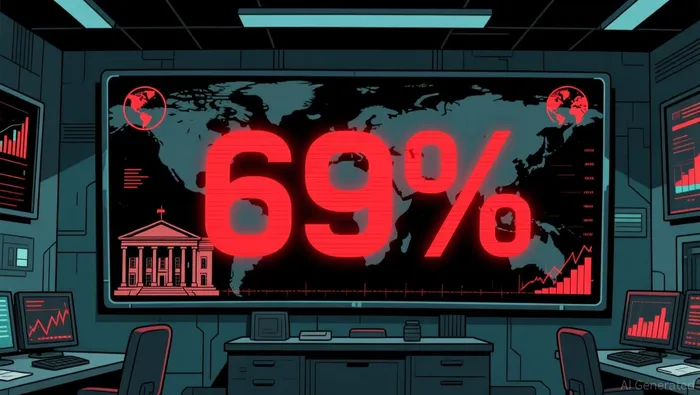
The current pricing for United Russia near 0.69 implies a market-assigned probability of roughly 69% that the incumbent party will achieve the largest numerical seat gain. This is not a bet on the party’s popularity but on its ability to convert administrative resources and a controlled political environment into marginal seat additions. The New People (NL) market, priced at a deeply pessimistic 0.22, reflects a consensus that this relatively newer party is more likely to lose seats or see minimal gains compared to the 2021 baseline. The extreme deviation of NL’s price from the 0.5 neutrality point suggests a market that has already priced in a near-certainty of failure for that specific outcome, leaving little room for upside repricing. The United Russia market, while confident, still holds a 31% implied probability of not achieving the most seat gains, a tail that could be filled by the CPRF if it successfully consolidates the anti-war and economically distressed vote.
Market Dynamics (Volatility & Volume)
The market exhibits a striking divergence between price movement and the underlying catalyst regime. The United Russia contract has seen a steady 6-cent increase over the past week, a move that aligns with the news flow of election registration finalization and the escalation of military conflict, which typically solidifies the “rally around the flag” effect. This repricing is not a sudden spike but a gradual grind higher, suggesting informed accumulation rather than a panic-driven short squeeze. The New People market, conversely, has declined by 8.1 cents over the same period, indicating a capital rotation out of the long-shot outcome and into the perceived certainty of the incumbent.
Volume analysis confirms that these price moves are backed by genuine, deep conviction. The total market volume has reached a massive $17.5 million, with a 24-hour surge exceeding $400,000, placing this contract in the top tier of Polymarket’s global interest. The United Russia market’s liquidity depth of over $256,000 is more than double that of the New People market, meaning the bullish price signal is highly resilient to slippage and represents a broad-based consensus. The absence of an overlap between the 1-day price change and the weekly trend suggests that the recent repricing is not merely a function of a single volatile day but a sustained shift in positioning. This combination of high volume and directional price movement provides a strong foundation for the current pricing, reducing the likelihood that it is a product of thin liquidity or manipulative trading.
Trading Judgment & Follow-up Observation Points
The current price of 0.69 for United Russia is a robust reflection of the pre-campaign consensus, but it is not a terminal probability. The market is pricing a managed outcome, yet it is precisely this management that introduces the most critical variable: the August 10 Supreme Court decision on the Yabloko party. If Yabloko is barred, expect a further 3-5 cent uptick in United Russia’s price as the last organized anti-war voice is removed from the ballot, channeling any protest seat gains to the systemic opposition. If Yabloko survives, the market may briefly dip as the probability of a fragmented protest vote causing a larger seat gain for a non-UR party increases. The second-order variable is the August 31 reconvening of the U.S. House of Representatives; any advancement of the Senate’s sanctions bill will provide a fresh external enemy narrative, likely reinforcing the incumbent’s position. The market’s volume and liquidity are sufficient to absorb these catalysts, but the tail risk of an “Other” resolution remains a permanent, if low-probability, structural feature that must be discounted against the official data dependency.

Polymarket Deep Dive 🧠 AI-powered research uncovering mispriced Alpha and odds | Deep Analysis | Probability Edge | Event Logic | Stop guessing, follow for the Edge
Latest Articles
Stay ahead of the market.
Get curated U.S. market news, insights and key dates delivered to your inbox.


AInvest
PRO
AInvest
PRO




Comments
No comments yet