
The Kremlin's Comfortable Cushion: Parsing Market Pricing in Russia's 2026 Duma Election
 Aime Summary
Lead
With 43 days until polls open, Polymarket traders are pricing a 69% probability that United Russia (ER) will again secure the largest seat gain in the State Duma. This high-confidence consensus, however, masks a critical analytical gap: the contract does not reward merely winning the most seats, but gaining the most seats relative to the pre-election baseline. This article dissects the wedge between political reality and settlement mechanics, examining how recent geopolitical escalations, sanctions legislation, and domestic registration data are shaping—or failing to shape—a market that may be trading more on regime continuity than on the specific mathematical condition required for resolution.
Event Definition
This market asks: "Which party will gain the most seats in the next Russian parliamentary election?" The contract resolves based on the party that achieves the greatest net increase in seats in the State Duma compared to the outgoing convocation. The election is scheduled for September 18–20, 2026, with the official campaigning period running from August 22 through September 18. The core disagreement is not whether United Russia will remain the largest party—a near-certainty—but whether its seat delta will exceed that of smaller parties that have far more room to grow from a lower base.
Latest News & Information Increments
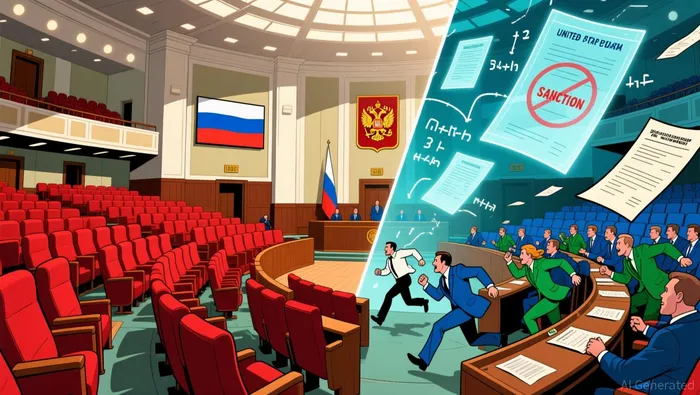
The most structurally significant news is the registration of eleven parties for the federal ballot, the highest number since 2007, with all exempt from signature collection. This expands the field of potential seat-gainers, particularly benefiting smaller parties like New People (NL), which currently holds a small fraction of seats and thus requires a proportionally smaller absolute gain to win this contract. Simultaneously, the geopolitical backdrop has intensified: US intelligence assessments warn that Vladimir Putin may authorize hybrid attacks on NATO territory to test Western resolve, while the US Senate approved the Graham Sanctioning Russia and Iran Act of 2026 by an 86-11 vote, granting the President authority to impose 100% tariffs on the top five importers of Russian oil and gas. These developments reinforce the narrative of a besieged Kremlin rallying around the incumbent, yet they do not alter the mathematical constraint of the contract: a high baseline for United Russia makes large seat gains mechanically difficult. Putin's approval rating, holding at 74% in July but down from 79% in April, suggests a slight softening of domestic support that could marginally affect turnout dynamics.
Market Resolution Rules Analysis
Resolution is determined by the Central Election Commission of the Russian Federation and is based on the number of seats gained by the named party compared to the pre-election State Duma composition. The settlement deadline is September 30, 2027, at 11:59 PM ET. If no definitive result is available by that date, the market resolves to "Other." In the event of a tie for the most seats gained, the tiebreaker is the party that received the greater number of valid votes; if a further tie persists, the party whose listed abbreviation appears first alphabetically prevails.
Rule Risk Points & Disputed Scenarios
The primary risk is the long-fuse resolution deadline: if the official results are contested, delayed, or not certified by September 30, 2027, the entire contract resolves to "Other," regardless of what may have been reported in media or preliminary tallies. A secondary risk lies in the tie-breaking mechanism. A close election where multiple small parties gain a similar number of seats could trigger the alphabetical tiebreaker, an arbitrary rule that has no relationship to political reality and could surprise traders who assume the party with higher vote totals will win. The contract's focus on seat gains rather than total seats also creates a scenario where a party that loses seats could still win if all others lose more—a possibility not currently reflected in prices.
Market Overview
The United Russia (ER) contract trades at a mid-price of 0.685, with a best ask of 0.69 and best bid of 0.68, implying a 69% probability of the incumbent party achieving the largest seat gain. The opposing outcome sits at 0.315. This 37-point spread from the 0.5 equilibrium indicates a strong directional consensus, but the tight 0.01 bid-ask spread suggests efficient price discovery rather than a one-sided liquidity hole. The New People (NL) contract, by contrast, trades at just 0.226, reflecting a 22.6% implied probability. This pricing structure implies that the market views the contest as United Russia's to lose, yet the 31% probability assigned to the field is not negligible and warrants examination of whether it fully accounts for the baseline mathematical challenge facing the incumbent.
Market Dynamics (Volatility & Volume)
United Russia's contract has appreciated 25.45% over the past month, from 0.55 to 0.69, a move that coincides with the Senate sanctions vote and heightened NATO-Russia tensions—events that typically consolidate domestic support around the ruling party. The one-week price change of +0.055 (8.66%) and the one-day dip of -0.01 suggest a pattern of accumulation punctuated by minor profit-taking, rather than a reversal of conviction. Critically, this repricing is supported by substantial volume: $831,162.21 in monthly turnover and $260,121.84 over the past week, with order-book liquidity of $255,539.88. The 24-hour volume of $306,022.78 across the market family confirms that price moves are backed by genuine capital commitment, not thin-air repricing. The New People contract, with a 24-hour volume of $7,798.06 and a tight 0.005 spread, shows active but comparatively shallow interest, suggesting that the 8.39% daily price increase in that contract may be more susceptible to position-driven volatility than the deeper United Russia market.
Trading Judgment & Follow-up Observation Points
The current 69% price embeds an assumption that United Russia's incumbency advantage and the rally-around-the-flag effect will translate into the largest seat gain. However, the contract's mechanical requirement—a net gain in seats—is a high bar for a party that already holds a supermajority. The most important variables to track are: (1) the final party list and any last-minute disqualifications before the August 22 campaign start; (2) pre-election polling that specifically measures seat-change projections, not just vote share; and (3) the speed and clarity of the Central Election Commission's certification process, given the "Other" resolution risk. The market's robust volume lends credibility to the current price, but traders should recognize that a high-probability price does not eliminate rule risk—it merely prices it at a discount that may or may not be warranted.

Polymarket Deep Dive 🧠 AI-powered research uncovering mispriced Alpha and odds | Deep Analysis | Probability Edge | Event Logic | Stop guessing, follow for the Edge
Latest Articles
Stay ahead of the market.
Get curated U.S. market news, insights and key dates delivered to your inbox.


AInvest
PRO
AInvest
PRO




Comments
No comments yet