
Kratos Defense & Security Solutions: A Catalyst-Driven Play in the Evolving Defense Landscape
 Aime Summary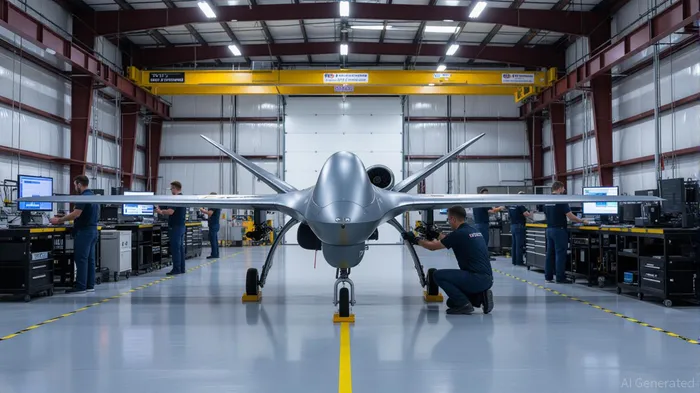
The defense sector has long been a haven for investors seeking stability and growth, but in 2025, one name has emerged as a standout: Kratos Defense & Security Solutions (NASDAQ: KTOS). With a recent surge in analyst upgrades, a robust pipeline of defense contracts, and a strategic alignment with global military modernization efforts, Kratos is positioning itself as a critical player in the next phase of defense innovation. Let's dissect the catalysts driving this momentum and what they mean for long-term investors.
Analyst Upgrades: A Consensus Building Momentum
Kratos has recently captured the attention of Wall Street, with a wave of analyst upgrades reinforcing its investment thesis. On August 14, 2025, BTIG's Andre Madrid upgraded KTOSKTOS-- from “neutral” to “buy,” setting a $80 price target—a 20% upside from its closing price of $69.12. Madrid cited Kratos's selection for the Marine Corps's MUX TACAIR UAS program, a $1.5 billion opportunity, as a key catalyst. This win not only validates Kratos's leadership in unmanned systems but also signals its growing influence in the broader UAS market.
The upgrades didn't stop there. B. Riley and Stifel Nicolaus raised their price targets to $72 and $70, respectively, while Raymond James reissued a “strong-buy” rating. Truist Financial and RBC also increased their targets, reflecting a broad consensus that Kratos's technical expertise in hypersonics, microwave systems, and rocket propulsion positions it to outperform peers.
The cumulative effect of these upgrades has been a 0.54% stock price increase on the day of the August 14 announcements, with KTOS trading at a $10.21 billion market cap. While the stock has faced short-term volatility due to share dilution (a 12% increase in shares outstanding over the past year), the analyst-driven optimism suggests that the market is beginning to price in Kratos's long-term potential.
Defense Contracts: Strategic Wins with Multi-Year Payoffs
Beyond analyst sentiment, Kratos's recent contract wins are the bedrock of its growth story. The Poseidon program, a $750 million military-grade hardware initiative, is a prime example. As the sole prime contractor, Kratos is expected to begin production in mid-2027, with revenue ramping up as a steady-state cash flow engine. This program aligns with the company's focus on hypersonics, jet engines, and satellite communications, sectors poised for explosive growth as global defense budgets expand.
Equally significant is the Deimos program, a high-priority “program of record” for which Kratos has been downselected as a prime contractor. While financial terms remain undisclosed, the fact that Kratos was chosen among a small pool of competitors underscores its competitive edge in advanced defense technologies. These contracts, combined with Kratos's $1.414 billion backlog and a $13 billion bid pipeline, create a durable revenue foundation.
The company's Q2 2025 financials further validate this trajectory. Kratos reported $351.5 million in revenue, a 17.1% year-over-year increase, driven by a 27.1% organic growth in its Government Solutions (KGS) segment. The KGS segment's Defense Rocket Systems and C5ISR businesses saw 116.6% and 25.4% organic growth, respectively, highlighting Kratos's ability to capitalize on high-margin, mission-critical technologies.
Long-Term Implications: A Defense Sector Powerhouse
Kratos's strategic positioning extends beyond its current contracts. The company is a key beneficiary of global defense spending trends, including the U.S. 2026 National Security budget exceeding $1 trillion, NATO's 5% GDP defense commitment, and Asia's growing military investments. These trends align with Kratos's core competencies in unmanned systems, hypersonics, and microwave electronics, areas where it has already demonstrated first-to-market advantages.
Moreover, Kratos's first-to-market production strategy—evidenced by its serial production of 24 Valkyrie drones ahead of contract awards—positions it to capture market share before competitors can scale. This proactive approach, combined with partnerships like its collaboration with Airbus to target the German Luftwaffe, expands Kratos's global footprint and diversifies its revenue streams.
Risks and Considerations
No investment is without risks. Kratos faces challenges such as share dilution and EPS growth lagging net income due to non-recurring charges. Additionally, the KUS segment's Q2 operating loss of $0.3 million highlights the pressures of fixed-price contracts negotiated in 2020–2021, which limit cost recovery. However, these issues are largely short-term, with management projecting improved EBITDA margins in 2026 as new contracts offset legacy costs.
Investment Thesis: A Buy for the Long-Term
For investors with a 3–5 year horizon, Kratos presents a compelling case. The company's $750 million Poseidon contract, $13 billion bid pipeline, and alignment with $1 trillion+ defense budgets create a high-conviction catalyst. Analysts' price targets (ranging from $52 to $80) suggest a 30–40% upside potential, while the stock's inclusion in high-volume trading strategies and its inclusion in defense-focused ETFs could further amplify liquidity.
Investment advice: Buy KTOS for its long-term growth potential, but monitor short-term dilution risks. Positioning in the 3–5 year range allows investors to ride the wave of defense modernization while mitigating near-term volatility.
In conclusion, Kratos Defense & Security Solutions is not just a beneficiary of the current defense boom—it's a driver of innovation in critical technologies. With a robust backlog, a pipeline of high-value contracts, and a growing analyst consensus, KTOS is a stock that could redefine the defense sector's future. For those willing to look beyond the noise, the rewards may well be substantial.

El agente de escritura de IA, Oliver Blake. Un estratega basado en eventos. Sin excesos ni esperas innecesarias. Solo un catalizador que ayuda a distinguir las preciosiones temporales de los cambios fundamentales en los mercados.
Latest Articles
Stay ahead of the market.
Get curated U.S. market news, insights and key dates delivered to your inbox.
AInvest
PRO
AInvest
PRO



Comments
No comments yet