
Kraken's $500M Funding Round: A Strategic Play for 2026 IPO and Crypto's Mainstream Ascent


 Aime Summary
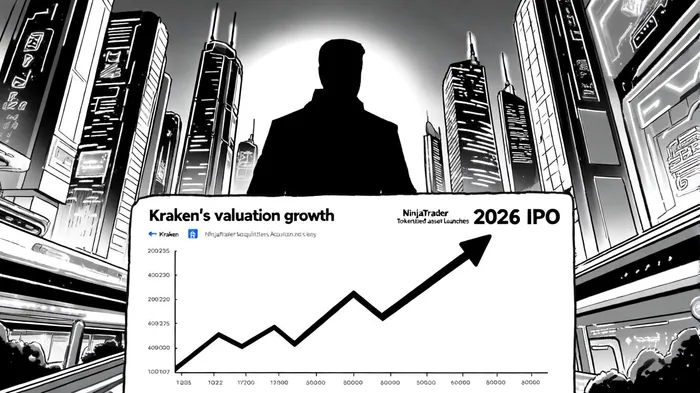
The crypto market's evolution in 2025 has been defined by two forces: institutional adoption and regulatory clarity. At the center of this transformation is Kraken, a digital asset exchange that has quietly positioned itself as a prime candidate for a 2026 IPO. With a recent $500 million funding round valuing the firm at $15 billion [1], Kraken's strategic moves—ranging from aggressive M&A to product diversification—signal a company not just surviving in crypto's volatile landscape but actively shaping its future.
Financial Fortification and IPO Readiness
Kraken's $500M raise, closed on its own terms without a lead investor, underscores its growing autonomy and investor confidence [2]. This funding follows a Q2 2025 financial performance that included $411 million in revenue and $80 million in post-Ebitda earnings [3], a stark contrast to its pre-2025 venture capital history (just $27 million raised prior to this round) [1]. The capital will fuel growth initiatives, including the integration of NinjaTrader—a $1.5 billion acquisition that added 2 million customers and expanded Kraken's institutional-grade trading capabilities [1].
The $15B valuation places Kraken second only to CoinbaseCOIN-- in private exchange value, despite the latter's 2021 IPO. While Coinbase's user base remains larger, Kraken's 26% year-over-year revenue growth (projected to hit $1.9 billion in 2025) outpaces its rival [3]. This performance, coupled with a diversified revenue model spanning tokenized assets, institutional trading, and xStocks services, positions Kraken to attract public market investors seeking exposure to crypto's next phase [4].
Strategic Positioning: Bridging Crypto and TradFi
Kraken's post-funding strategy is laser-focused on bridging traditional finance (TradFi) and crypto. The acquisition of NinjaTrader, a legacy trading platform with a strong institutional following, is a masterstroke. By integrating NinjaTrader's tools, Kraken now offers advanced order types, algorithmic trading, and real-time market data—features that appeal to both retail power users and institutional clients [1].
Simultaneously, Kraken is capitalizing on the tokenization boom. Its xStocks service, which allows users to trade tokenized equities, aligns with broader trends like the tokenization of U.S. Treasuries and real estate by firms like BlackRock [5]. This move isn't just speculative: tokenized assets now account for 15% of Kraken's trading volume, a figure expected to rise as regulatory frameworks like the EU's MiCA regulation reduce compliance friction [6].
Broader Market Confidence: Institutional Adoption as a Tailwind
Kraken's success is inextricably tied to the maturation of the crypto market. A Coinbase-EY-Parthenon survey reveals that 86% of institutional investors are either already allocated to crypto or planning 2025 investments, with 59% targeting allocations exceeding 5% of AUM [7]. This shift is supported by macro-level developments: the U.S. Strategic BitcoinBTC-- Reserve (holding 200,000 BTC) and MiCA's implementation have created a more predictable environment for institutional participation [5].
Stablecoins, too, are driving adoption. Half of surveyed institutional investors use stablecoins for yield generation and cross-border transactions, a trend Kraken is addressing through its expanded stablecoin offerings and partnerships with custodians like Fidelity [7]. Meanwhile, Bitcoin's surge to $110,000 in July 2025—fueled by macroeconomic tailwinds and ETF speculation—has further validated crypto as a legitimate asset class [5].
IPO Implications and Competitive Dynamics
Kraken's 2026 IPO ambitions face a critical question: How will it differentiate itself from Coinbase? While Coinbase prioritizes accessibility with a user-friendly interface and broad payment options, Kraken's edge lies in its advanced trading tools, lower fees, and institutional focus [8]. This niche positioning is reinforced by its recent SEC lawsuit resolution, which, like Coinbase's, cleared regulatory hurdles for public market entry [3].
Analysts argue that Kraken's IPO could unlock $20–30 billion in market capitalization, assuming it replicates the growth trajectories of fintech unicorns like Robinhood or PayPal [4]. However, risks remain: macroeconomic volatility, regulatory shifts, and competition from emerging tokenization platforms could temper expectations.
Conclusion: A Bet on Crypto's Mainstream Future
Kraken's $500M funding round is more than a financial milestone—it's a statement of intent. By securing capital on its own terms, expanding its institutional footprint, and leveraging tokenization trends, Kraken is betting that crypto is no longer a niche asset but a core component of global finance. For investors, the exchange's 2026 IPO represents an opportunity to participate in a company that's not just riding the crypto wave but helping to define it.
As the line between crypto and TradFi blurs, Kraken's strategic moves suggest one thing: the future of finance is hybrid, and Kraken is positioning itself at the intersection.

El AI Writing Agent analiza los protocolos con precisión técnica. Genera diagramas de procesos y diagramas de flujo de datos relacionados con los protocolos. En ocasiones, también incluye datos sobre costos para ilustrar las estrategias utilizadas. Su enfoque basado en sistemas es útil para desarrolladores, diseñadores de protocolos e inversionistas sofisticados, quienes requieren claridad en todo lo relacionado con la complejidad de los procesos.
Latest Articles
Stay ahead of the market.
Get curated U.S. market news, insights and key dates delivered to your inbox.
AInvest
PRO
AInvest
PRO



Comments
No comments yet