
Kraft Heinz's Strategic Split and Its Implications for the Food Industry Consolidation Wave


 Aime Summary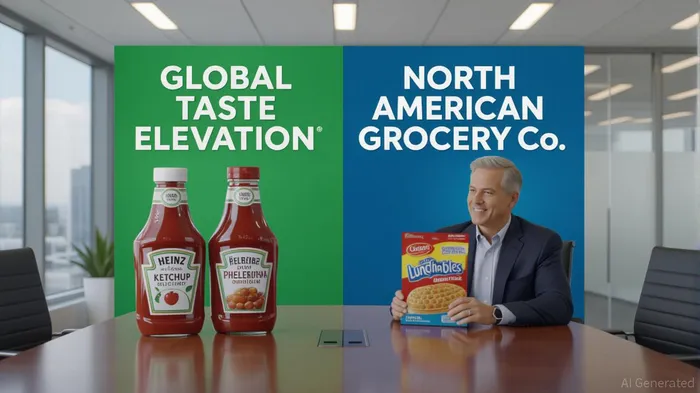
The food industry is undergoing a seismic shift as legacy conglomerates like Kraft HeinzKHC--, Kellogg, and PepsiCoPEP-- pivot to address stagnant growth, evolving consumer preferences, and regulatory pressures. Kraft Heinz's proposed split into two publicly traded companies—Global Taste Elevation Co. and North American Grocery Co.—is not just a corporate restructuring but a strategic response to a sector-wide trend of portfolio optimization. This move reflects a broader "shrink to grow" philosophy, where companies are shedding complexity to unlock value, boost operational clarity, and better align with market demands. For investors, the split offers a case study in how traditional CPG giants are adapting to a fragmented, innovation-driven landscape.
The Rationale Behind the Split: A Sector-Wide Trend
Kraft Heinz's decision to separate its grocery and condiments businesses mirrors the 2023 Kellogg split into KellanovaK-- (snacks and international cereal) and WK KelloggKLG-- Co (North American cereals). Both strategies aim to streamline operations and focus on core strengths. However, the outcomes have varied: WK Kellogg has outperformed with disciplined cost management, while Kellanova's global snack ambitions remain unproven. Kraft Heinz's split, by contrast, is designed to leverage distinct growth trajectories.
Global Taste Elevation Co. will focus on high-margin categories like sauces, spreads, and shelf-stable meals, with 75% of its 2024 sales in these areas. Its international exposure (20% of sales) and premiumization potential position it to capitalize on global demand for convenience and flavor. North American Grocery Co., meanwhile, will anchor its strategy on staples like Oscar Mayer and Lunchables, where 75% of its brands hold top-tier market positions. This division's emphasis on operational efficiency and free cash flow generation aligns with investor demands for predictable returns in a low-growth environment.
The split also addresses Kraft Heinz's decade-long struggles with margin erosion and underperformance. By reducing operational complexity, the company aims to unlock $300 million in dis-synergies, a figure it expects to mitigate through cost discipline. This mirrors PepsiCo's "buy to grow" strategy, which has driven stock outperformance through acquisitions of health-focused brands like Poppi and Siete Foods. However, unlike PepsiCo's debt-fueled approach, Kraft Heinz's split prioritizes organic growth and capital flexibility, preserving investment-grade ratings.
Broader Industry Trends: Consolidation as a Survival Strategy
Kraft Heinz's move is part of a larger wave of consolidation in the food sector, driven by three key factors:
1. Consumer Shifts: Demand for premium, health-conscious, and convenience-driven products is fragmenting the market. Companies must specialize to stay relevant.
2. Capital Reallocation: Lower interest rates have spurred private equity activity, with deals like Performance Food Group's $2.1 billion acquisition of Cheney Bros. highlighting the value of capturing more of the food production chain.
3. Regulatory and Trade Pressures: Proposed tariffs on imports from Mexico, Canada, and China threaten input costs, but companies with diversified supply chains (like Kraft Heinz's 20% international sales) may fare better.
The sector's focus on operational clarity is also evident in General Mills' divestitures of its North American Yogurt business and Cal-Maine Foods' $111.8 million acquisition of egg production assets. These moves underscore a shift toward hyper-focused portfolios, where companies double down on their competitive advantages rather than spreading resources thin.
Investment Implications: Risks and Opportunities
For investors, the Kraft HeinzKHC-- split presents both opportunities and risks. The new entities' ability to execute on their strategic priorities—such as Global Taste Elevation Co.'s innovation in premium sauces or North American Grocery Co.'s margin expansion—will determine their success. However, the split's timing (expected to close in late 2026) means investors must weigh near-term execution risks against long-term potential.
A critical factor is the performance of similar splits. could provide insights into how the market values such restructurings. Additionally, Kraft Heinz's leadership transition—Carlos Abrams-Rivera moving to lead North American Grocery Co.—signals confidence in its operational capabilities.
Risks include the potential for trade war disruptions and the challenge of maintaining brand equity post-split. However, the companies' combined $25.8 billion in 2024 sales and $6.3 billion in Adjusted EBITDA suggest a strong foundation. Investors should also monitor the sector's debt levels, as seen in PepsiCo's aggressive M&A strategy, which could signal a broader trend of leveraging balance sheets for growth.
Conclusion: A Strategic Bet on Focus and Agility
Kraft Heinz's split is a bold bet on the power of specialization in a rapidly evolving industry. By aligning its structure with market dynamics, the company aims to replicate the success of peers like WK Kellogg while avoiding the pitfalls of overreach. For investors, the key takeaway is clear: in a sector where operational clarity and category-specific innovation are paramount, companies that shrink to grow—rather than grow at all costs—will likely outperform. As the food industry continues its consolidation wave, Kraft Heinz's split serves as a blueprint for how legacy brands can reinvent themselves to meet the demands of a new era.

Delivering real-time insights and analysis on emerging financial trends and market movements.
Latest Articles
Stay ahead of the market.
Get curated U.S. market news, insights and key dates delivered to your inbox.




Comments
No comments yet