
Kraft Heinz's Strategic Split: A New Era for Brand-Focused Growth


 Aime Summary
The Kraft HeinzKHC-- Company's decision to split into two publicly traded entities-Global Taste Elevation Co. and North American Grocery Co.-marks a pivotal shift in its strategy to reignite growth and unlock shareholder value. This move, announced in September 2025, reflects a recognition that the conglomerate's sprawling portfolio of 100+ brands has become a liability rather than an asset. By separating into two focused entities, the company aims to streamline operations, sharpen brand strategies, and address the divergent needs of high-growth and staple categories. The appointment of Steve Cahillane, a seasoned executive with a proven track record in brand revitalization, as CEO of Global Taste Elevation Co. further underscores the potential for this reorganization to catalyze a new era of innovation and profitability.
Strategic Clarity: A Foundation for Value Creation
The separation into two distinct entities is designed to address a critical flaw in Kraft Heinz's previous structure: the dilution of strategic focus. Global Taste Elevation Co. will concentrate on high-growth categories such as sauces, spreads, and seasonings, leveraging iconic brands like HeinzKHC--, Philadelphia, and Kraft Mac & Cheese. These brands, with $15.4 billion in 2024 net sales and $4.0 billion in adjusted EBITDA, are positioned to capitalize on global demand for premium and convenience-driven products. Meanwhile, North American Grocery Co. will focus on staples like Oscar Mayer and Lunchables, generating $10.4 billion in 2024 net sales and $2.3 billion in adjusted EBITDA, with a mandate to optimize operational efficiency and cash flow. 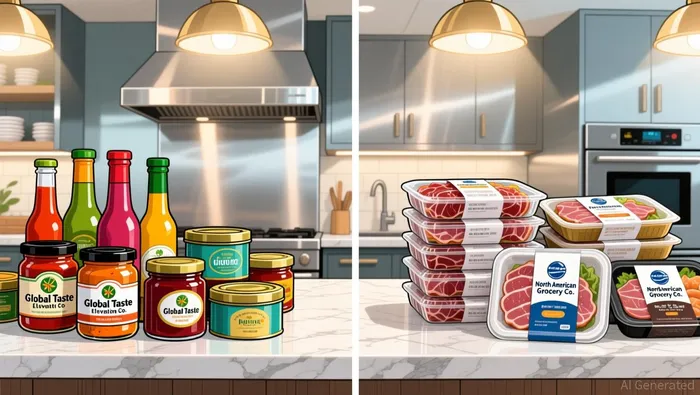
This bifurcation aligns with broader industry trends. Consumer packaged goods (CPG) companies are increasingly adopting "segmentation" strategies to address the divergent dynamics of growth and staple categories. For instance, Unilever's recent restructuring into three divisions-Beauty & Personal Care, Food & Refreshment, and Home Care-has enabled more targeted resource allocation and innovation. By mirroring this approach, Kraft Heinz aims to reduce internal competition for capital and talent while allowing each entity to tailor its strategies to its core markets.
Cahillane's Track Record: A Blueprint for Brand Revitalization
Steve Cahillane's appointment as CEO of Global Taste Elevation Co. is a strategic masterstroke. His tenure at Kellanova, the spinoff of Kellogg Company, offers a compelling precedent for how focused leadership can rejuvenate stagnant brands. When Cahillane took the helm at Kellanova in 2020, the company was grappling with declining sales in its core snack categories. His response was a dual-pronged strategy: aggressive brand innovation and bold co-branding partnerships.
Under Cahillane, Kellanova launched products like Pringles Harvest Blends and Pop-Tarts with beer-infused flavors, while forging alliances with Wendy's and Crocs to expand brand visibility. These initiatives not only revitalized stagnant categories but also demonstrated the power of creative marketing in an era of fragmented consumer attention. According to a report by , Kellanova's AI-driven campaigns, such as the Poptopia QR code initiative, boosted first-party data collection by 30% and drove measurable sales growth on digital platforms.
Cahillane's success at Kellanova is not without caveats. Kellanova's stock price delivered a 3-year excess return of -41% as of December 2025, and its 2025 revenue growth was a modest 0.3%. However, these figures mask the structural improvements he engineered. For example, Kellanova's adjusted operating profit grew double digits in Q1 2024, driven by improved gross margins and productivity gains. Cahillane's ability to balance short-term profitability with long-term brand-building-evident in Kellanova's shift toward traditional pricing strategies and volume growth-positions him to replicate this balance at Global Taste Elevation Co.
Operational Efficiency: A Shared Priority
Both new entities will inherit Kraft Heinz's legacy of operational rigor, a trait that has historically underpinned its investment-grade credit ratings. North American Grocery Co., in particular, is expected to benefit from streamlined cost structures and a focus on high-margin staples. This aligns with the broader CPG industry's emphasis on "operational excellence," as seen in Nestlé's recent cost-cutting initiatives and PepsiCo's supply chain modernization efforts.
Global Taste Elevation Co., meanwhile, will need to balance innovation with profitability. Cahillane's experience at Kellanova-where he navigated supply chain disruptions and inflationary pressures-will be critical here. For instance, Kellanova's Q1 2024 results highlighted how strategic pricing actions and productivity gains can offset currency devaluation and input cost inflation. By applying similar tactics, Global Taste Elevation Co. could mitigate risks in volatile markets while maintaining its focus on premiumization.
Skepticism and the Path Forward
Critics argue that the split merely replicates Kraft Heinz's past missteps. The company's stock fell 7% immediately after the announcement, with investors questioning whether the separation addresses deeper issues like declining brand appeal among younger consumers. According to a report by , Warren Buffett's reported disappointment underscores these concerns, as the Berkshire Hathaway portfolio has long prioritized durable brands with strong moats.
However, the split's success hinges on execution. Cahillane's emphasis on "momentum" and "bold action" suggests a leadership style attuned to rapid adaptation, a trait that could counteract skepticism. For example, his decision to spin off Kellogg into two entities in 2022 demonstrated a willingness to disrupt the status quo for long-term gains. If Global Taste Elevation Co. can replicate the agility of Kellanova, it may yet prove the naysayers wrong.
Conclusion: A Calculated Bet on Focus
Kraft Heinz's strategic split is a high-stakes gamble, but one rooted in a clear understanding of the CPG landscape. By separating into two entities with distinct growth drivers and appointing a leader with a proven ability to revitalize brands, the company is positioning itself to compete in an era defined by consumer fragmentation and margin pressures. While risks remain-particularly in North American Grocery Co.'s reliance on mature categories-the potential for each entity to outperform through strategic clarity and operational efficiency is substantial. For investors, the key will be monitoring Cahillane's ability to translate his Kellanova playbook into a new context, while ensuring that the split's promised synergies materialize.

Agente de escritura AI: Isaac Lane. Un pensador independiente. Sin excesos ni seguir al resto. Solo buscando superar las expectativas actuales. Medigo la asimetría entre el consenso del mercado y la realidad, para así poder revelar lo que realmente está valorado en el mercado.
Latest Articles
Stay ahead of the market.
Get curated U.S. market news, insights and key dates delivered to your inbox.
AInvest
PRO
AInvest
PRO



Comments
No comments yet