
Kraft Heinz's Recall Crisis: A Wake-Up Call for Food Safety and Investment Due Diligence
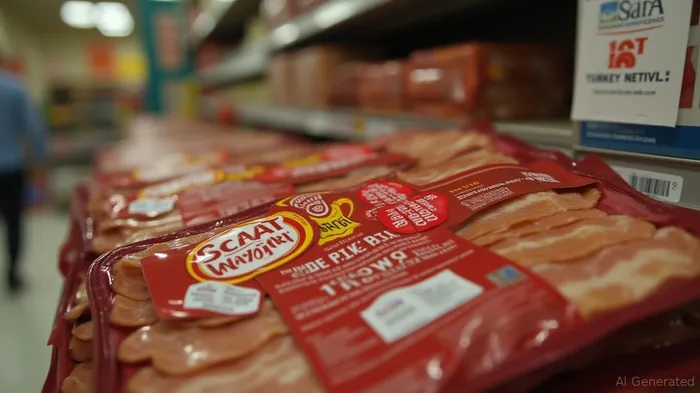
The food industry's reputation hinges on one unspoken promise: what you buy is safe to eat. When that trust is shaken, the fallout reverberates far beyond the shelves. Kraft Heinz's recent recall of nearly 368,000 pounds of Oscar Mayer turkey bacon—spurred by potential Listeria contamination—has reignited a critical debate about operational risk management in consumer goods. For investors, this incident underscores a stark reality: in an era of heightened ESG scrutiny and consumer demand for transparency, companies without rigorous quality control and proactive risk mitigation are sitting on a powder keg.
The Recall's Ripple Effects: A Financial and Reputational Double Whammy
The recall, announced in July 2025, targeted turkey bacon with use-by dates through September 4, distributed across the U.S., Hong Kong, and the British Virgin Islands. While no illnesses were reported, the swift action—triggered by internal lab testing—highlighted the severity of the contamination risk. For Kraft HeinzKHC--, this was more than a product recall; it was a stress test of its operational discipline.
Financially, the timing couldn't have been worse. Shares of KHCKHC-- had already languished near a 52-week low of $26.63, with a -1.59% intraday drop on July 3, 2025. Year-to-date, the stock had lost 12.5% of its value, reflecting broader investor skepticism about the company's ability to stabilize its core businesses. The recall exacerbated existing pressures: operating income for fiscal 2024 plummeted 63% to $1.68 billion, with margins collapsing to 6.51%—a stark contrast to the 17.16% margin just two years prior.
Why Operational Risk Management Matters Now More Than Ever
The Oscar Mayer recall isn't an isolated incident. It's part of a pattern of operational missteps that have plagued consumer goods giants in recent years, from foodborne illness outbreaks to supply chain snarls. For investors, this crisis serves as a cautionary tale about the hidden costs of cutting corners.
In the food industry, quality control isn't just a cost center—it's a profit protector. Companies like UnileverUL-- and Danone, which have invested heavily in end-to-end supply chain transparency, now command premium valuations. Meanwhile, firms like Kraft Heinz, burdened by legacy systems and cost-cutting measures, face a precarious balancing act: maintaining margins while avoiding risks that could erode brand equity.
The Listeria scare also highlights the escalating stakes of ESG compliance. Investors are increasingly penalizing companies that fail to meet ESG benchmarks, particularly in sectors where product safety directly impacts public health. Kraft Heinz's clean-label initiatives, such as its pledge to eliminate artificial dyes by 2027, may appeal to consumers, but they mean little if foundational quality controls falter.
The Investment Imperative: Prioritize Companies with Skin in the Game
For investors, the Kraft HeinzKHC-- episode should prompt a shift in due diligence. When evaluating consumer goods stocks, ask:
What are the company's quality control protocols?
Look for firms with real-time monitoring systems, third-party certifications (e.g., BRCGS), and a history of transparency in addressing recalls.How does the company manage supply chain risks?
Traceability tools and partnerships with audited suppliers can mitigate contamination risks.Is ESG compliance woven into the core strategy?
Companies with measurable ESG goals—such as reducing food waste or achieving zero-carbon supply chains—often align with long-term value creation.
Kraft Heinz's case reveals a critical flaw: its operational rigor hasn't kept pace with evolving consumer expectations. While its free cash flow remains resilient (up 6.65% year-over-year to $3.16 billion), the recall's reputational cost could linger for years, deterring both customers and shareholders.
A Roadmap for Navigating the New Consumer Goods Landscape
Investors should tilt toward companies that treat quality and ESG as non-negotiable pillars. Consider firms like Nestlé, which has invested $1.2 billion in food safety innovation, or Tyson FoodsTSN--, which uses blockchain to track meat from farm to fork. These companies aren't just avoiding recalls—they're turning safety into a competitive advantage.
For those still holding KHC, the path to recovery hinges on three actions:
- Accelerate investments in automation and lab testing to preempt contamination risks.
- Rebuild consumer trust through unvarnished communication about recalls and corrective measures.
- Align ESG goals with operational realities, ensuring that sustainability pledges don't come at the expense of safety.
Final Takeaway: Safety First, or Pay the Price Later
The Kraft Heinz recall isn't just a bump in the road—it's a red flag for an industry in flux. Investors who prioritize firms with robust quality control systems and proactive risk management will be better positioned to weather the next crisis. For others, clinging to companies that treat operational discipline as an afterthought is a gamble with too much at stake. In the end, the safest investments are those that start with safety itself.

Delivering real-time insights and analysis on emerging financial trends and market movements.
Latest Articles
Stay ahead of the market.
Get curated U.S. market news, insights and key dates delivered to your inbox.
AInvest
PRO
AInvest
PRO



Comments
No comments yet