
Kraft Heinz and PepsiCo's Strategic Moves Amid Food Industry Consolidation: Navigating Turbulence for Value Creation


 Aime Summary
The consumer packaged goods (CPG) sector is in the throes of a transformation, driven by shifting consumer preferences, health-conscious trends, and macroeconomic headwinds. Kraft HeinzKHC-- and PepsiCoPEP--, two titans of the industry, are responding with bold strategic moves that could redefine their competitive positioning. For investors, these developments present a unique opportunity to assess valuation gaps and long-term growth potential in a fragmented market. Let's dissect how leadership changes, tariff pressures, and operational restructurings are shaping the trajectories of these companies—and where the smart money might be.
Kraft Heinz: A Split to Unlock Value
Kraft Heinz's decision to split into two publicly traded entities—North American Grocery Co. and Global Taste Elevation Co.—is a direct response to a decade of underperformance. The merger of Kraft and Heinz in 2015, once hailed as a blockbuster deal, has left the company with a 60% stock price decline and a reputation for operational complexity. By separating into distinct businesses, Kraft Heinz aims to unlock value by allowing each entity to trade at a more appropriate multiple. The higher-margin sauces and condiments segment (e.g., Heinz ketchup, Philadelphia cream cheese) could command a premium, while the slower-growing North American staples (e.g., Oscar Mayer, Lunchables) will face a more modest valuation.
Leadership changes have been pivotal to this transition. Miguel Patricio, the former CEO, now serves as Executive Chair, while Carlos Abrams-Rivera remains CEO of the current entity and will lead the North American Grocery Co. The Board has also formed a Separation Committee led by John Cahill, a seasoned veteran of the company, to ensure a smooth transition. These moves signal a commitment to governance stability and operational clarity, critical for executing a complex spin-off.
Financially, Kraft Heinz carries a debt-to-equity ratio of 0.51 and an interest coverage ratio of 5.75, indicating manageable leverage and strong interest coverage. However, its net debt position of -$18.65 billion (cash reserves of $2.56 billion vs. total debt of $21.21 billion) raises questions about its ability to fund the separation without diluting shareholders. Analysts have set an average price target of $30.18, 15.99% above its current price, but the “Hold” consensus suggests skepticism about near-term outperformance.
The key for investors lies in the sum-of-the-parts analysis. MorningstarMORN-- estimates the split could add $10–$15 per share in value, assuming the sauces business trades at a 14x EBITDA multiple and the grocery arm at 9x. If the separation executes smoothly, this could create a compelling entry point for long-term investors. However, short-term volatility is likely as the market digests the transition.
PepsiCo: Activist Pressure and Operational Overhaul
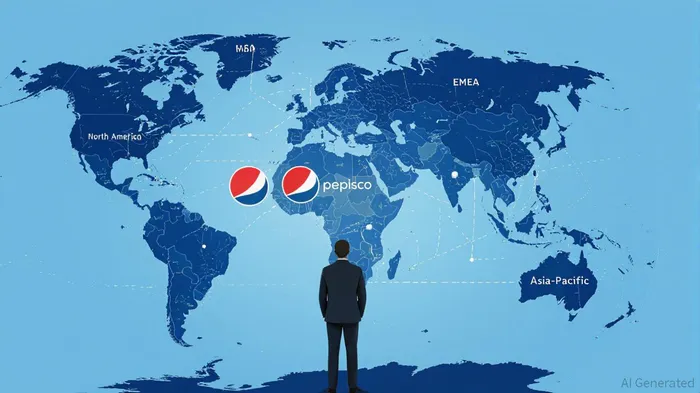
PepsiCo, meanwhile, is facing a $4 billion activist push from Elliott Management, which argues the company has “self-inflicted” its decline in the soda market. Elliott is demanding a refranchising of North American bottling operations, cost cuts in its snack division, and the divestiture of underperforming brands. While PepsiCo has yet to commit to specific changes, its recent leadership reshuffle—promoting regional leaders like Alexandre Carreteiro (Brazil/South Cone) and Silviu Popovici (EMEA)—suggests a pivot toward regional autonomy with centralized innovation, a model gaining traction in the CPG sector.
Financially, PepsiCo is in a stronger position than Kraft Heinz. It maintains a gross profit margin of 55.07%, a 14.03% operating margin, and a 52-year dividend streak. Its debt-to-equity ratio is significantly lower, and its free cash flow is robust, allowing it to weather macroeconomic headwinds. However, its Q2 2025 results—$22.73 billion in revenue and $2.12 EPS—were tempered by soft North American demand and new tariffs. The company revised its full-year guidance to “flat” growth, a stark contrast to its previous mid-single-digit expectations.
The activist campaign adds a layer of uncertainty. Elliott's push for refranchising could unlock value by reducing overhead in bottling operations, but it also risks alienating key partners. PepsiCo's global footprint, particularly in China and India, offers a buffer against North American headwinds, but its reliance on the U.S. market remains a vulnerability. Analysts have set an average price target of $158.73, implying a 4.37% upside from its current price, but the “Hold” consensus reflects caution about near-term execution risks.
Tariff Pressures and Market Fragmentation: A Double-Edged Sword
Both companies are navigating the shadow of U.S. tariffs, which remain in limbo until October 2025. While Kraft Heinz's split may insulate its North American Grocery Co. from some of these pressures, PepsiCo's global operations could mitigate the impact. However, the broader CPG sector is experiencing market fragmentation, with smaller players and private-label brands gaining traction. This fragmentation favors companies with strong brand equity and operational agility—traits both Kraft Heinz and PepsiCo possess, but with different execution risks.
Investment Thesis: Where to Play the Shift
For Kraft Heinz, the split is a high-conviction play. If the separation executes as planned, the sauces business could trade at a premium, while the grocery arm's cost discipline and brand reinvestment (e.g., Lunchables, Oscar Mayer) offer defensive appeal. Investors should monitor free cash flow conversion and share repurchase activity as indicators of post-split momentum.
PepsiCo, on the other hand, is a “Hold” for now. Its strong balance sheet and global diversification make it a defensive play, but the activist campaign introduces short-term noise. A successful refranchising or cost restructuring could unlock upside, but investors should wait for clarity on Elliott's demands before committing.
Conclusion: Strategic Clarity in a Chaotic Sector
The CPG landscape is no longer about scale alone—it's about strategic clarity and operational agility. Kraft Heinz's split and PepsiCo's leadership overhaul are responses to a world where consumer preferences shift faster than ever, and tariffs add a layer of unpredictability. For investors, the key is to differentiate between companies that are adapting and those that are merely reacting.
In the end, both firms are betting on their ability to simplify and focus. Kraft Heinz's split could be a catalyst for long-term value creation, while PepsiCo's activist-driven changes may force a much-needed reset. As the sector continues to consolidate, the winners will be those that can balance innovation with efficiency—and the smart money will be watching closely.

Delivering real-time insights and analysis on emerging financial trends and market movements.
Latest Articles
Stay ahead of the market.
Get curated U.S. market news, insights and key dates delivered to your inbox.
AInvest
PRO
AInvest
PRO



Comments
No comments yet