
Kraft Heinz Considers Splitting into Two Entities, Undoing 2015 Merger
ByAinvest
Monday, Jul 21, 2025 6:04 am ET1min read
K--
The spin-off is part of a broader effort to recalibrate Kraft Heinz's business around its most promising assets and future growth drivers. The company has been actively reshaping its portfolio to align with evolving consumer preferences for healthier, less processed foods. The potential spin-off would allow Kraft Heinz to focus on its high-growth condiments and sauces segment, which includes iconic names like Heinz ketchup and Grey Poupon mustard [1].
The decision to spin off its grocery business reflects a broader industry shift, similar to Kellogg's 2023 split into Kellanova and WK Kellogg. Since then, Kellanova's stock rose 43.7%, and WK Kellogg gained 36.4%, while Kraft Heinz's shares dropped by 19.0% during the same period [1]. Kraft Heinz has already demonstrated a willingness to pare down its portfolio through the divestment of non-core units, signaling that the potential spin-off is part of a larger recalibration of its brand ecosystem.
However, the success of the spin-off is not guaranteed, as investors would only reap value if acquirers step in to buy either of the new companies. The potential spin-off could undo the $46 billion deal and is not a guaranteed success. The new entity would focus on stabilizing and optimizing legacy brands, while the remaining company would prioritize innovation and global expansion.
References:
[1] https://www.forbes.com/sites/joecornell/2025/07/17/kraft-heinz-evaluating-potential-spin-off-of-a-grocery-business/
[2] https://www.reuters.com/legal/transactional/kraft-heinz-carvery-would-hinge-new-sandwiches-2025-07-17/
KHC--
KLG--
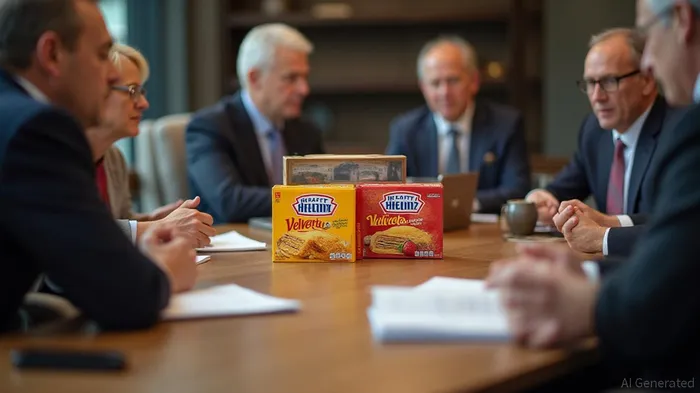
Kraft Heinz is considering spinning off its slower-growing brands, including Velveeta cheese, into a new entity worth up to $20 billion. This move aims to boost returns by reversing its unsuccessful 2015 merger with H.J. Heinz. The Chicago- and Pittsburgh-based foodmaker has struggled with declining sales and shareholder value, losing about two-thirds of its value since the merger. The potential spinoff could undo the $45 billion deal and is not a guaranteed success, as investors would only reap value if acquirers step in to buy either of the new companies.
The Kraft Heinz Company (NASDAQ: KHC), a leading global packaged food company, is reportedly evaluating the potential spin-off of its slower-growing grocery business. This strategic move, if executed, would aim to boost returns and reverse the unsuccessful 2015 merger with H.J. Heinz. According to media reports, the spin-off entity could be valued at up to $20 billion, with a focus on stabilizing and optimizing legacy brands such as Kraft cheese, Oscar Mayer meats, Maxwell House coffee, and Jell-O [1].The spin-off is part of a broader effort to recalibrate Kraft Heinz's business around its most promising assets and future growth drivers. The company has been actively reshaping its portfolio to align with evolving consumer preferences for healthier, less processed foods. The potential spin-off would allow Kraft Heinz to focus on its high-growth condiments and sauces segment, which includes iconic names like Heinz ketchup and Grey Poupon mustard [1].
The decision to spin off its grocery business reflects a broader industry shift, similar to Kellogg's 2023 split into Kellanova and WK Kellogg. Since then, Kellanova's stock rose 43.7%, and WK Kellogg gained 36.4%, while Kraft Heinz's shares dropped by 19.0% during the same period [1]. Kraft Heinz has already demonstrated a willingness to pare down its portfolio through the divestment of non-core units, signaling that the potential spin-off is part of a larger recalibration of its brand ecosystem.
However, the success of the spin-off is not guaranteed, as investors would only reap value if acquirers step in to buy either of the new companies. The potential spin-off could undo the $46 billion deal and is not a guaranteed success. The new entity would focus on stabilizing and optimizing legacy brands, while the remaining company would prioritize innovation and global expansion.
References:
[1] https://www.forbes.com/sites/joecornell/2025/07/17/kraft-heinz-evaluating-potential-spin-off-of-a-grocery-business/
[2] https://www.reuters.com/legal/transactional/kraft-heinz-carvery-would-hinge-new-sandwiches-2025-07-17/
Stay ahead of the market.
Get curated U.S. market news, insights and key dates delivered to your inbox.
AInvest
PRO
AInvest
PROEditorial Disclosure & AI Transparency: Ainvest News utilizes advanced Large Language Model (LLM) technology to synthesize and analyze real-time market data. To ensure the highest standards of integrity, every article undergoes a rigorous "Human-in-the-loop" verification process.
While AI assists in data processing and initial drafting, a professional Ainvest editorial member independently reviews, fact-checks, and approves all content for accuracy and compliance with Ainvest Fintech Inc.’s editorial standards. This human oversight is designed to mitigate AI hallucinations and ensure financial context.
Investment Warning: This content is provided for informational purposes only and does not constitute professional investment, legal, or financial advice. Markets involve inherent risks. Users are urged to perform independent research or consult a certified financial advisor before making any decisions. Ainvest Fintech Inc. disclaims all liability for actions taken based on this information. Found an error?Report an Issue




Comments
No comments yet