
Kraft Heinz Claims Top Dollar Volume Spot Despite Earnings Headwinds
 Aime Summary
Market Snapshot
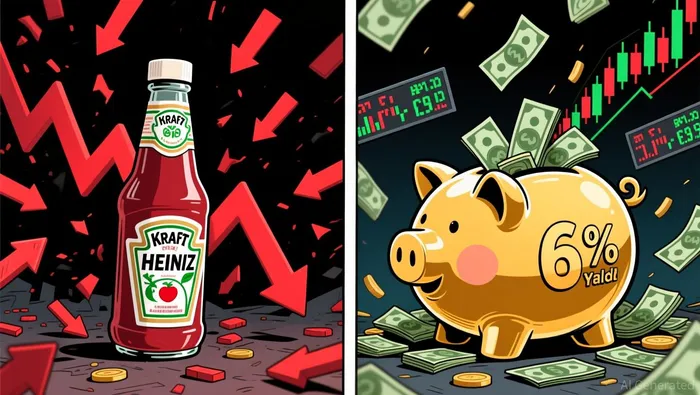
The Kraft HeinzKHC-- Company (NASDAQ: KHC) experienced a notable decline in trading activity on July 31, 2026, with shares closing down 2.01%. Despite the downward price movement, the stock attracted significant investor attention, recording a trading volume of $0.34 billion. This level of transactional activity placed KHCKHC-- as the top traded stock by dollar volume across the broader market for the day, indicating heightened institutional or speculative interest despite the negative price action. The stock’s valuation metrics remain complex, with a current price-to-earnings ratio of -5.62 and a market capitalization of approximately $32.37 billion. Technical indicators suggest the stock is trading well above its key moving averages, sitting near $27.30, while the 50-day and 200-day moving averages rest at $24.30 and $23.62, respectively. This positioning places the share price closer to its 52-week high of $29.19 than its low of $21.03, reflecting a period of relative resilience against broader market volatility, even as it faces fundamental headwinds.
Key Drivers
Investor sentiment surrounding The Kraft Heinz CompanyKHC-- is currently being heavily influenced by the anticipation of its second-quarter 2026 earnings report, scheduled for release on August 5. The market is bracing for a quarter characterized by declining year-over-year figures, with analysts forecasting earnings per share (EPS) of $0.53, representing a sharp 23.2% drop from the previous year. Revenue is expected to contract by approximately 3% to $6.16 billion. This pessimistic outlook is compounded by recent downward revisions to consensus estimates; over the last 30 days, the EPS forecast has been adjusted lower by 0.32%. However, there is a conflicting signal from the Zacks research model, which assigns KHC a Rank #2 (Buy) and calculates a positive Earnings ESP (Expected Surprise Prediction) of +0.82%. This metric suggests that the most accurate recent estimates are slightly higher than the broader consensus, hinting at a potential for a positive earnings surprise, a trend the company has historically demonstrated by beating estimates in the last four consecutive quarters.
The broader analyst community remains cautious, maintaining a consensus "Reduce" rating with an average price target of $23.19. This target is significantly below the stock’s recent trading levels, implying substantial downside risk according to Wall Street’s aggregate view. The divergence between the current share price and the analyst targets highlights a disconnect between market pricing and fundamental expectations. While some brokerages have recently upgraded their outlook, such as Wall Street Zen’s move to a "Buy" rating, others remain bearish. BNP Paribas Exane recently lowered its price target to $19.00 with an "underperform" rating, underscoring the skepticism regarding the company’s ability to sustain growth amidst macroeconomic pressures.
Valuation metrics further complicate the investment thesis. Kraft Heinz is currently trading at a forward P/E ratio of 13.18, which offers a slight discount compared to the industry average of 13.68. Despite this apparent value, the company’s negative net margin of 23.05% reported in the previous quarter raises concerns about profitability efficiency. The company’s balance sheet remains relatively stable with a debt-to-equity ratio of 0.46 and a current ratio of 1.20, providing some financial flexibility. However, the high institutional ownership of 78.17% suggests that large funds are closely monitoring the upcoming earnings for signs of operational improvement or strategic missteps.
Corporate governance developments have also entered the spotlight, with amendments to the company’s by-laws on July 22, 2026, reshaping procedures for shareholder meetings and legal disputes. Some market narratives suggest these changes, combined with the upcoming earnings, may be driving a reassessment of the company’s fair value. One prominent analysis estimates the stock is undervalued by approximately 24.6%, positing a fair value of $35.00 based on strong cash generation and dividend support. This perspective contrasts sharply with the prevailing analyst consensus, creating a polarized environment where investors are weighing the potential for a turnaround against the risks of continued top-line sluggishness and inflationary pressures.
The high dividend yield, currently cited at nearly 6% to 7.12% depending on the metric, continues to attract income-focused investors. With a quarterly dividend of $0.40 per share, the payout provides a cushion against capital depreciation. However, the dividend payout ratio is negative at -32.92%, indicating that the current dividend is not fully covered by earnings, which could raise sustainability questions if margins do not improve. As the August 5 earnings date approaches, the convergence of these factors—earnings expectations, valuation gaps, governance changes, and dividend mechanics—will likely dictate the stock’s trajectory in the near term.

Stay ahead of the market.
Get curated U.S. market news, insights and key dates delivered to your inbox.


AInvest
PRO
AInvest
PRO




Comments
No comments yet