
KPTI Stock Down on Mixed Phase III Myelofibrosis Combo Study Data
 Aime Summary
Shares of Karyopharm Therapeutics KPTI plunged 18.3% on Tuesday after the company reported mixed top-line results from a late-stage study evaluating a 60 mg dose of selinexor in combination with Incyte’s INCY Jakafi (ruxolitinib) to treat frontline myelofibrosis.
The phase III SENTRY study enrolled 353 patients who were randomized in a 2:1 ratio to either receive 60 mg of selinexor once weekly plus Jakafi or placebo plus Jakafi. Jakafi dosing was selected according to patients’ baseline platelet counts in line with prescribing guidelines.
The study achieved its first co-primary endpoint, showing a statistically significant improvement in spleen volume reduction of 35% or more (SVR35) in patients treated with the selinexor/Jakafi combination, with rapid, deep and sustained responses observed in the combination arm. However, it failed to meet the second co-primary endpoint of absolute total symptom score (Abs-TSS). At week 24, mean changes in Abs-TSS from baseline were comparable between the two arms, indicating similar symptom improvement, but the difference did not reach statistical significance.
Karyopharm Therapeutics’ selinexor is already FDA-approved and is marketed under the brand name Xpovio as a combination therapy for treating adult patients across two multiple myeloma indications and as a monotherapy for adults with relapsed or refractory diffuse large B-cell lymphoma. The monotherapy indication is approved under the FDA’s accelerated pathway, and continued approval is contingent upon the verification and description of clinical benefit in a confirmatory study. The drug is also marketed in the EU and the United Kingdom, under the brand name Nexpovio, for the multiple myeloma indications.
KPTI’s Phase III Myelofibrosis Study Data in Detail
The combination of selinexor plus Incyte’s Jakafi demonstrated a clear benefit in spleen volume reduction. At week 24, 50% of patients in the combination arm achieved a statistically significant improvement in SVR35 compared with 28% with Jakafi alone. Responses were rapid, with nearly half of combination-treated patients reaching SVR35 as early as week 12, and remained durable through week 36.
In contrast, symptom improvement was similar across both treatment arms. At week 24, reductions in Abs-TSS were comparable, with patients in the combination arm reporting a 9.89-point improvement compared with a 10.86-point improvement for those in the Jakafi arm, indicating no meaningful differentiation in symptom relief.
In the past six months, shares of Karyopharm TherapeuticsKPTI-- have lost 20.8% compared with the industry’s 10.3% decline.
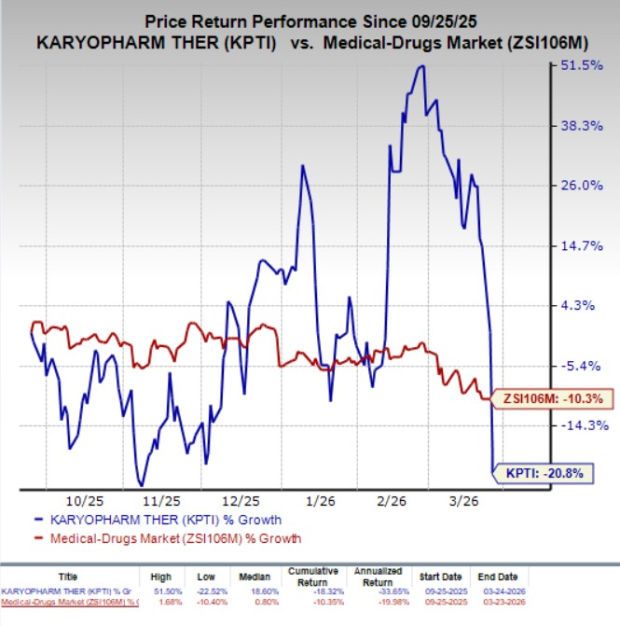
Image Source: Zacks Investment Research
The combination therapy showed a promising overall survival (OS) trend, with a hazard ratio of 0.43, suggesting a potential survival advantage. Additionally, post-hoc analyses indicated that achieving SVR35 at weeks 12 and 24 may correlate with improved survival outcomes, though longer follow-up is needed to confirm these findings.
Exploratory analyses pointed to possible disease-modifying effects, as a higher proportion of patients in the combination arm achieved meaningful reductions in variant allele frequency. However, as of the Feb. 20, 2026, data cut-off, no significant differences were observed across other secondary endpoints, including progression-free survival, hemoglobin stabilization and bone marrow fibrosis, between the study arms, with further evaluation planned as data mature.
Karyopharm Therapeutics also reported that the combination therapy showed a manageable safety and tolerability profile consistent with the known effects of selinexor and Jakafi individually, with no new safety signals identified.
Incyte’s Jakafi is a first-in-class JAK1/JAK2 inhibitor, approved for polycythemia vera, myelofibrosis and refractory acute graft-versus-host disease. Jakafi is marketed by IncyteINCY-- in the United States and by Novartis NVS as Jakavi in ex-U.S. markets. Incyte receives royalty payments from Novartis on Jakavi sales.
KPTI’s Next Steps in the Myelofibrosis Program
Despite mixed results, Karyopharm Therapeutics believes the findings reinforce the need to expand treatment approaches in myelofibrosis beyond JAK inhibition. While JAK inhibitors remain foundational, the company highlights that further progress will depend on targeting additional biological pathways, with selinexor’s XPO1 inhibition offering a differentiated and complementary mechanism of action. The SENTRY data support selinexor’s potential to enhance outcomes and advance the myelofibrosis treatment landscape through novel combination strategies.
Karyopharm Therapeutics is gearing up to engage with the FDA to review the full phase III SENTRY study dataset and discuss its supplemental regulatory filing plan. KPTIKPTI-- also intends to present additional SENTRY study data at an upcoming medical conference.
Besides the myelofibrosis indication, selinexor is simultaneously being evaluated both as a combination and a monotherapy across several oncology indications in separate mid to late-stage studies. Beyond selinexor, Karyopharm Therapeutics has another candidate in its pipeline, eltanexor, currently undergoing mid-stage development for myelodysplastic neoplasms.
Karyopharm Therapeutics Inc. Price and Consensus
Karyopharm Therapeutics Inc. price-consensus-chart | Karyopharm Therapeutics Inc. Quote
KPTI’s Zacks Rank & Stock to Consider
Karyopharm Therapeutics currently carries a Zacks Rank #3 (Hold).
A better-ranked stock in the biotech sector is Catalyst Pharmaceuticals CPRX, sporting a Zacks Rank #1 (Strong Buy) at present. You can see the complete list of today’s Zacks #1 Rank stocks here.
Over the past 60 days, estimates for Catalyst Pharmaceuticals’ 2026 EPS have risen from $2.55 to $2.87. CPRX shares have gained 20.5% over the past six months.
Catalyst Pharmaceuticals’ earnings beat estimates in each of the trailing four quarters, with the average surprise being 35.19%.
Radical New Technology Could Hand Investors Huge Gains
Quantum Computing is the next technological revolution, and it could be even more advanced than AI.
While some believed the technology was years away, it is already present and moving fast. Large hyperscalers, such as Microsoft, Google, Amazon, Oracle, and even Meta and Tesla, are scrambling to integrate quantum computing into their infrastructure.
Senior Stock Strategist Kevin Cook reveals 7 carefully selected stocks poised to dominate the quantum computing landscape in his report, Beyond AI: The Quantum Leap in Computing Power.
Kevin was among the early experts who recognized NVIDIA's enormous potential back in 2016. Now, he has keyed in on what could be "the next big thing" in quantum computing supremacy. Today, you have a rare chance to position your portfolio at the forefront of this opportunity.
See Top Quantum Stocks Now >>Want the latest recommendations from Zacks Investment Research? Today, you can download 7 Best Stocks for the Next 30 Days. Click to get this free report
Novartis AG (NVS): Free Stock Analysis Report
Incyte Corporation (INCY): Free Stock Analysis Report
Catalyst Pharmaceuticals, Inc. (CPRX): Free Stock Analysis Report
Karyopharm Therapeutics Inc. (KPTI): Free Stock Analysis Report
This article originally published on Zacks Investment Research (zacks.com).

Zacks is the leading investment research firm focusing on equities earnings estimates and stock analysis for the individual investor, including stock picks, stock screening, portfolio stock tracker and stock screeners. Copyright 2006-2026 Zacks Equity Research, Inc. editor@zacks.com (Manaing editor) webmaster@zacks.com (Webmaster)
Latest Articles
Stay ahead of the market.
Get curated U.S. market news, insights and key dates delivered to your inbox.
AInvest
PRO
AInvest
PRO



Comments
No comments yet