
KOSPI Index Drops As Tech Selloff Weighs On Korean Markets
 Aime Summary
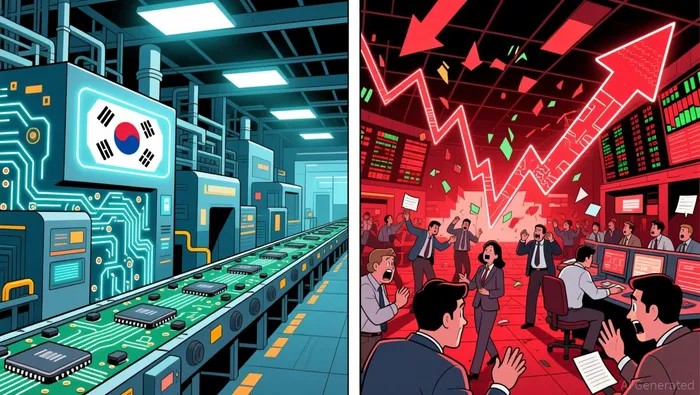
South Korean equities opened sharply lower on Thursday, August 6, 2026, as a wave of profit-taking in global technology markets spilled over into Asia. The benchmark Korea Composite Stock Price Index (KOSPI) declined nearly 5% to approximately 6,285, erasing previous gains and signaling a renewed risk-off sentiment among institutional and retail investors alike. The decline was primarily concentrated in the country's semiconductor sector, which accounts for a significant portion of the KOSPI's market capitalization. SK HynixSKHY-- and Samsung Electronics, the twin pillars of South Korea's export-driven economy, saw their shares drop by roughly 5% and 8%, respectively, following a retreat in the Nasdaq overnight .
Why Is KOSPI Falling Amid Global Tech Selloff?
The sharp decline in the KOSPI reflects a broader dislocation in global equity markets, where investors are rapidly rotating out of high-growth technology stocks in favor of defensive assets. The overnight selloff on Wall Street was driven by profit-taking after a prolonged rally in major tech names, coupled with concerns about elevated valuations and potential shifts in monetary policy . For South Korea, a country heavily reliant on semiconductor exports, this external shock has immediate and pronounced effects on domestic market sentiment.
The impact was felt across several key sectors beyond semiconductors. SK Square, a major conglomerate affiliate, plunged by 10.2%, while SK Inc. dropped 9.1%, highlighting the breadth of the sell-off . Other notable losers included LS Electric (-3.8%), LG Electronics (-2.5%), and Hyundai Motor (-1.6%), indicating that the negative sentiment extended beyond just the tech-heavy components of the index . This widespread decline suggests that investors are reassessing their exposure to cyclical and growth-oriented assets amid growing macroeconomic uncertainty.
Despite the equity downturn, underlying economic fundamentals in South Korea continue to show strength. The country reported a record current account surplus of $49.73 billion in June, driven by robust semiconductor exports that reinforced positive outlooks for the nation's trade performance . This divergence between strong economic data and weak market performance underscores the sensitivity of the KOSPI to external global factors, particularly movements in U.S. technology markets and broader risk appetite.
How Geopolitical Tensions Impact the KOSPI Index
Geopolitical developments have also played a significant role in shaping market sentiment on August 6, 2026. Reports of progress toward an interim transit arrangement between Iran and Oman provided some relief regarding potential disruptions to shipping through the Strait of Hormuz, a critical chokepoint for global energy trade . However, the lingering threat of conflict in the Middle East continues to weigh on investor confidence, contributing to the cautious tone in early trading.
The Strait of Hormuz tensions are particularly relevant to South Korea, as the country is heavily dependent on imported energy. Any disruption to shipping lanes in the region could lead to spikes in oil prices, which would negatively impact South Korea's trade balance and corporate profitability. The fact that the KOSPI declined despite these positive geopolitical developments suggests that the tech selloff was the dominant factor driving market sentiment .
Regional dynamics are also influenced by broader trends in Asia-Pacific capital flows. Vietnamese banks, for instance, are arranging significant offshore loans to meet domestic credit growth targets, reflecting broader regional financial trend of financial institutions seeking international funding amid geopolitical uncertainties. This trend highlights the interconnectedness of Asian financial markets and the challenges they face in balancing domestic growth objectives with external funding constraints.
What Investors Should Watch Next for the KOSPI Stock Market
Looking ahead, investors will be closely monitoring several key factors that could influence the trajectory of the KOSPI. The Federal Reserve's monetary policy decisions remain a critical variable, as any indication of a more hawkish stance could further pressure global equity markets and exacerbate the current selloff . Additionally, developments in the Strait of Hormuz and broader Middle East tensions will continue to impact energy prices and risk sentiment.
On the domestic front, investors will be watching for signs of stabilization in the semiconductor sector, which is crucial for the KOSPI's recovery. Earnings reports from major tech companies, including Samsung Electronics and SK Hynix, will provide insights into demand trends and pricing power in the global chip market . Any positive developments in corporate guidance or inventory levels could help restore confidence in the sector.
Furthermore, the performance of the KOSPI will be influenced by broader market sentiment and capital flows. The recent decline in dollar-denominated loan issuance across Asia Pacific ex-Japan, which hit a 16-year low, reflects the challenges financial institutions face in securing funding amid geopolitical uncertainties . This trend could have implications for liquidity and credit conditions in South Korea, potentially affecting corporate investment and consumer spending.
As the market digests the latest developments, investors should remain cautious and focus on fundamental analysis. The divergence between strong economic data and weak market performance highlights the importance of looking beyond short-term volatility to assess the underlying health of the South Korean economy. While the KOSPI faces headwinds from global tech selloffs and geopolitical tensions, the country's robust export performance and current account surplus provide a solid foundation for long-term growth .

Stay ahead of the market.
Get curated U.S. market news, insights and key dates delivered to your inbox.


AInvest
PRO
AInvest
PRO




Comments
No comments yet