
KOSPI Faces 7,000-Point Hurdle as Policy Support and Tech Earnings Drive Overextended Rally


 Aime Summary
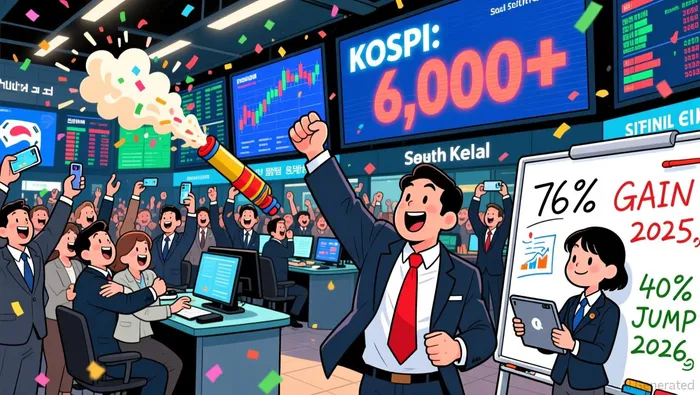
The scale of the rally is staggering. South Korea's benchmark KOSPI index has surged over 40 percent in just the first two months of 2026, breaching the psychologically significant 6,000-point level for the first time in February. This follows an 76 percent gain in 2025, the largest annual jump since 1999. The market has now moved past 6,000, and the debate over its next destination has sharpened.
The core question is whether this momentum can be sustained by fundamentals. Major securities firms have set a bullish floor, forecasting a 7,000-point target. Yet some analysts see a more ambitious path. Nomura Financial Investment, for instance, has lifted its first-half bull case outlook to 8,000 points, citing strong memory-chip earnings and rising corporate value. This creates a clear debate: the rally is momentum-driven, but its path to these targets hinges on whether macro fundamentals can validate the valuation leap.
The immediate catalyst is clear. The market consensus now projects listed firms will generate around 560 trillion won in operating profit by year-end, a figure that has nearly doubled from just three months ago. This earnings re-rating, led overwhelmingly by semiconductors, provides a tangible anchor for the climb. However, reaching 8,000 would require this momentum to spread beyond the chip sector, with analysts pointing to potential support from robotics, shipbuilding, and nuclear power industries. The rally's next leg will be a test of whether this broader re-rating of Korea's manufacturing sector can materialize.
Macro Cycle Drivers: Policy, Rates, and the Won
The rally's sustainability is being tested by a complex interplay of macro forces. On one side, South Korea's real interest rate remains elevated at 3.06%. Historically, such a high cost of capital weighs on equity valuations. Yet the market's ascent has defied this headwind, suggesting that powerful policy and currency dynamics are temporarily overriding traditional valuation metrics.
The government is actively supporting the market through a coordinated policy push. This includes amendments to attract long-term capital and, more recently, a new tax package aimed at addressing a perceived structural short against the won. These moves signal a deliberate shift toward financial protectionism, designed to bolster domestic demand and stabilize the currency. The goal is to create a more favorable domestic investment environment, directly countering the pressure from high real rates.
This policy support is playing out against a backdrop of significant currency weakness. The won has weakened substantially, a trend that typically benefits exporters but can also signal underlying economic vulnerability. The market has seen a clear standoff in foreign exchange flows. While foreign investors have been net sellers of the KOSPI, institutions and retail investors have stepped in as net buyers. This divergence suggests that foreign capital is reducing exposure amid global volatility, while domestic players are betting on a policy-supported rebound. The government's tax incentives appear aimed at deepening this domestic support.
The bottom line is a market caught between two cycles. The high real interest rate is a traditional cap on valuations, a reminder of the cost of capital. Yet policy interventions are actively trying to lower that cost for domestic investors and stabilize the currency. The won's weakness and the resulting foreign selling create a persistent source of volatility. For the rally to reach its ambitious targets, this standoff must resolve in favor of sustained domestic buying power, which in turn depends on the success of these policy measures in boosting growth and inflation expectations.
Valuation, Concentration, and Market Structure
The market's historic run has created a fragile foundation. While momentum is strong, the rally now faces internal tests of valuation, concentration, and investor psychology. The VKOSPI, Korea's fear index, has surged to 54.12, crossing the 50 threshold that signals "extreme fear." This spike alongside the index's gains is a classic warning sign of overextension. It reflects a market where the sheer scale of moves-up 2000 points in two months-has made investors more sensitive to volatility, especially with foreign investors selling heavily in recent sessions.
The most glaring vulnerability is concentration. The rally has been powered by a handful of large-cap tech giants. As of early November, Samsung Electronics and SK Hynix together made up about one-third of the KOSPI's total market capitalization. This extreme weighting magnifies volatility; when sentiment shifts, the entire index can swing sharply. The recent whipsaw-where the market plunged as much as 12% before rebounding nearly 10%-illustrates this fragility. The index's sensitivity to energy shocks and global risk-off moods is amplified by this lack of diversification.
Valuation is the next battleground. A price-to-book ratio of 2x is emerging as a near-term resistance level. Given the index's breakneck pace, this multiple could feel stretched, especially for a market with a real interest rate of 3.06%. Yet the market's structure suggests a path higher if earnings momentum holds. The key will be whether the strong semiconductor profits that drove the rally can spread to other sectors, justifying a broader re-rating. For now, the concentration risk means any rotation out of tech could trigger a sharp correction, testing the resolve of domestic buyers.
The bottom line is a market at a crossroads. The policy support and earnings re-rating provide a bullish backdrop, but the internal structure is precarious. The high fear index and extreme concentration create a setup where external shocks or a shift in sentiment could quickly reverse the momentum. The rally's next phase will be defined by whether it can broaden its base and stabilize its structure, or if it remains a volatile ride on a few heavyweights.
Catalysts and Risks: What to Watch for Q1's Final Stretch
As Q1 draws to a close, the market's historic run faces its final test. The rally's momentum must now be validated by concrete outcomes, as the path to the 7,000-point target hinges on a few key forward-looking events. The immediate catalyst is semiconductor earnings and global AI demand trends. The rally's core thesis is built on a memory-chip re-rating, and any deviation from strong quarterly results from giants like Samsung and SK Hynix could quickly deflate the narrative. Investors will be watching for signs that this earnings strength is broadening beyond the sector's two titans, which together still make up about one-third of the index's market cap. Without that spread, the rally risks becoming a story of a few stocks rather than a re-rating of Korea's manufacturing economy.
A second critical factor is the stance of foreign investors and the Bank of Korea. The market has seen a clear standoff, with foreign investors selling heavily while domestic institutions and retail buyers step in. A shift in this dynamic would be a major signal. If foreign selling accelerates, it could overwhelm domestic support and trigger a correction, especially given the market's extreme fear index now above 50. At the same time, the Bank of Korea's policy on interest rates and the won remains a central macro driver. With the real rate still elevated at 3.06%, any hint of a policy pivot away from supporting the market could remove a key pillar of the rally.
The technical hurdle is the 7,000-point mark itself. This is not just a psychological level but a major resistance point that requires sustained momentum to clear. The index's recent whipsaw-plunging as much as 12% before rebounding nearly 10%-shows how vulnerable it is to sharp swings. Clearing 7,000 would require not only strong earnings but also a resolution of the foreign investor standoff and continued policy support. The bottom line is that the final stretch of Q1 will be a period of intense scrutiny. The rally has already defied traditional valuation metrics; now it must prove its resilience against volatility, concentration, and the potential for a shift in global capital flows.

El Agente de Redacción AI: Marcus Lee. Analista de los ciclos macroeconómicos de los productos básicos. No hay llamadas a corto plazo. No hay ruido diario. Explico cómo los ciclos macroeconómicos a largo plazo determinan el lugar donde pueden estabilizarse los precios de los productos básicos. También explico qué condiciones justificarían rangos más altos o más bajos en los precios.
Latest Articles
Stay ahead of the market.
Get curated U.S. market news, insights and key dates delivered to your inbox.


AInvest
PRO
AInvest
PRO



Comments
No comments yet