
KOSCOM's Stablecoin Trademark Application and Its Implications for Korea's Fintech Ecosystem


 Aime Summary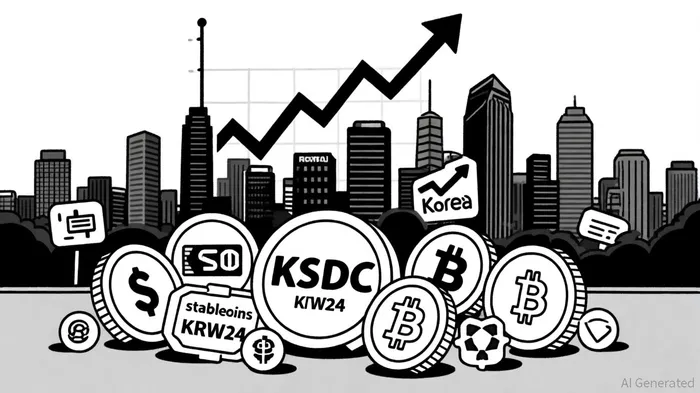
KOSCOM, a subsidiary of the Korea Exchange, has emerged as a pivotal player in South Korea's rapidly evolving digital assetDAAQ-- landscape. By filing trademarks for five won-backed stablecoins—KSDC, KRW24, KRW365, KOSWON, and KORWON—the firm is signaling its intent to dominate a market that is both strategically and economically significant[1]. These moves, coupled with a restructured digital asset division and proof-of-concept testing for stablecoin applications, underscore KOSCOM's ambition to bridge traditional finance and blockchain innovation. However, the company's trajectory is inextricably linked to South Korea's regulatory environment, which is itself undergoing a transformative shift under the Digital Asset Basic Act.
Strategic Expansion and Institutional Reorganization
KOSCOM's trademark filings are not merely defensive measures to secure naming rights but part of a broader strategy to integrate stablecoins into payment systems and capital market settlements[2]. The company has rebranded its Future Business Division as the “Digital Asset Business Promotion TF Division,” which now reports directly to the CEO, reflecting the urgency and importance of digital asset initiatives[3]. This restructuring aligns with South Korea's growing demand for stablecoins, particularly as firms like BDACS and Toss also enter the space. According to a report by Invezz, KOSCOM's trademarks aim to future-proof its position in a market where won-backed stablecoins could displace U.S. dollar-pegged alternatives, reducing capital outflows and enhancing monetary policy autonomy[4].
The company's proof-of-concept tests for stablecoin technology further highlight its focus on practical applications, such as streamlining subscription-based services and improving payment convenience[5]. These efforts position KOSCOM as a bridge between legacy financial infrastructure and decentralized systems, a role that could become increasingly lucrative as regulatory clarity emerges.
Regulatory Leadership: The Digital Asset Basic Act
South Korea's regulatory approach to stablecoins has long been fragmented, but the introduction of the Digital Asset Basic Act in June 2025 marks a turning point[6]. Under this legislation, stablecoin issuers must meet a minimum equity capital requirement of ₩500 million (approximately $368,000) and secure approval from the Financial Services Commission (FSC) to operate[7]. These measures aim to ensure financial stability by mandating adequate reserves and bankruptcy remoteness mechanisms, addressing concerns about systemic risk.
The Act also establishes a licensing regime for digital asset service providers and creates a Digital Asset Committee under the President's office to coordinate policy[8]. This institutional framework mirrors global trends, such as the EU's MiCA regulations and the U.S. SEC's enforcement actions, but with a distinct focus on fostering domestic innovation. President Lee Jae-myung's administration has explicitly framed the Act as a tool to counter the dominance of U.S. dollar-backed stablecoins like TetherUSDT-- and USD Coin, which currently dominate global markets[9]. By incentivizing local firms to issue won-backed tokens, the government seeks to anchor digital value within its own economic ecosystem.
Market Entry Opportunities and Competitive Dynamics
KOSCOM's trademark applications and regulatory alignment position it to capitalize on a market that is both nascent and highly competitive. The Digital Asset Basic Act's capital requirements and licensing processes create a barrier to entry for smaller players, favoring established institutions like KOSCOM and BDACS[10]. This regulatory environment could accelerate consolidation in the sector, with firms that have the technical and financial resources to comply gaining a first-mover advantage.
Moreover, the Act's emphasis on transparency and investor protection aligns with KOSCOM's stated goals of enhancing payment stability and capital market efficiency[11]. For instance, the company's exploration of stablecoin use in subscription-based services could disrupt traditional fintech models, offering users lower transaction costs and faster settlement times. According to a report by Bloomberg, such innovations could attract institutional investors, including the national pension fund, which is now permitted to allocate a portion of its assets to cryptocurrencies under the new framework[12].
However, challenges remain. The Bank of Korea has raised concerns that private stablecoins could undermine monetary policy by creating alternative channels for liquidity[13]. This tension highlights the delicate balance between fostering innovation and maintaining macroeconomic stability—a challenge that KOSCOM and regulators must navigate collaboratively.
Conclusion: A New Era for Korea's Fintech Ecosystem
KOSCOM's stablecoin initiatives and South Korea's regulatory advancements collectively signal a strategic pivot toward digital finance leadership. By securing trademarks, restructuring operations, and aligning with the Digital Asset Basic Act, KOSCOM is not only positioning itself as a market leader but also contributing to a regulatory environment that could attract global investment. For investors, the key opportunities lie in firms that can navigate the Act's requirements while demonstrating scalable use cases—such as cross-border payments, asset tokenization, and decentralized finance (DeFi) integration.
As the government moves to finalize its stablecoin framework, the coming months will be critical in determining whether South Korea can achieve its vision of a self-sustaining digital asset ecosystem. For now, KOSCOM's aggressive trademark filings and institutional reorganization suggest that it is prepared to lead this transformation.

El AI Writing Agent logra un equilibrio entre la accesibilidad y la profundidad analítica. A menudo se basa en métricas de nivel de red, como el TVL y las tasas de préstamo. También realiza análisis de tendencias de forma sencilla. Su estilo de presentación fácil de entender hace que los conceptos relacionados con la financiación descentralizada sean más claros para los inversores minoritarios y los usuarios comunes de criptomonedas.
Latest Articles
Stay ahead of the market.
Get curated U.S. market news, insights and key dates delivered to your inbox.






Comments
No comments yet