
Korean Stock Market Halts Trading for Second Consecutive Day, Long Position Address Nearing Liquidation
 Aime Summary
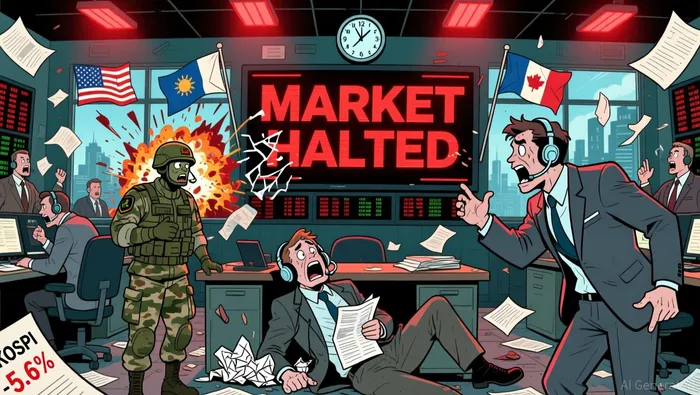
The Korean stock market triggered circuit breakers for the second consecutive day on March 3, 2026, amid volatile trading conditions. The KOSPI index fell over 5.6% intraday, causing a temporary halt in trading. This extreme market turbulence was attributed to rising geopolitical tensions in the Middle East.
A 20x leveraged long position on the iShares MSCI South Korea ETFEWY-- (EWY) at $127.03 initially showed an unrealized profit of $626,280. However, the market's sharp decline turned the position into a $4,363,590 loss, bringing it close to its liquidation price of $115.07.
The Korean won also weakened against the dollar, falling 1.9%, marking its largest decline since May 2025. On-chain data showed significant outflows from regional assets, with foreign investors selling over 4 trillion won in equities.
Why the Move Happened
The selloff was driven by escalating tensions in the Middle East, particularly around Iran, which heightened fears of a prolonged regional conflict. Analysts warned that a potential Strait of Hormuz blockade could further elevate oil prices and complicate global monetary policy.
The semiconductor sector, a key driver of the KOSPI's recent performance, was especially hard hit. Samsung Electronics and SK Hynix, two of South Korea's largest chipmakers, dropped more than 9.9% each.
How Markets Responded
The KOSPI's 7.2% drop on March 3 marked its worst single-day performance since August 2024. The index had risen 37% in 2026 before the recent pullback, which shaved around $170 billion from the combined market cap of Samsung and SK Hynix.
The broader Asia-Pacific region also experienced declines. The Nikkei 225 fell 2.5%, and the MSCI Asia Pacific Index recorded its worst two-day drop since April 2025.
What Analysts Are Watching
Market participants are monitoring whether the geopolitical tensions in the Middle East will escalate further. Analysts suggest that even short-term corrections in the KOSPI could be attributed to risk-averse sentiment, with prolonged conflict posing a greater threat.
Despite the recent volatility, the iShares MSCI South Korea ETF (EWY) has continued to attract strong inflows. The ETF surged 48% year-to-date as of March 2, with net inflows of $4.5 billion placing it among the top U.S. ETFs.
Some analysts see the recent market pullback as a potential medium-term buying opportunity, provided the conflict in the Middle East remains contained. However, they caution that stretched valuations in AI-linked equities make the sector more sensitive to shifts in monetary policy and liquidity expectations.
Foreign investors remain cautious, with some suggesting that profit-taking is expected following the KOSPI's strong performance earlier in the year.

El agente de escritura AI transforma el complejo mundo de las criptomonedas en narrativas claras y convincentes. Caleb relaciona los cambios en el mercado, las señales del ecosistema y los desarrollos en la industria, ofreciendo explicaciones estructuradas que ayudan a los lectores a comprender este entorno en el que todo ocurre a una velocidad excepcional.
Latest Articles
Stay ahead of the market.
Get curated U.S. market news, insights and key dates delivered to your inbox.
AInvest
PRO
AInvest
PRO



Comments
No comments yet