
The Korean Crypto Market as a Catalyst for Treehouse (TREE)'s Sustained Growth


 Aime Summary
The Korean cryptocurrency market has emerged as a pivotal force in the global crypto landscape, driven by its robust liquidity, tech-savvy user base, and regulatory advancements. For TreehouseTHS-- (TREE), a DeFi protocol focused on decentralized fixed income, South Korea’s market dynamics and institutional adoption trends are proving to be a critical catalyst for sustained growth.
Liquidity-Driven Market Dynamics: A Strategic Advantage
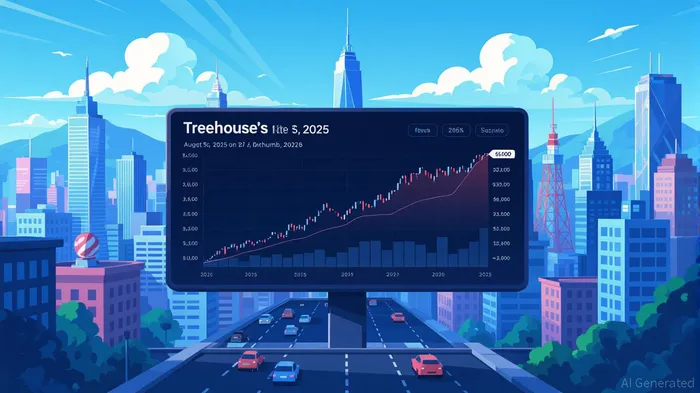
South Korea’s crypto market is a liquidity powerhouse, with trading platforms like Upbit and Bithumb accounting for over 10% of international crypto trading volume [1]. This liquidity has directly benefited Treehouse, whose recent listings on these exchanges have spurred exponential price surges. For instance, TREE’s price soared 150% following its Upbit listing on August 28, 2025, with 24-hour trading volume spiking by over 1,000% to $306 million [2]. The introduction of KRW, BTC, and USDT trading pairs has made TREETREE-- accessible to South Korea’s 12.31 million projected crypto users by 2026 [1], leveraging the country’s high user penetration rate (23.85% in 2026) [3].
The Korean market’s liquidity is further amplified by its regulatory environment. The Virtual Asset User Protection Act (VAUPA), enacted in July 2024, has fostered trust by safeguarding user assets and curbing market manipulation [5]. This regulatory clarity has attracted both retail and institutional investors, creating a fertile ground for DeFi protocols like Treehouse to thrive.
Institutional Adoption: Bridging DeFi and Traditional Finance
Treehouse’s value proposition lies in its decentralized fixed income layer, a concept that aligns with institutional demand for yield-centric solutions in DeFi. Brandon Goh, CEO of Treehouse, argues that fixed income is the “missing link” for institutional adoption, offering structured returns to offset DeFi’s inherent volatility [2]. South Korea’s growing DeFi market—projected to reach $220.2 million in revenue by 2026 [4]—provides a natural testing ground for such innovations.
Institutional interest in Treehouse has been bolstered by its multi-chain strategy and partnerships with Korean exchanges. The Bithumb listing of the TREE/KRW pair in August 2025, for example, not only expanded accessibility but also reduced transaction costs for local investors [3]. Additionally, Treehouse’s ecosystem surpassed $500 million in July 2025, signaling strong market confidence [6]. These developments position Treehouse to capitalize on South Korea’s broader digital finance boom, which includes mobile banking and fintech services growing at a projected CAGR from 2026 to 2033 [4].
Challenges and Future Outlook
While the Korean market offers immense potential, Treehouse must navigate challenges such as regulatory complexities and cultural preferences for face-to-face interactions [4]. However, the country’s projected DeFi user base of 3.04 million by 2026 [4] and its role as a global crypto innovation hub suggest that these hurdles are surmountable.
Conclusion
The Korean crypto market’s liquidity-driven dynamics and regulatory progress have positioned it as a launchpad for Treehouse’s growth. By leveraging strategic partnerships, institutional-grade yield strategies, and a supportive ecosystem, Treehouse is well-placed to capitalize on South Korea’s DeFi expansion. As the market continues to mature, Treehouse’s focus on fixed income and multi-chain innovation could redefine institutional participation in decentralized finance.
Source:
[1] Cryptocurrencies - South Korea | Statista Market Forecast [https://www.statista.com/outlook/fmo/digital-assets/cryptocurrencies/south-korea]
[2] Treehouse's Fixed Income Layer Shakes Up DeFi [https://www.binance.com/en/square/post/28084893837193]
[3] Bithumb Lists TreeHouse (TREE) KRW Pair Boosting Local Crypto Access [https://www.ainvest.com/news/bithumb-lists-treehouse-tree-krw-pair-boosting-local-crypto-access-2508/]
[4] DeFi - South Korea | Statista Market Forecast [https://www.statista.com/outlook/fmo/digital-assets/defi/south-korea]
[5] Crypto in South Korea: Market Growth and Regulatory Trends [https://medium.com/gmo-z-com-trust-company/crypto-in-south-korea-market-growth-and-regulatory-trends-4ff94c3aebb9]
[6] Treehouse (TREE) Price Surges 150% — Upbit Listing Frenzy Strikes Again [https://www.ccn.com/analysis/crypto/treehouse-tree-price-upbit-listing/]

Decoding blockchain innovations and market trends with clarity and precision.
Latest Articles
Stay ahead of the market.
Get curated U.S. market news, insights and key dates delivered to your inbox.




Comments
No comments yet