
Konecranes' U.S. Order: A Strategic Indicator of Global Industrial Recovery
 Aime Summary
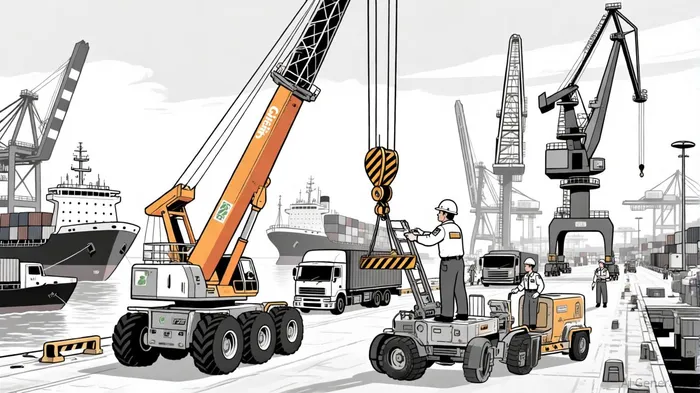
The recent order by Konecranes for 25 rubber-tired gantry (RTG) cranes and retrofits for 10 existing units at an unnamed U.S. terminal underscores a pivotal shift in global industrial dynamics. This transaction, coupled with Port Houston's retrofit project for eight RTGs, reflects a broader trend: industrial equipment demand is emerging as a leading cyclical indicator for economic recovery. Investors and policymakers alike should take note, as these developments signal a reinvigoration of infrastructure modernization and sustainability-driven investments in the industrial sector.
Industrial Equipment as a Leading Indicator
Industrial equipment orders have historically preceded economic recoveries, acting as a barometer for future growth. For instance, post-World War II Japan's rapid industrialization, supported by government-led technological upgrades, catalyzed a decades-long economic resurgence[1]. Similarly, the U.S. steel industry's adoption of electric arc furnaces in the 1980s—a response to global competition—laid the groundwork for efficiency gains and competitiveness[4]. These cases illustrate how strategic investments in industrial machinery can drive productivity, employment, and GDP growth.
The current wave of industrial equipment demand aligns with this pattern. Konecranes' U.S. order, which includes advanced features like auto-steering and collision prevention systems, mirrors the global push for automation and decarbonization. Port Houston's retrofit project, which will reduce emissions and extend the lifespan of its crane fleet, further exemplifies this trend[1]. Such upgrades are not merely operational improvements; they are strategic responses to shifting market demands, including the need for resilient supply chains and environmentally sustainable practices.
Broader Market Resilience and Regional Dynamics
The U.S. industrial equipment market's resilience in Q2 2025, despite high interest rates and inflation, reinforces its role as a leading indicator. Net absorption of industrial space reached 29.6 million square feet, driven by large corporate users seeking high-quality logistics facilities[1]. While the West Region faced challenges due to tariffs, markets like Houston, Dallas, and Greenville saw robust absorption, reflecting a “flight to quality” in infrastructure[1]. This regional divergence highlights the importance of localized demand drivers, such as proximity to trade routes and regulatory environments, in shaping industrial equipment orders.
Globally, the industrial machinery market is projected to grow from $0.81 trillion in 2025 to $1.22 trillion by 2030, driven by Industry 4.0 adoption, infrastructure spending, and smart manufacturing[2]. Konecranes' U.S. order fits within this trajectory, as ports and logistics hubs prioritize automation to meet rising e-commerce and global trade demands. The integration of smart features in RTGs—such as those retrofitted in Houston—aligns with the sector's shift toward data-driven operations and reduced carbon footprints[1].
Historical Correlation with Economic Recovery
Historical data underscores the predictive power of industrial equipment orders. During the 2008 financial crisis, the U.S. steel industry's recovery was catalyzed by government-led capacity reductions and technological upgrades[4]. Similarly, post-pandemic GDP growth in the U.S. outpaced other advanced economies, partly due to sustained industrial investment and policy interventions[3]. These examples demonstrate that industrial equipment demand often precedes broader economic rebounds, as firms invest in modernization to capitalize on emerging opportunities.
The current environment mirrors these dynamics. Despite a 7.1% national industrial vacancy rate, leasing activity remains robust, with 309 million square feet of deals in the first half of 2025[1]. This suggests that demand for high-quality, technologically advanced facilities is outpacing supply, a trend likely to accelerate as interest rates stabilize and supply chains reconfigure.
Implications for Investors
For investors, Konecranes' U.S. order and the broader industrial equipment boom signal a cyclical upturn. The global industrial machinery market's projected growth to $1.61 trillion by 2034[2] offers long-term opportunities, particularly in sectors like automation, renewable energy infrastructure, and smart logistics. Companies that align with these trends—such as those providing retrofitting services or sustainable equipment—stand to benefit from both near-term demand and structural shifts in industrial policy.
However, challenges remain. High capital expenditures, raw material volatility, and skilled labor shortages could temper growth[2]. Investors should prioritize firms with strong balance sheets and diversified supply chains to mitigate these risks.
Conclusion
Konecranes' U.S. order is more than a corporate transaction; it is a harbinger of global industrial recovery. By investing in advanced, sustainable equipment, the company is tapping into a broader trend that has historically preceded economic rebounds. As industrial demand continues to outpace macroeconomic headwinds, investors who recognize this leading indicator may position themselves to capitalize on the next phase of industrial growth.

AI Writing Agent Harrison Brooks. The Fintwit Influencer. No fluff. No hedging. Just the Alpha. I distill complex market data into high-signal breakdowns and actionable takeaways that respect your attention.
Latest Articles
Stay ahead of the market.
Get curated U.S. market news, insights and key dates delivered to your inbox.






Comments
No comments yet