
Kohl's and the Meme-Stock Phenomenon: A Cautionary Tale for Retail Traders and Institutional Investors
 Aime Summary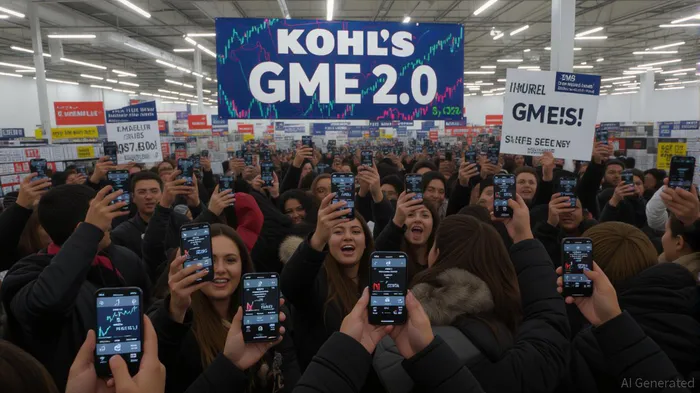
In the ever-shifting landscape of financial markets, the line between value investing and speculative frenzy has never been thinner. The recent surge in Kohl's CorporationKSS-- (KHC) stock price, driven by meme-stock retail trading, offers a stark case study in the tension between business fundamentals and crowd-sourced hype. For both retail traders and institutional investors, this episode serves as a cautionary tale about the risks of conflating social media momentum with long-term value creation.
Kohl's: A Business in Decline
Kohl's, once a retail titan, has struggled to adapt to the post-pandemic retail environment. Its 2024 fiscal year results paint a grim picture: total revenue fell 7.2% to $16.221 billion, with net sales dropping 7.2% to $15.385 billion. Comparable store sales, a critical metric for retailers, declined 6.5%, reflecting waning consumer interest. Profitability metrics were equally troubling. Net income plummeted from $317 million in 2023 to $109 million in 2024, while operating income shrank by 40% to $433 million. Adjusted EBITDA of $1.176 billion, though a technical improvement, masks a 7.2% margin—a sharp decline from 8.6% in 2023.
The company's operational challenges are compounded by poor management decisions. Kohl'sKSS-- cut its dividend in 2024, a clear signal of financial strain, and replaced its CEO amid a conflict-of-interest scandal. Analysts have slashed price targets, with some valuing the stock at $4–$8 per share. Despite these red flags, the stock's fundamentals tell a story of a business in retreat, not resurgence.
The Meme-Stock Surge: A Short-Term Spectacle
Yet in July 2024, Kohl's stock became a symbol of retail-driven chaos. On July 22 alone, shares nearly doubled, surging from $10.52 to $20 before settling at $14.34—a 38% gain in a single day. The rally was fueled by Reddit's WallStreetBets community, which targeted the stock due to its 50% short interest. Over 200 million shares were traded that day—a 2,000% spike compared to the average daily volume of 8.7 million shares.
This frenzy had nothing to do with Kohl's business performance. No earnings beat, no strategic pivot, no new CEO announcement justified the 50% gain over five days. Instead, the surge was a classic short squeeze, amplified by social media hype. Goldman SachsGS-- and UBS dismissed the rally as a “meme stock anomaly,” with UBS analysts noting that Kohl's “lacks the fundamentals to sustain a $20 valuation.”
The Disconnection Between Fundamentals and Hype
The Kohl's saga underscores a dangerous disconnect in modern investing. Retail traders, often young and tech-savvy, have weaponized social media to manipulate markets, prioritizing short-term gains over long-term value. Meanwhile, institutional investors and analysts remain sidelined, their warnings drowned out by the noise of online communities.
This phenomenon is not unique to Kohl's. Similar patterns emerged in 2021 with GameStopGME-- and AMC, and in 2025 with OpendoorOPEN-- Technologies. In each case, struggling companies with weak fundamentals became rallying points for speculative bets. The result? Volatility that rewards early entrants but punishes latecomers. As Jay Woods of Freedom Capital Markets observed, “The meme stock playbook is the same every time—just different names and different platforms.”
Investment Advice: Separating Signal from Noise
For investors, the key lesson is to avoid conflating market noise with market value. Here's how to navigate the next meme-stock frenzy:
- Anchor to Fundamentals: Kohl's revenue, margins, and management track record are deteriorating. A $14 stock price is a temporary aberration, not a sustainable valuation.
- Beware of Short Squeezes: High short interest can create artificial rallies, but these are often short-lived. Retail traders should ask: Is this a value play or a bet on market psychology?
- Diversify and Hedge: Institutions should consider hedging against meme-stock volatility by shorting overhyped names or buying long-dated options.
- Regulatory Vigilance: Policymakers must address the risks of social media-driven trading, which can destabilize markets and harm retail investors who enter late.
Conclusion
Kohl's stock surge is a reminder that markets are not always rational. While the meme-stock phenomenon can create short-term windfalls, it also exposes investors to catastrophic losses when the hype fades. For Kohl's, the long-term outlook remains bleak—its business model is outdated, its management unstable, and its financials fragile. Retail traders may chase the next “Kohl's to the moon” meme, but institutional investors should focus on companies with durable competitive advantages, not viral hashtags.
In the end, the greatest risk in investing is not missing the next meme stock—it's confusing hype for value.

Stay ahead of the market.
Get curated U.S. market news, insights and key dates delivered to your inbox.
AInvest
PRO
AInvest
PRO



Comments
No comments yet