
Kodiak’s 2026 Q2 Call: Hardware Shift, Long-Haul Delays, and Revenue Uncertainty Clash
 Aime Summary
Date of Call: Aug 6, 2026
Financials Results
- Revenue: $3.5 million, representing a 91% quarter-over-quarter growth, primarily driven by expansion of driver-as-a-service revenue and a one-time contribution from an autonomous trucking demonstration program
Guidance:
- Driverless truck deployments expected to increase to high thirties during Q3, with a temporary slowdown as the new platform is integrated.
- Free cash flow for Q3 expected to be negative $39 million to negative $41 million.
- Full-year 2026 free cash flow guidance narrowed to negative $162 million (from prior range of negative $155 million to negative $165 million).
- Expect to complete the initial 100 truck commitment with Atlas by end of first half of 2027.
- Target long-haul driverless launch by year-end.
Business Commentary:
Commercial Deployment and Fleet Expansion:
- Kodiak achieved a total of
35 driverless trucksdeployed by the end of Q2 2026, an increase from28in the prior quarter. - The company completed
over 40,000 paid driverless hours, marking a71%increase from Q1 and a significant rise year-on-year. - This growth was driven by the expansion of customer-owned driverless truck fleets and the introduction of more efficient and reliable autonomous trucking solutions.
Autonomy Readiness and Long-Haul Launch:
- The company's long-haul autonomous readiness measure increased to
91%as of July, up5 pointsin three months. - Significant progress was made in safety-critical vehicle control architecture and a probabilistic risk assessment framework.
- This advancement is attributed to investments in AI-enabled development tools, growing fleet of dedicated development trucks, and structured track testing programs.
Revenue Growth and Strategic Partnerships:
- Revenue for Q2 2026 was
$3.5 million, reflecting a91%quarter-over-quarter increase, driven by expansion in driver-as-a-service revenue. - The company saw strong sequential growth excluding a one-time demonstration revenue contribution.
- Revenue growth was supported by strategic partnerships and the successful execution of long-haul driverless initiatives.
Gen 7 Platform Introduction:
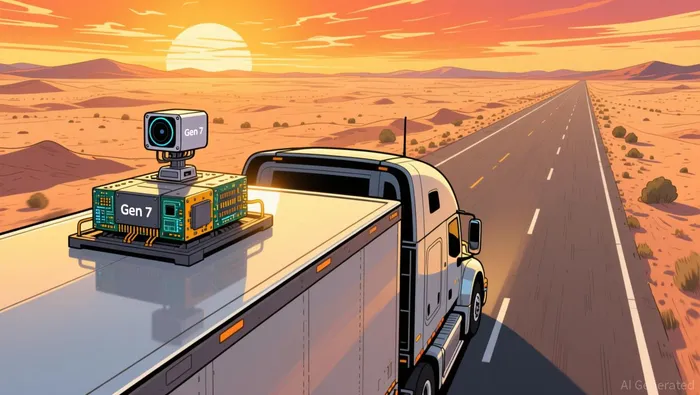
- Kodiak introduced its 7th generation platform, which is
50%more powerful than the previous generation and features a more compact form factor. - This platform represents a significant step in cost reduction and efficiency improvements for Kodiak's AV hardware stack.
- The enhancements are aimed at improving reliability and expanding integration possibilities across various truck configurations.
Regulatory Progress and Market Opportunity:
- California's Department of Motor Vehicles finalized new regulations extending its autonomous vehicle permitting program to include heavy-duty trucks.
- This regulatory development creates a clear path for Kodiak to offer coast-to-coast driverless services.
- The favorable regulatory environment, combined with economic and industry trends, reinforces the long-term trucking opportunity for Kodiak.
Sentiment Analysis:
Overall Tone: Positive
- Statements like 'Q2 was a quarter of significant commercial validation and increasing scale' and 'We are also moving at high velocity toward our targeted driverless long-haul launch by year-end' underscore strong progress. Management expressed confidence in the long-haul launch timing and regulatory developments, stating 'we are increasingly confident that autonomous trucking will be included in the final surface transportation legislative package.'
Q&A:
- Question from Andres Fitzgerald: Can you provide more granularity on the cadence for Q3 and Q4 deployments and for next year?
Response: Will start small with Q3 deployments on the new platform, ramp up through Q4, Q1, and Q2, and deploy a similar number in the second half of 2026 as in the first half.
- Question from Andres Fitzgerald: How does the Gen 7 hardware launch affect scale and fleet planning, and what are the plans for previous hardware?
Response: Will continue supporting existing platforms; all new trucks will have Gen 7 for improved efficiency, reliability, and cost savings. The transition to Gen 7 is part of a strategy to drive down AV hardware costs.
- Question from Andres Fitzgerald: How are you thinking about opportunities in California?
Response: Excited about California permit, which would enable coast-to-coast operations. Already discussing opportunities with customers there, but focus remains on Texas for the next several quarters.
- Question from TD Cowen: What milestones should we expect in the next 6-12 months in defense, and how do we size the opportunity?
Response: Defense is a long-term strategy; visibility on program sizing and timing is difficult. Revenues from defense are viewed as purely additive to the core business.
- Question from TD Cowen: Can you quantify the cost or unit economics impact of Gen 7, and does it incorporate Bosch benefits?
Response: Gen 7 is expected to result in a low double-digit reduction in AV hardware stack costs. Benefits from the Bosch supply chain initiative will be seen more in 2027 and beyond.
- Question from Brian (Craig Hallam Capital Group): Can you quantify the previous generation's useful life and Gen 7's lifetime?
Response: Gen 7 is expected to exceed the typical ~4-year useful lifetime of trucks in the Permian Basin. Previous generation systems have shown 'incredible reliability' over 18 months.
- Question from Brian (Craig Hallam Capital Group): What does the Daimler engagement mean for Kodiak?
Response: It validates Kodiak's platform-agnostic approach and allows integration onto a more economical day cab configuration, expanding deployment opportunities.
- Question from Nancy (Morgan Stanley): Which safety case claims remain open, and what are the gating factors before 100% readiness?
Response: Most technically challenging and longest lead-time claims have been closed. The system is expected to reach 100% readiness and launch by the end of December.
- Question from Nancy (Morgan Stanley): How does Breakpoint technology differentiate Kodiak and help close the safety case faster?
Response: Breakpoint is a game-changer that intelligently searches for rare edge cases in a high-dimensional simulation space, focusing resources on the hardest scenarios to close safety claims efficiently.
- Question from Walt (Unknown Firm): How was the Gen 7 platform integrated into the day cab configuration to achieve 50% more compute power?
Response: Required engineering work on form factor, thermal management, and power challenges to fit the compute system into the smaller day cab, proving the platform's agnosticism to different truck configurations.
Contradiction Point 1
Hardware Platform Strategy and Support
Contradiction on supporting existing hardware vs. transitioning to new platform, impacting product lifecycle and customer support strategy.
Andres Fitzgerald (Questioner) - Andres Fitzgerald (Questioner)
2026Q2: We do not plan to retrofit existing trucks and will continue supporting the previous platform. - Don Brunette(CEO) and Sirajit Dada(CFO)
Can you provide details on the deployment cadence for Q3 and Q4, the full deployment timeline by mid-2027, and for the Gen 7 hardware launch, whether previous hardware will be discontinued and your strategy for opportunities in California? - Colin Rusch (Oppenheimer)
2026Q1: The next-gen SensorPod concept demonstrated with Bosch includes the supplier's in-house radar and camera sensors. - Don Burnette(CEO)
Contradiction Point 2
Future Revenue Visibility and Specificity
Contradiction on providing specific guidance for defense programs, affecting investor predictability and valuation.
TD Cowen (Questioner) - TD Cowen (Questioner)
2026Q2: The company is cautious about providing specific guidance and views these potential revenues as purely additive. - Don Brunette(CEO)
What milestones should we expect in the next 6-12 months for defense opportunities, and how do you size the opportunity over the next few years? - Itay Michaeli (TD Cowen)
2026Q1: Defense is promising due to significant budget increases (e.g., $50B+ for autonomy in FY2027) but timing is harder to predict. - Don Burnette(CEO)
Contradiction Point 3
Deployment Cadence and Ramp Expectations
Contradiction on the expected pace of deployment in the second half of 2026, affecting operational planning and investor expectations.
Andres Fitzgerald (Questioner) - Andres Fitzgerald (Questioner)
2026Q2: There will be a temporary slowdown in Q3 as the new platform is validated, with ramp-up beginning in Q4... - Don Brunette(CEO) and Sirajit Dada(CFO)
Can you provide more details on the deployment cadence for Q3 and Q4, as well as the full deployment timeline by mid-2027? - Andres Sheppard (Cantor Fitzgerald)
2026Q1: Deployments in the second half of 2026 are expected to look similar to the first half. The ramp of trucks is expected to accelerate quarter-over-quarter... - Don Burnette(CEO)
Contradiction Point 4
Customer Truck Economics
The economic benefit model for customers appears to have changed, impacting the value proposition and financial modeling for customers and investors.
Walt (Questioner) - Walt (Questioner)
2026Q2: The primary economic benefit of the day cab (lower cost) is passed on to the customer, who owns the trucks. In this DAS (Driver-as-a-Service) model, the savings are directly realized in the customer's bottom line. - Don Brunette(CEO)
Does the customer capture the per-mile economic benefit of the day cab, or can Kodiak increase its per-truck rate? - James McIlree (Chardan Capital Markets, LLC, Research Division)
2025Q4: The scale of Kodiak's operations is not materially affected by short-term oil market fluctuations. - Don Burnette(CEO)
Contradiction Point 5
Long-Haul Launch Readiness and Timeline
Inconsistency regarding the timeline for achieving 100% safety readiness and launching long-haul operations, impacting strategic milestones and investor confidence.
Nancy (Morgan Stanley) - Nancy (Morgan Stanley)
2026Q2: The company is confident that the readiness measure will accelerate and reach 100% by the end of December 2026. - Don Brunette(CEO)
At 91% autonomous readiness, what safety case claims remain unresolved, and what are the key factors preventing a 100% declaration? - Andres Sheppard-Slinger (Cantor Fitzgerald & Co.)
2025Q3: Kodiak is reasonably confident in a second-half 2026 launch and expects to see quarter-over-quarter improvement in the ARM metric. - Don Burnette(CEO) and Surajit Datta(CFO)
 <<
<<
Discover what executives don't want to reveal in conference calls
Latest Articles
Stay ahead of the market.
Get curated U.S. market news, insights and key dates delivered to your inbox.


AInvest
PRO
AInvest
PRO




Comments
No comments yet