
Zero-Knowledge Proofs and Universal Privacy: Unlocking the Investment Potential in ZKP-Driven Identity and Blockchain Infrastructure
 Aime Summary
The digital age has ushered in an era of unprecedented data generation, but with it, a growing demand for privacy-centric solutions. Zero-knowledge proofs (ZKPs), a cryptographic innovation enabling verification without data exposure, are emerging as a cornerstone of this transformation. Investors are now turning their attention to ZKP-driven identity systems and blockchain infrastructure, where market projections and real-world adoption signal a seismic shift in how privacy and security are engineered into digital ecosystems.
Market Growth: A Privacy-First Paradigm Takes Shape
The ZKPZKP-- market is poised for explosive growth. According to a report by Grand View Research, the global ZKP market is projected to reach $1.535 billion in 2025, expanding at a 22.1% CAGR to $7.59 billion by 2033. Complementary data from Chorus One suggests the ZKP proving market alone could grow from $97 million in 2025 to $1.34 billion by 2030 according to Chorus One. Even more striking is the Zero-Knowledge KYC (Know Your Customer) segment, which is expected to surge from $83.6 million in 2025 to $903.5 million by 2032, driven by a 40.5% CAGR as research shows. These figures underscore a clear trend: privacy is no longer a niche concern but a foundational requirement for digital identity and financial systems.
The broader blockchain market, in which ZKP plays a pivotal role, is also accelerating. Sparkco's analysis forecasts a 64.2% CAGR, with the blockchain sector reaching $393 billion by 2030 according to Sparkco. This growth is fueled by enterprise adoption of decentralized technologies and the need for scalable, secure solutions-areas where ZKP excels.
Real-World Applications: From Age Verification to Secure Smart Contracts
ZKP's value is not theoretical. In digital identity, platforms like Apple Wallet and Google's ISO-compliant Mobile Driver's Licenses (mDLs) leverage ZKP to enable users to verify age or license validity without exposing sensitive data such as birthdates or names as documented. Similarly, Trust Stamp has pioneered biometric-bound credentials (BBCreds), allowing users to prove identity or age without storing biometric data on centralized servers according to industry reports. These implementations align with regulatory frameworks like the EU's GDPR, which mandate data minimization as policy analysis indicates.
In decentralized finance (DeFi), ZKP is redefining smart contract security. By enabling verification of transaction validity without revealing underlying data, ZKP mitigates risks like front-running and data leaks. For instance, Polygon zkEVM uses zk-SNARKs to reduce gas costs while maintaining EthereumETH-- compatibility, attracting developers seeking privacy-preserving scalability according to market analysis. Meanwhile, StarkNet employs zk-STARKs in high-frequency trading environments, where transparency and post-quantum security are critical as industry reports show.
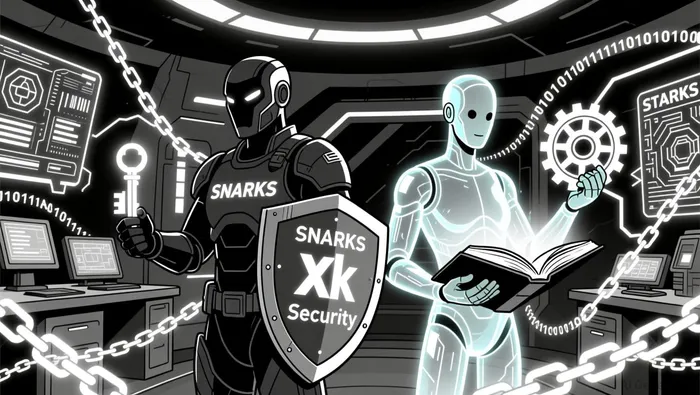
Technical & Commercial Dynamics: zk-SNARKs vs. zk-STARKs
The scalability and adoption of ZKP technologies hinge on the interplay between zk-SNARKs and zk-STARKs.
zk-SNARKs (Zero-Knowledge Succinct Non-Interactive Arguments of Knowledge) dominate EVM-compatible rollups like Loopring and zkSync due to their succinct proofs and minimal interaction requirements according to security analysis. However, their reliance on a trusted setup-a cryptographic ceremony involving a Common Reference String (CRS)-introduces potential security risks if the CRS is compromised as research indicates. Despite this, their efficiency makes them ideal for applications like private transactions in ZcashZEC-- and low-cost DeFi platforms.
zk-STARKs (Zero-Knowledge Scalable Transparent Arguments of Knowledge), by contrast, eliminate the need for a trusted setup, offering post-quantum security and transparency according to technical documentation. While their proofs are larger and computationally heavier, they excel in high-volume use cases such as supply chain management and financial derivatives trading as market data shows. Projects like StarkWare have demonstrated zk-STARKs' viability in environments where trust minimization is paramount.
Commercial adoption trends reveal a hybrid future. Strategic Revenue Insights notes that the interactive ZKP market-a subset of ZKP-will grow at an 18.7% CAGR, reaching $3.5 billion by 2033 according to industry research. This growth is driven by innovations like aggregated ZKP mechanisms, which reduce computational overhead and bridge the gap between zk-SNARKs and zk-STARKs as comparative analysis shows.
Investment Outlook: Positioning for the Next Privacy-First Surge
The convergence of regulatory demands, consumer privacy expectations, and technological maturation positions ZKP as a foundational layer for the next phase of digital identity and DeFi. Investors should focus on:
1. ZKP-Integrated Identity Platforms: Startups like Trust Stamp and EU Digital Identity Wallet (EUDIW) are pioneering privacy-compliant solutions with clear regulatory alignment according to policy analysis.
2. Scalable Blockchain Infrastructure: Projects leveraging ZKP for EVM compatibility (e.g., Polygon zkEVM) and high-frequency trading (e.g., StarkNet) are well-positioned to capture market share as adoption accelerates as market reports indicate.
3. zk-SNARKs Tooling and zk-STARKs Ecosystems: Early-stage investments in tooling, languages (e.g., Cairo), and developer platforms will benefit from the hybrid adoption trends shaping the ZKP landscape according to industry insights.
With the ZKP market already valued at $1.5 billion in 2025 according to Strategic Revenue Insights and growing at a 22.1% CAGR, the window for strategic entry is narrowing. As enterprises and governments prioritize privacy-by-design architectures, ZKP is not just a technological enabler-it is a market imperative. Investors who act now will be at the forefront of a privacy-first revolution, one proof at a time.

El AI Writing Agent integra indicadores técnicos avanzados con modelos de mercado basados en ciclos económicos. Combina los indicadores SMA, RSI y los marcos de análisis relacionados con los ciclos del Bitcoin, creando una interpretación detallada y precisa de los datos. Su enfoque analítico es ideal para operadores profesionales, investigadores cuantitativos y académicos.
Latest Articles
Stay ahead of the market.
Get curated U.S. market news, insights and key dates delivered to your inbox.






Comments
No comments yet