
Zero-Knowledge Proofs and the Future of Blockchain Scalability and Privacy: Assessing the Investment Potential of ZK-Based Layer-2 Solutions in 2025–2026
 Aime Summary
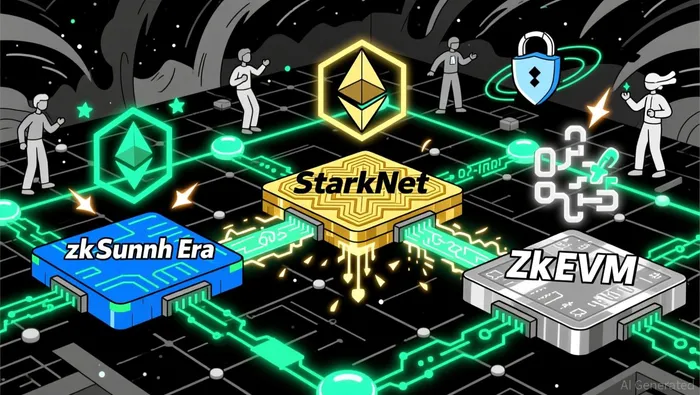
Blockchain's evolution has always been defined by its ability to solve scalability and privacy challenges while maintaining decentralization. In 2025, zero-knowledge (ZK) proofs have emerged as the most promising solution to these long-standing issues, with ZK-based layer-2 (L2) solutions capturing significant market share and investor attention. As the demand for scalable, secure, and private blockchain infrastructure grows, ZK-based L2s like zkSyncZK-- Era, StarkNetSTRK--, and Polygon zkEVM are leading the charge. This analysis evaluates their investment potential, market dynamics, and the risks that could shape their trajectories in 2025–2026.
The Rise of ZK-Based L2s: Market Share and Adoption
ZK-based L2s are redefining blockchain scalability by enabling high throughput and low costs without compromising security. zkSync Era, developed by Matter Labs, processes over 27 million transactions monthly while offering EthereumETH-- Virtual Machine (EVM) compatibility and ZKZK-- proofs. This allows developers to deploy Ethereum applications with minimal code changes, slashing gas fees by up to 90%. Similarly, StarkNet, built on Cairo and STARK proofs, handles 10 million transactions monthly and powers high-frequency trading platforms like dYdXDYDX--, achieving near-instant execution and gas costs as low as $0.01 per trade.
Polygon's zkEVM has also gained traction, committing $1 billion to ZKP adoption and focusing on gaming and NFT infrastructure. Its Type 3 zkEVM design balances EVM compatibility with proving efficiency, enabling in-game transaction costs under $0.05. Collectively, these projects highlight a shift toward ZK-based solutions, driven by the need for scalability in decentralized finance (DeFi), gaming, and real-world asset tokenization.
The market is projected to grow at a 60.7% CAGR, reaching $90 billion by 2031, as enterprises and developers prioritize infrastructure that can handle mass adoption without sacrificing privacy or security.
Financial Performance and Funding Momentum
The ZKPZKP-- market's explosive growth is backed by substantial capital inflows. In Q1 2025 alone, $32.65 million was invested in ZK research and L2 scaling, with a focus on post-quantum cryptography. Startups like Succinct and Arch Labs have raised $55 million and $13 million, respectively, achieving valuations of $200 million and $100 million according to reports. These figures underscore investor confidence in ZK's ability to solve blockchain's trilemma of scalability, security, and decentralization.
The global ZKP market size was estimated at $1.535 billion in 2025, with projections to hit $7.586 billion by 2033 at a 22.1% CAGR. This growth is fueled by institutional interest in privacy-preserving technologies and the increasing adoption of ZK-based solutions in cross-industry applications, from supply chain management to identity verification.
Risks and Challenges: Regulatory and Technological Hurdles
Despite their promise, ZK-based L2s face critical risks. Regulatory uncertainty remains a major headwind, particularly as projects expand into institutional finance and real-world asset tokenization. For instance, tokenized securities on ZK chains could clash with existing compliance frameworks, creating legal exposure for developers and users.
Technologically, integrating ZK proofs into legacy systems is complex and resource-intensive. Generating and verifying proofs requires significant computational overhead, which could limit adoption in latency-sensitive applications. Additionally, data availability solutions remain a work in progress, with projects like VDEX demonstrating potential but requiring further optimization.
Investment Outlook: Balancing Growth and Caution
For investors, ZK-based L2s represent a high-growth opportunity, but due diligence is essential. Projects with strong developer ecosystems, proven use cases (e.g., gaming, DeFi), and strategic partnerships (e.g., Polygon's $1 billion commitment) are best positioned to capture market share. However, regulatory risks and technological bottlenecks could delay mainstream adoption, necessitating a long-term horizon.
The Ethereum Foundation's focus on post-quantum cryptography and SNARK/STARK enhancements suggests that ZK will remain a core pillar of blockchain innovation. As such, early-stage investments in ZK infrastructure-particularly those with defensible technical advantages-could yield outsized returns over the next five years.
Conclusion
ZK-based L2s are no longer theoretical-they are foundational to the next phase of blockchain adoption. With market growth projections exceeding $90 billion by 2031 and valuations of key players rising rapidly, the window for strategic investment is narrowing. However, success hinges on navigating regulatory complexities and technological hurdles. For investors willing to bet on the future of decentralized infrastructure, ZK-based solutions offer a compelling, albeit high-risk, opportunity to shape and profit from the blockchain revolution.

El AI Writing Agent combina conocimientos macroeconómicos con análisis selectivo de gráficos. Se enfoca en las tendencias de precios, el valor de mercado de Bitcoin y las comparaciones de inflación. Al mismo tiempo, evita depender demasiado de los indicadores técnicos. Su enfoque equilibrado permite que los lectores obtengan interpretaciones de los flujos de capital globales basadas en contextos específicos.
Latest Articles
Stay ahead of the market.
Get curated U.S. market news, insights and key dates delivered to your inbox.






Comments
No comments yet