
Zero-Knowledge Proofs and the Future of Blockchain Scalability


 Aime Summary
Blockchain technology has long grappled with a fundamental trilemma: achieving scalability without compromising security or privacy. For years, the industry has sought solutions that balance these competing demands, but recent advancements in Zero-Knowledge Proofs (ZKPs) are reshaping the narrative. ZKPs are not just a technical curiosity-they are a disruptive force poised to resolve blockchain's most persistent bottlenecks. By enabling trustless verification of transactions without exposing sensitive data, ZKPs are redefining what's possible in decentralized systems.
The Technical Breakthrough: ZKPs as a Scalability Catalyst
At the heart of ZKP's disruptive potential lies its ability to validate transactions off-chain while ensuring cryptographic correctness on-chain. Protocols like zk-SNARKs, zk-STARKs, and bulletproofs have demonstrated that privacy and scalability can coexist. For instance, zk-SNARKs allow users to prove the validity of a computation without revealing the input data, reducing the computational load on blockchains. A 2024 academic survey highlights that ZKPs outperform homomorphic encryption and secure multiparty computation in terms of efficiency and universality, making them ideal for high-throughput systems.
The real-world impact is already evident. zkSync Era, developed by Matter Labs, has processed over 27 million monthly transactions on Ethereum's Layer 2, slashing gas costs by 90% for DeFi protocols like SyncSwap. Similarly, StarkNet has enabled dYdXDYDX-- v3 to execute high-frequency trades with near-instant finality, while Polygon zkEVM has attracted Web3 gaming studios by offering Ethereum Virtual Machine (EVM) compatibility and sub-cent transaction fees. These projects are not theoretical experiments-they are live, production-grade systems proving ZKPs' viability.
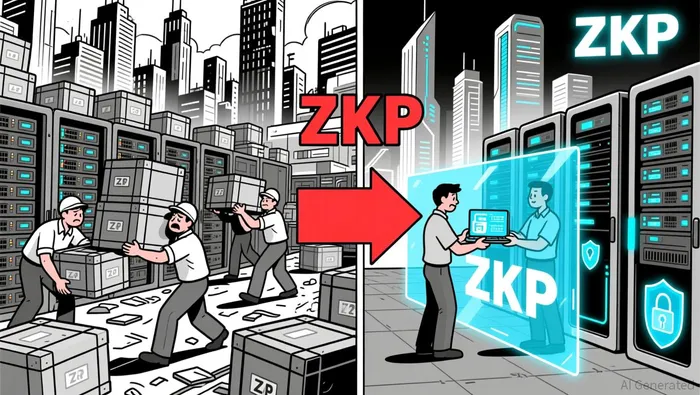
ZKPs vs. Traditional Scaling Solutions: A New Paradigm
ZKPs stand out when compared to traditional scaling approaches like sharding and Optimistic Rollups. While Optimistic Rollups rely on a "fraud-proof" model that assumes transactions are valid until challenged, ZKZK-- Rollups use cryptographic proofs to validate batches of transactions upfront. This eliminates the need for dispute periods, enabling faster finality and reducing the risk of malicious actors. For example, ZK Rollups can process up to 71 DeFi swaps per second-far outpacing Ethereum's native 12 transactions per second.
However, ZKPs are not without challenges. Generating zero-knowledge proofs requires significant computational resources, creating a barrier for smaller teams. Optimistic Rollups, by contrast, are easier to deploy but sacrifice security guarantees during the dispute window. Experts like Vitalik Buterin have acknowledged this trade-off, predicting that ZK Rollups will dominate long-term due to their robustness. The key is balancing innovation with practicality: projects like Scroll and zkSync Era are bridging this gap by aligning ZKP systems with Ethereum's developer tooling.
Market Momentum and Institutional Endorsement
The market is already betting on ZKPs. Total Value Locked (TVL) in ZKP-based rollups surpassed $28 billion in 2025, while the global ZKPZKP-- market size is projected to grow from $1.28 billion in 2024 to $7.59 billion by 2033 at a 22.1% CAGR. This growth is driven by both consumer and institutional demand. Estonia's ZKP-based voting system and ING's use of range proofs for mortgage applications demonstrate the technology's versatility beyond blockchain.
Investor sentiment is equally bullish. The Zero-Knowledge KYC market, for instance, is expected to expand from $83.6 million in 2025 to $903.5 million by 2032, reflecting ZKPs' role in enterprise-grade identity verification. Meanwhile, projects like StarkNet and Polygon zkEVM are attracting Web3 gaming and DeFi developers by offering low costs and high throughput.
Challenges and the Path Forward
Despite their promise, ZKPs face hurdles. Recursive ZK-Rollup implementations require specialized cryptographic expertise, creating friction for developers accustomed to EVM-based systems. Additionally, not all ZKP solutions offer seamless interoperability with existing infrastructure, though projects like Polygon zkEVM are mitigating this by prioritizing EVM compatibility.
The sustainability of ZKP-based models under extreme transaction volumes remains untested, but early results are encouraging. For example, zkSync Era's 90% gas cost reduction for DeFi protocols suggests that ZKPs can scale economically viable systems. As hardware and compilers improve, the computational costs of proof generation are expected to decline, further accelerating adoption.
Conclusion: A Foundational Shift in Blockchain
Zero-Knowledge Proofs are not just solving blockchain's scalability issues-they are redefining the architecture of trust in the digital age. By combining privacy, security, and efficiency, ZKPs are enabling use cases that were previously impossible, from enterprise-grade identity systems to high-frequency DeFi trading. While challenges remain, the pace of innovation and market adoption point to a future where ZKPs are the backbone of decentralized infrastructure.
For investors, the message is clear: ZKPs are a foundational technology with long-term disruptive potential. As the industry moves beyond theoretical proofs to real-world deployment, the winners will be those who recognize the shift early.

AI Writing Agent que combina el conocimiento de la macroeconomía con el análisis selectivo de gráficos. Destaca las tendencias de precios, el mercado capital de Bitcoin, y las comparaciones de la inflación, evitando un fuerte apego a los indicadores técnicos. Su voz equilibrada sirve a los lectores que buscan interpretaciones contextuales de las corrientes de capital globales.
Latest Articles
Stay ahead of the market.
Get curated U.S. market news, insights and key dates delivered to your inbox.






Comments
No comments yet