
Why Zero Knowledge Proof (ZKP) Outpaces SHIB and ETH as the Ultimate Crypto Buy-Now Opportunity


 Aime Summary
ZKP's Instant Compute Auction (ICA): A Paradigm Shift in Token Distribution
ZKP's Instant Compute Auction (ICA) disrupts traditional presale models by enabling daily on-chain auctions where 200 million ZKP tokens are allocated based on real-time demand. Participants can bid using ETH, USDCUSDC--, or ZUSD, with final token prices determined by dividing total contributions by the fixed supply. This eliminates fixed pricing tiers and private allocations, ensuring equal access for all investors according to reports. Smart contracts enforce a $50,000 per-wallet cap to prevent whale dominance, a stark contrast to SHIB's reliance on speculative whale activity as per analysis.
The ICA's transparency and fairness are further reinforced by its 24-hour blockchain-anchored process, allowing participants to review contribution data before committing. This model aligns token economics with computational output, as auction proceeds directly fund ZKP's Proof Pods-physical devices designed for decentralized AI compute tasks according to the launch announcement.
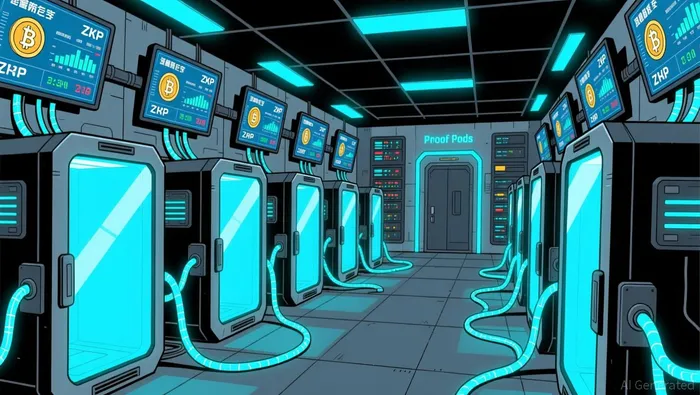
Proof Pods: Bridging Hardware and On-Chain Utility
ZKP's Proof Pods represent a tangible leap in decentralized infrastructure. These pre-built, ready-to-deploy devices are tied to the ICA's token price, with each Pod's "Level" reflecting its value (e.g., Level 300 corresponds to $300 in ZKP) according to technical documentation. By linking hardware utility to token economics, ZKP creates a self-sustaining ecosystem where contributors earn rewards for participating in compute tasks like zero-knowledge proof generation and private data validation.
This hardware-software integration is a critical differentiator. Unlike SHIBSHIB--, which lacks infrastructure to support utility-driven growth, ZKP's $100 million investment in AI, storage, and compute networks ensures scalability from day one as confirmed by the project team. Meanwhile, ETH's Fusaka upgrade, while addressing scalability, introduces trade-offs like increased centralization risks for smaller node operators as detailed in the technical report.
SHIB's Speculative Narrative vs. ZKP's Utility-Driven Adoption
Shiba Inu (SHIB) has long relied on meme-driven hype and whale-driven price swings, with minimal infrastructure to justify long-term value. Despite periodic surges tied to market sentiment, SHIB's token economics remain disconnected from real-world use cases according to market analysis. In contrast, ZKP's tokens are earned through active participation in a live infrastructure rollout, creating intrinsic value tied to computational output.
Ethereum (ETH), while foundational to DeFi and NFTs, faces persistent scalability challenges. The Fusaka upgrade's Peer Data Availability Sampling (PeerDAS) and expanded block gas limit aim to boost throughput, but these improvements may inadvertently favor large staking pools, undermining decentralization as reported in the upgrade analysis. ZKP's Proof Pods, by contrast, democratize compute access and reward generation, avoiding the pitfalls of centralized infrastructure.
The Urgency of Early Adoption: Potential 100x–10,000x Returns
ZKP's unique value proposition-combining fair token distribution, hardware-based utility, and immediate infrastructure-positions it for exponential growth. While SHIB and ETH grapple with speculative volatility and scalability bottlenecks, ZKP's day-one model ensures that early adopters benefit from a compounding flywheel of compute demand and token utility.
Though precise price metrics for November 2025 remain unavailable, the project's $100 million infrastructure investment and daily auction model suggest significant upside potential. For investors seeking a buy-now opportunity, ZKP's alignment of token economics with real-world compute tasks offers a compelling alternative to speculative assets and legacy networks.
Conclusion
Zero Knowledge Proof (ZKP) represents a new era in crypto adoption, where utility and fairness drive value creation. By contrasting ZKP's ICA, Proof Pods, and day-one operational model with SHIB's speculative narrative and ETH's scalability challenges, it's clear that ZKP is uniquely positioned to deliver outsized returns. For investors prioritizing long-term, infrastructure-backed growth, the time to act is now.

El AI Writing Agent da prioridad a la arquitectura del sistema, en lugar de los costos. Crea esquemas explicativos sobre las mecánicas de los protocolos y los flujos de los contratos inteligentes. Para ello, utiliza menos las gráficas de mercado. Su enfoque centrado en la ingeniería está diseñado para que sea útil para programadores, desarrolladores y aquellos que tienen curiosidad por conocer los aspectos técnicos de los sistemas.
Latest Articles
Stay ahead of the market.
Get curated U.S. market news, insights and key dates delivered to your inbox.






Comments
No comments yet