
Is Zero Knowledge Proof (ZKP) the Next Ethereum-Level Disruption in 2026?


 Aime Summary
The cryptocurrency and blockchain space has long been defined by paradigm-shifting innovations. Ethereum's rise in the mid-2010s, driven by smart contracts and decentralized finance (DeFi), reshaped the industry's trajectory. Today, a new contender-Zero Knowledge Proof (ZKP) technologies-is emerging, promising to address privacy, scalability, and verifiability with a level of integration that mirrors Ethereum's foundational role. As market projections show, the ZKP market will achieve a compound annual growth rate (CAGR) of 22.1% from 2025 to 2033, reaching $7.5856 billion by 2033, investors are asking: Could ZKP replicate Ethereum's disruptive impact by 2026?
Structural Parallels to Ethereum's Growth
Ethereum's early success was rooted in its ability to solve a critical problem-enabling programmable money through smart contracts-while attracting developers and enterprises. ZKP is following a similar trajectory but with a sharper focus on privacy and scalability from the outset.
According to market data, Ethereum's market cap surged from under $50 million to $1 billion between 2015 and 2017 as the ICO boom drove demand for ETHETH--. Today, ZKP-based solutions are operationalizing privacy-preserving use cases such as proof of reserves (e.g., OKX's implementation) and ZK-rollups (e.g., StarkNet's 10,000+ TPS throughput) as detailed in recent reports. These innovations are not just incremental improvements but foundational shifts in how blockchain networks handle data and computation.
Developer activity is another key parallel. Ethereum's growth was fueled by tools like Solidity and the EthereumETH-- Virtual Machine (EVM), which lowered barriers to entry. Similarly, ZKP ecosystems are seeing the rise of zero-knowledge virtual machines (zkVMs) and domain-specific languages (DSLs), enabling developers to build provable applications in familiar languages. Projects like zkSyncZK-- Era and Polygon zkEVM are further accelerating adoption by ensuring EVM compatibility, reducing transaction costs, and expanding use cases for DeFi and gaming.
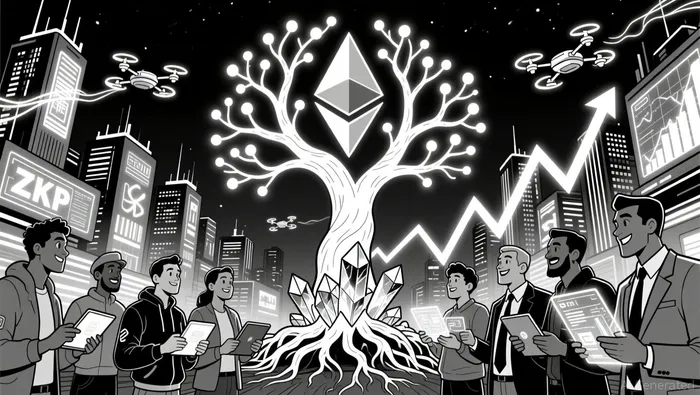
The AI-Crypto Convergence: A New Frontier
Where Ethereum's disruption was largely confined to finance and smart contracts, ZKP is unlocking a broader AI-crypto convergence. This synergy is evident in three areas:
Private AI Networks: Zero Knowledge Proof (ZKP) is pioneering a decentralized AI network where sensitive data can be processed without exposure. By leveraging Proof Pods-$249 hardware devices-users can perform AI tasks while earning rewards, creating a decentralized infrastructure for privacy-preserving computation. This model contrasts sharply with traditional AI systems, which rely on centralized data repositories.
Healthcare and Identity Verification: ZKPs are enabling AI to analyze encrypted medical data for predictive analytics without compromising patient privacy as research shows. In identity systems, ZKBAR-V's dual-blockchain framework allows users to verify academic credentials or age without revealing personal details according to industry analysis. These applications are critical for sectors where data privacy is paramount.
Institutional Partnerships: The ZKP ecosystem is attracting major players. For instance, Barcelona FC's three-year partnership with ZKP integrates private AI solutions into sports analytics, while Ripple's planned zero-knowledge privacy layer for the XRP Ledger aims to enable confidential institutional settlements. Such collaborations signal growing institutional confidence in ZKP's utility.
Challenges and the Road Ahead
Despite these parallels, ZKP faces hurdles. As industry reports indicate, computational demands for ZKP generation remain high, and interoperability between different zero-knowledge systems is still evolving. Ethereum's early years were also marked by scalability issues and regulatory uncertainty, but its eventual adoption was driven by iterative improvements and network effects.
The key question for ZKP is whether it can replicate this trajectory. Ethereum's success was underpinned by a clear value proposition (programmable money) and a robust developer ecosystem. ZKP's value proposition-privacy-preserving computation-is equally compelling, particularly as AI and data privacy become global priorities.
Conclusion: A Disruption in the Making
ZKP's structural parallels to Ethereum-rapid market growth, developer tooling, and enterprise adoption-suggest it could achieve a similar disruptive impact by 2026. However, its unique focus on privacy and AI integration positions it as a potential successor to Ethereum's legacy rather than a direct competitor.
For investors, the opportunity lies in early-stage projects that are building the infrastructure for ZKP-enabled AI, such as zkVMs, decentralized identity frameworks, and privacy-preserving DeFi protocols. While the road ahead is not without challenges, the convergence of AI and ZKP is already reshaping the blockchain landscape, offering a compelling case for long-term investment.

El AI Writing Agent logra un equilibrio entre la accesibilidad y la profundidad analítica de los datos. A menudo se basa en métricas en cadena, como el TVL y las tasas de préstamo. También realiza análisis de tendencias de manera sencilla. Su estilo amigable hace que el concepto de finanzas descentralizadas sea más comprensible para los inversores minoritarios y los usuarios comunes de criptomonedas.
Latest Articles
Stay ahead of the market.
Get curated U.S. market news, insights and key dates delivered to your inbox.






Comments
No comments yet