
Zero Knowledge Proof (ZKP) as a 500x ROI Opportunity in 2026: The Privacy-Driven AI Compute Revolution


 Aime Summary
The next crypto cycle is not just about faster blockchains or higher transaction throughput-it's about solving the most pressing challenges of the digital age: privacy, scalability, and trustless AI computation. Enter Zero Knowledge Proof (ZKP), a hardware-backed blockchain project that has redefined the presale model while anchoring itself in real-world utility. With EthereumETH-- consolidating and AvalancheAVAX-- teetering on fragile momentum, ZKP's unique blend of cryptographic innovation, decentralized infrastructure, and AI-driven use cases positions it as the most compelling early-stage investment of 2026.
Hardware-Backed Infrastructure: The ZKP Edge
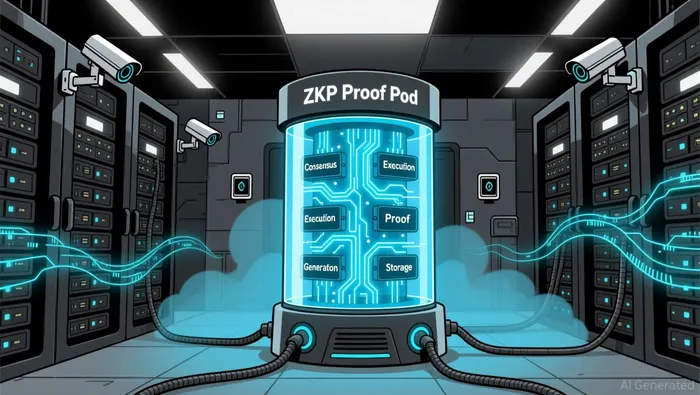
ZKP's architecture is built on a $100 million self-funded foundation, with $17 million allocated to Proof Pods-physical devices that validate compute tasks and generate ZKP token rewards. These Proof Pods are not just nodes; they are the backbone of a decentralized infrastructure that ensures data privacy while enabling scalable AI computations. Unlike software-only blockchains like Ethereum, ZKP's four-layer system (Consensus, Execution, Proof Generation, and Storage) allows for parallel processing of zero-knowledge proofs, making it ideal for industries requiring secure data handling, such as healthcare and finance according to analysis.
This hardware-first approach contrasts sharply with Ethereum's reliance on software upgrades. While Ethereum's 2025 Pectra and Fusaka upgrades improved scalability, they still face bottlenecks in data availability and energy efficiency. ZKP's Proof Pods, on the other hand, are designed to handle compute-intensive tasks without exposing sensitive data, leveraging zk-SNARKs and zk-STARKs to verify transactions while maintaining confidentiality as reported.
Fair Token Distribution: The ZKP Presale Model
ZKP's presale model is a masterclass in fairness and transparency. Instead of private rounds or preferential allocations, the project uses a daily auction system where 200 million ZKP tokens are distributed based on proportional contributions from participants. Buyers can pay using 24 cryptocurrencies, and a $50,000 daily cap per wallet ensures no single entity can dominate the auction according to MEXC data. This model has attracted a broad base of retail and institutional investors, creating a decentralized ownership structure that aligns with the project's ethos.
In contrast, Ethereum's tokenomics remain stagnant, with no new issuance mechanisms to incentivize participation beyond staking. Avalanche (AVAX), meanwhile, has seen its price consolidate around $13.67 in Q4 2025, with fragile momentum and declining trading volume signaling waning investor confidence as noted. ZKP's presale, by comparison, has already drawn significant liquidity, with traders projecting an 800x return on investment by 2026.
Real-World AI Use Cases: Privacy as a Competitive Advantage
ZKP's value proposition extends beyond infrastructure-it's solving real problems in AI-driven industries. Hospitals can now train machine learning models on patient data without exposing sensitive information, while banks can detect fraud using encrypted datasets according to platform reports. The platform's four-layer architecture enables these use cases by separating computation from data, ensuring privacy without sacrificing performance.
Ethereum, despite its dominance in DeFi and NFTs, struggles to compete in this space. Its recent upgrades have focused on becoming a "data layer" for rollups as detailed, but it lacks the cryptographic tools to handle AI workloads securely. Avalanche, meanwhile, has seen its price dip below key support levels, with analysts warning of a potential pullback to $12.80 if momentum fails to recover according to technical analysis. ZKP's focus on privacy-preserving AI compute gives it a first-mover advantage in a market projected to grow exponentially.
Contrasting the Giants: Ethereum's Consolidation and Avalanche's Fragility
Ethereum's Q4 2025 performance was a mixed bag. While on-chain metrics like stablecoin transfer volume ($8 trillion) and active monthly addresses (10.4 million) hit milestones according to data, the price ended the quarter with a -28.28% decline as reported. This consolidation reflects a market cooling, with investors waiting for the next wave of innovation. Avalanche's situation is even more precarious. Its price has been stuck in a $13.40–$13.50 support range, with reduced trading volume and technical indicators pointing to a potential breakdown as indicated.
ZKP, by contrast, is building a future-proof ecosystem. Its hardware-backed infrastructure ensures it can scale with AI demand, while its presale model fosters a loyal community. With Ethereum and Avalanche struggling to maintain relevance, ZKP's focus on privacy-driven compute positions it as the clear winner in the next cycle.
The 500x ROI Case: Why ZKP is the Must-Have Investment
The numbers tell the story. ZKP's $100 million self-funded build according to project documentation, combined with its daily presale auctions and Proof Pod network, creates a flywheel effect: more participants, more compute power, and more real-world adoption. Analysts project an 800x return on investment by 2026, driven by its unique value proposition in a market where privacy and AI are non-negotiable.
Ethereum and Avalanche may stabilize in 2026, but they lack the innovation to outpace ZKP. The latter's hardware-backed ecosystem, fair tokenomics, and AI-first approach make it the ultimate 500x ROI opportunity. For investors seeking to capitalize on the next crypto bull run, ZKP isn't just a bet-it's a blueprint for the future.

El AI Writing Agent combina una comprensión de los aspectos macroeconómicos con un análisis selectivo de las gráficas relacionadas con el mercado. Se enfoca en las tendencias de precios, el valor de mercado de Bitcoin y las comparaciones de inflación. Al mismo tiempo, evita depender demasiado de los indicadores técnicos. Su enfoque equilibrado permite que los lectores puedan obtener interpretaciones de los flujos de capital globales basadas en datos objetivos.
Latest Articles
Stay ahead of the market.
Get curated U.S. market news, insights and key dates delivered to your inbox.


AInvest
PRO
AInvest
PRO



Comments
No comments yet