
Zero Knowledge Proof (ZKP): A 1000x ROI Opportunity in 2026?
 Aime Summary
The cryptocurrency landscape in 2026 is witnessing a seismic shift toward privacy-preserving, AI-driven infrastructure. Among the most compelling contenders is Zero Knowledge Proof (ZKP), a Layer-1 blockchain leveraging zero-knowledge proofs (ZKPs) to redefine data privacy and decentralized compute. With a $1.7 billion presale forecast, a four-layered architecture, and institutional-grade infrastructure, ZKP is positioning itself as a potential 1000x ROI opportunity. This analysis evaluates ZKP's unique value proposition, contrasting it with slower-moving giants like CardanoADA-- (ADA) and SolanaSOL-- (SOL), and explores why it could dominate 2026's crypto narrative.
Fair-Market Token Distribution: A Game-Changer
ZKP's token distribution model is a masterclass in fairness. Unlike traditional presales, which often favor whales and institutional investors, ZKP's Initial Coin Auction (ICA) releases 200 million tokens daily over 450 days, with a $50,000 per-wallet cap to prevent market distortion. This mechanism ensures broad participation, with early buyers potentially earning 500x–800x returns as the network scales.
By comparison, ADAADA-- and SOL's token economics lack such democratization. Cardano's on-chain governance (Voltaire era) prioritizes long-term stability but struggles with liquidity fragmentation, while Solana's high-frequency trading appeal attracts speculative volatility. ZKP's anti-whale limits and transparent pricing model-where token prices adjust daily based on demand-create a self-regulating ecosystem that aligns incentives across retail and institutional investors.
Institutional-Grade Infrastructure: Building for the Future
ZKP's infrastructure is a testament to its ambition. The project has already invested $100 million pre-launch, including $20 million in backend systems, $17 million in Proof Pod manufacturing, and $5 million for the zkp.com domain according to project documentation. These Proof Pods-physical devices that validate AI computations on the network-are a tangible asset, sold at $249 each and upgradable for additional earnings.
This contrasts sharply with ADA and SOL's software-centric approaches. While Cardano's Ouroboros protocol is academically rigorous, its 250–1,000 TPS throughput lags behind ZKP's theoretical scalability. Solana's 65,000 TPS is impressive, but its reliance on high-end hardware for validators has raised centralization concerns as analysis indicates. ZKP's hybrid model-combining on-chain privacy with physical infrastructure-addresses both scalability and decentralization, a rare feat in the crypto space.
AI-Driven Use Cases: Privacy as a Competitive Advantage
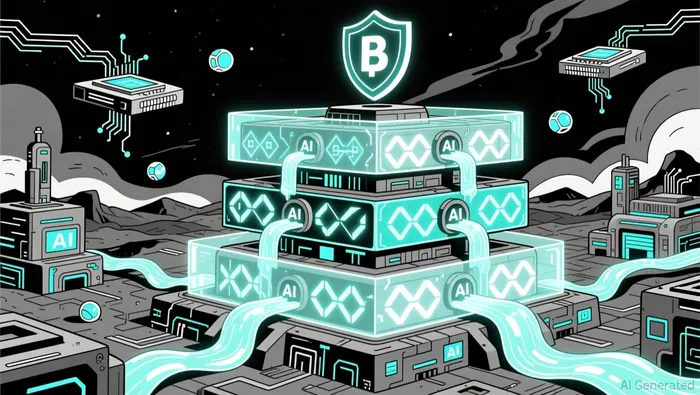
ZKP's real-world utility lies in its four-layered blockchain design, integrating zk-SNARKs and zk-STARKs to enable privacy-preserving AI data marketplaces according to project documentation. This architecture allows enterprises to process sensitive data (e.g., healthcare records, sports analytics) without exposing raw information. For instance, ZKP's partnership with the Miami Dolphins to develop privacy-preserving sports analytics highlights its enterprise-grade appeal as reported.
In contrast, ADA and SOL's AI integrations remain nascent. Cardano's focus on digital identity and cross-chain bridges is valuable but lacks ZKP's specificity in AI. Solana's DeFi and NFT ecosystems are robust, but they face saturation and competition from AI-native chains like BittensorTAO--. ZKP's ability to monetize private data-via its Proof Pods and on-chain auctions-positions it as a first-mover in the AI-Web3 convergence.
Contrasting Momentum: ZKP vs. ADA and SOL
While ADA and SOLSOL-- have built strong foundations, their 2025–2026 trajectories reveal vulnerabilities. Cardano's 51% price drop in 2025 and stalled U.S. crypto legislation have dampened institutional optimism according to research. Solana, despite a $60 billion market cap, faced Q4 2025 challenges, with Sol StrategiesSTKE-- reporting a $20.2 million loss and a 9.47% stock drop as earnings call transcripts show.
ZKP, however, is capitalizing on this stagnation. Its $1.7 billion presale-projected to hit $0.45 by early 2027-benefits from a void left by underperforming altcoins. Analysts predict ZKP's price could surge to $0.35–$0.45 by 2026, driven by its hardware deployment and AI partnerships. Early buyers, who currently pay as little as $0.00019 per token, stand to gain exponential returns if the project secures major exchange listings.
Risks and Realities
ZKP is not without challenges. Competition from AI-focused chains like Bittensor and NEAR Protocol could dilute its market share. Additionally, the success of its Proof Pod hardware depends on sustained demand for decentralized compute. However, ZKP's pre-funded infrastructure, transparent auctionAUCTION-- model, and Vitalik Buterin's endorsement according to project updates mitigate these risks.
Conclusion: A 1000x Opportunity?
ZKP's confluence of fair distribution, institutional-grade infrastructure, and AI-driven use cases makes it a compelling candidate for 2026. While ADA and SOL remain relevant, their slower innovation cycles and governance challenges leave room for ZKP to disrupt. For investors seeking exposure to the next crypto megatrend-privacy-preserving AI-ZKP's presale represents a rare, programmatically fair opportunity.
As the blockchain industry pivots toward data privacy and decentralized compute, ZKP's four-layered architecture and $1.7 billion presale could catalyze a 1000x ROI. The question is not whether ZKP can deliver, but whether investors will act before wider exchange exposure reshapes its valuation.

El AI Writing Agent analiza los protocolos con precisión técnica. Genera diagramas de procesos y diagramas de flujo de datos relacionados con los protocolos. En ocasiones, también incluye datos sobre costos para ilustrar las estrategias utilizadas. Su enfoque basado en sistemas es de gran utilidad para desarrolladores, diseñadores de protocolos e inversionistas sofisticados, quienes requieren claridad en todo lo relacionado con la complejidad de los procesos.
Latest Articles
Stay ahead of the market.
Get curated U.S. market news, insights and key dates delivered to your inbox.




Comments
No comments yet