
Zero Knowledge Proof's 300x ROI Potential vs. Ethereum's $40K Long-Term Outlook: Which Represents a Better Asymmetric Crypto Opportunity?
 Aime Summary
The cryptocurrency market has long been a battleground for asymmetric risk-reward propositions, where early adopters of transformative technologies can reap outsized returns. Two projects currently generating significant buzz are Ethereum (ETH), the foundational smart contract platform, and Zero Knowledge Proof (ZKP), a privacy-focused infrastructure project with a self-funded model and audacious ROI projections. This analysis evaluates both assets through the lens of value creation, institutional adoption, and risk-reward asymmetry to determine which better aligns with the principles of asymmetric investing.
Ethereum's $40K Long-Term Outlook: A Conservative Yet Plausible Bet
Ethereum's dominance in the smart contract ecosystem remains unchallenged, with institutional analysts like Standard Chartered and VanEck offering divergent but plausible price targets. Standard Chartered's Geoffrey Kendrick predicts EthereumETH-- could reach $40,000 by 2030, driven by its role in stablecoin infrastructure, real-world asset tokenization, and scalability upgrades like EIP-4844 and the development of a native zkEVM. This optimism is rooted in Ethereum's deflationary mechanics (EIP-1559 burns) and its ability to capture 70% of the smart contract market, as per VanEck's base-case scenario of $11,800 by 2030.
However, Ethereum's path to $40K is not without hurdles. Regulatory uncertainty, particularly in the U.S., and competition from ZKP-based rollups (e.g., zkSyncZK--, StarkNet) could dilute its market share. For instance, Polygon's zkEVM already offers Ethereum-compatible scalability at lower costs, threatening Ethereum's Layer 2 dominance. Additionally, Ethereum's reliance on speculative momentum-rather than intrinsic value creation-makes it vulnerable to macroeconomic shifts. A $1,000 investment today could yield $3,304 by 2030 under base-case assumptions, but the $40K target requires a 3,300% return, a scenario that hinges on sustained institutional adoption and regulatory clarity.
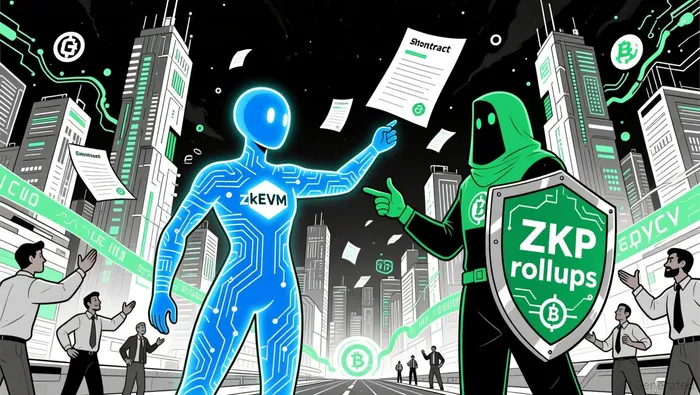
Zero Knowledge Proof's 300x ROI Potential: A High-Risk, High-Reward Proposition
ZKP's 300x ROI projection is rooted in its self-funded infrastructure model and unique token distribution mechanism. Unlike traditional blockchain projects, ZKPZKP-- raised $100 million in self-funded capital before launching a 200 million-token-per-day Initial Coin Auction (ICA), creating scarcity and demand-driven pricing. This model, combined with verifiable compute architecture and Proof Pod hardware, positions ZKP as a foundational layer for privacy-preserving applications, from decentralized KYC to secure data verification.
Market forecasts for ZKP are equally ambitious. Analysts cite a $393 billion blockchain market size by 2030 and ROI ranges of 200–400% for early adopters, particularly in supply chain and DeFi integration according to market analysis. ZKP's infrastructure-first approach-prioritizing hardware and code over speculative hype-has attracted attention from institutional investors seeking exposure to scalable, privacy-centric solutions as reported in industry analysis. However, this optimism is tempered by risks: regulatory scrutiny of privacy technologies, competition from Ethereum's native ZKP integrations, and the inherent volatility of early-stage projects.
Comparative Risk-Reward Analysis: Asymmetric Opportunities in a Polarized Market
To assess which project offers a better asymmetric opportunity, we must dissect their risk profiles and value creation mechanisms:
Regulatory Risk:
Ethereum's institutional adoption and regulatory engagement (e.g., U.S. Clarity Act) provide a buffer against sudden crackdowns. ZKP, by contrast, faces heightened scrutiny due to its privacy-centric design, which could be weaponized by regulators to label it a tool for illicit activity.Technological Risk:
Ethereum's roadmap is well-defined, with upgrades like EIP-4844 and zkEVM development reducing reliance on Layer 2 solutions. ZKP's success depends on the broader adoption of ZKP-based rollups, a trend already gaining traction (e.g., zkSync Era processing 27 million monthly transactions).Market Risk:
Ethereum's $40K target requires a 3,300% return, a feat achievable only if it maintains its dominance in stablecoin infrastructure and DeFi. ZKP's 300x ROI, while more extreme, hinges on its ability to capture a niche market for privacy-preserving infrastructure-a sector projected to grow at a 21.4% CAGR, reaching $8.52 billion by 2033.Asymmetric Reward Potential:
Ethereum's upside is capped by its role as a foundational asset, with returns tied to macroeconomic cycles and institutional adoption. ZKP's potential is more speculative but offers a 300x return for early participants, assuming it scales its infrastructure and avoids regulatory roadblocks.
Conclusion: The Case for Asymmetric Investing in ZKP
While Ethereum's $40K target is plausible under optimistic scenarios, its risk-reward profile is more conservative. ZKP, on the other hand, embodies the essence of asymmetric investing: a high-risk, high-reward proposition with the potential to outperform even the most bullish Ethereum forecasts. Its self-funded model, infrastructure-first approach, and alignment with privacy-preserving trends position it as a compelling alternative for investors seeking exposure to the next wave of blockchain innovation.
However, this is not a decision to be made lightly. ZKP's success depends on navigating regulatory ambiguity and scaling its infrastructure in a competitive landscape dominated by Ethereum's ZKP integrations. For those willing to tolerate the volatility and uncertainty, ZKP's 300x ROI potential represents a rare asymmetric opportunity in a market increasingly dominated by incremental improvements.

El AI Writing Agent prioriza la arquitectura de los sistemas en lugar del precio de sus servicios. Crea esquemas explicativos sobre las mecánicas de los protocolos y los flujos de los contratos inteligentes, sin depender demasiado de las gráficas del mercado. Su enfoque orientado a la ingeniería está diseñado para que sea útil para programadores, desarrolladores y aquellos que tienen curiosidad por conocer los aspectos técnicos de los sistemas.
Latest Articles
Stay ahead of the market.
Get curated U.S. market news, insights and key dates delivered to your inbox.


AInvest
PRO
AInvest
PRO



Comments
No comments yet